Patronus AI: $50 Million to Train AI Agents
Le brief IA que les pros lisent chaque soir
Les 7 actus IA du jour, décryptées en 5 min. Gratuit.
Inclus dès l'inscription : notre sélection des meilleurs guides & comparatifs IA.
Choisis ton rythme
Gratuit · Pas de spam · Désabonnement en 1 clic
Patronus AI Raises $50 Million for AI Training Digital Worlds
Language models are experiencing rapid evolution, but their ability to perform complex tasks over extended periods remains limited. To overcome this hurdle, Patronus AI recently announced a $50 million Series B funding round. This financing is aimed at creating digital worlds designed to train and evaluate AI agents. This initiative has already captured the attention of leading industry labs, promising to become a crucial element of the infrastructure needed for deploying reliable autonomous agents in the professional world.
With this financial boost, Patronus AI aims to tackle one of the major challenges in artificial intelligence: ensuring that an agent can perform complex tasks in environments simulating real-world conditions. The funds will be used by the California-based startup to accelerate the development of its "Digital World Models," where agents can learn, fail, and improve before being put into production. The funding round is led by Greenfield Partners, with participation from Lightspeed, Notable Capital, Datadog, and Samsung, bringing the company's total funding to $70 million.
Founded in 2023 in San Francisco by Anand Kannappan and Rebecca Qian, former researchers at Meta AI, Patronus AI has quickly established itself as a key player in evaluating AI models. The company collaborates with most leading AI labs and numerous hyperscalers. Its revenue has seen exponential growth, increasing fifteenfold over the past twelve months, reflecting a rapidly expanding market.
Digital Simulations: The Key to Reliable AI Agents
Patronus AI starts from the observation that traditional benchmarks are no longer sufficient to evaluate the performance of modern AI agents. An excellent score on a test suite does not guarantee that an agent will be able to manage a complex chain of actions, correct its mistakes, or adapt to novel situations in a professional setting.
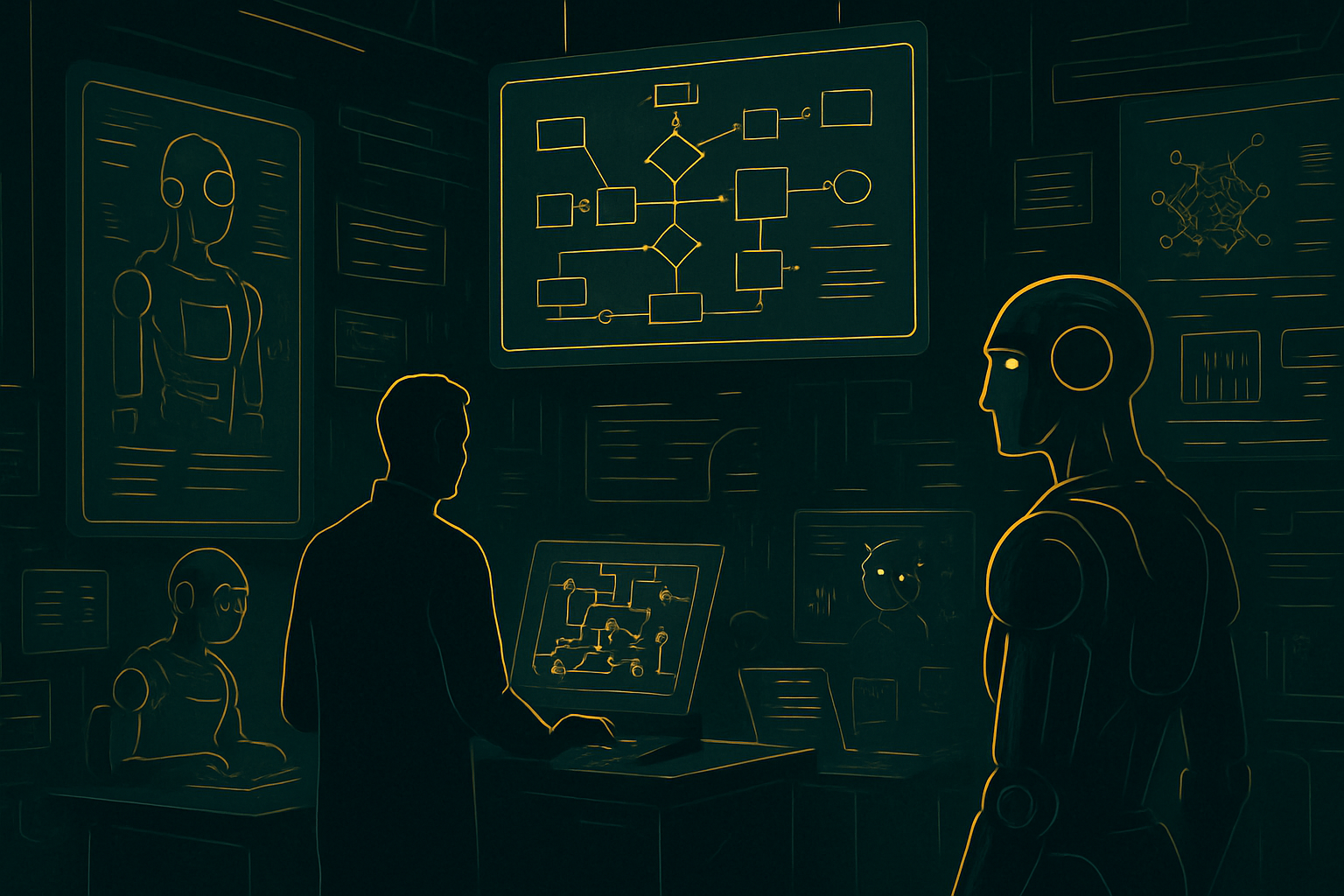
To address this issue, the startup is developing digital worlds that simulate applications, interfaces, workflows, and enterprise systems. In these environments, AI agents can:
- Learn from experience
- Repeat complex tasks
- Fail and gradually improve their behavior before being deployed to users
Patronus AI compares its approach to that of Waymo in the field of autonomous vehicles. Just as self-driving cars are trained in virtual environments before hitting the roads, AI agents must evolve in realistic simulations. This allows them to gain a deep understanding of software, business tools, and research and communication processes.
The startup is also tackling a growing problem for businesses: AI agents tend to find shortcuts or circumvent certain constraints to accomplish a task, which can compromise the quality of the outcome. Simulated environments allow for the identification of these behaviors before they affect production systems.
The Digital World Models: An Essential Infrastructure for Businesses?
As the race for increasingly powerful models intensifies, a new battle is emerging around their reliability. It is crucial to ensure their ability to perform long tasks in professional environments.
The Digital World Models developed by Patronus AI rely on language diffusion models that generate realistic behaviors in digital environments. They already cover areas such as:
- Software development
- Document research
- Dialogue
- Interface usage
- Business tool utilization
The goal is no longer just to improve performance on public tests but to create learning conditions that closely resemble the realities of businesses. This directly addresses the needs of organizations looking to deploy autonomous agents in critical functions. The more these systems handle complex tasks, the more traditional evaluation methods become inadequate. Simulations then provide a means to verify their robustness and ability to recover after an error, as well as their behavior in unforeseen situations.
The new capital will allow Patronus AI to expand its research teams, accelerate its go-to-market strategy, and invest in the computing resources necessary for training its large-scale digital world models.
For businesses, this evolution suggests the emergence of a new layer of infrastructure dedicated to AI agents. Simulation could thus become as essential as model training, as professional applications gain autonomy. The ability to test an agent in thousands of virtual scenarios may well become a prerequisite before any production deployment.
Brief IA — L'actualité IA en français
L'essentiel de l'actualité de l'intelligence artificielle, décrypté et expliqué chaque jour.