Why AI-Generated Food Images Look So Unhealthy
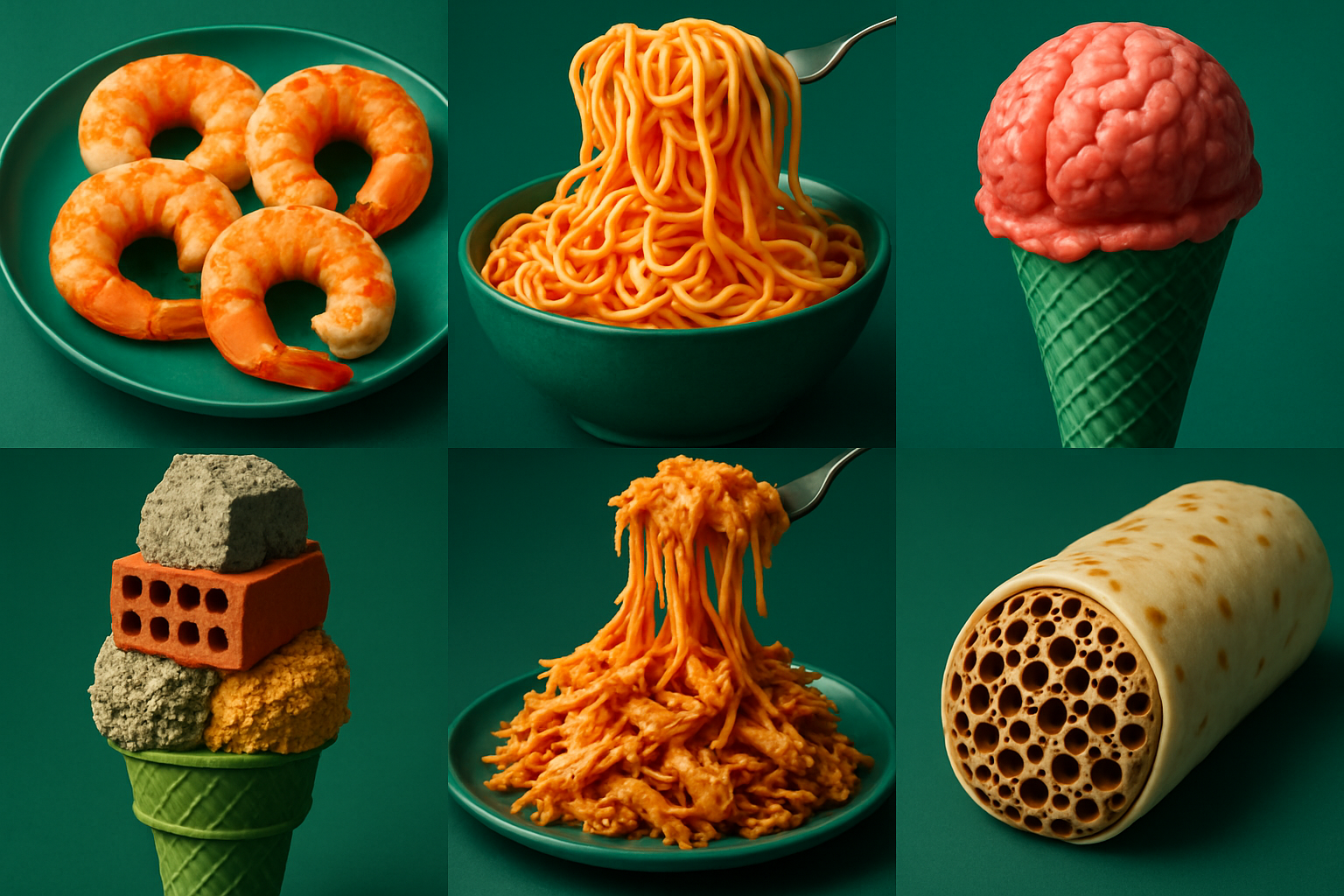
AI-generated dishes from brands inspire more rejection than appetite. Researchers describe a range of causes: the weaknesses of diffusion models regarding fine structures, the nature of training images, and how our brains detect signals of food danger. As a result, these visuals often fall into the culinary "uncanny valley."
The disgust felt towards AI images stems from evolutionary mechanisms
Many culinary visuals generated by AI slip into the uncanny valley. Scientific studies suggest that disgust has evolved to protect us from parasites, pathogens, and toxins, sharpening our sensitivity to what appears dangerous to eat. Giovanbattista Califano believes that this valley, when applied to food, is more visceral than when faced with almost human figures. The images activate several triggers: filaments reminiscent of parasites, clusters of holes suggesting infestations, abnormal hues and textures associated with contamination or spoilage. They may resemble food, but are instinctively perceived as a mush to be avoided.
What the models miss: poorly defined structures and slipping details
Dominant generators rely heavily on diffusion, a technique that starts from random noise and erodes it to reveal the image. These models struggle with fine, continuous, and well-defined structures. Chris Russell describes early structuring failures: the basic shape is poorly established, then convincing textures are layered onto this erroneous base, resulting in oddities like shrimp shaped like donuts. Even when the structure holds, Giovanbattista Califano observes that fine details often derail, especially for elongated objects like noodles or filaments, which spill into areas lacking anatomical or culinary logic.
Le brief IA que les pros lisent chaque soir
Les 7 actus IA du jour, décryptées en 5 min. Gratuit.
Inclus dès l'inscription : notre sélection des meilleurs guides & comparatifs IA.
Choisissez votre rythme
Gratuit · Pas de spam · Désabonnement en 1 clic
Stylized training data and few "ordinary" images
Michael Cook emphasizes that the datasets and learned associations remain largely opaque. The food photography that circulates is often highly stylized, saturated with contrasts, bright lighting, and exaggerated shapes, and the "food" photographed is not always edible. Simon Colton adds that mundane images, like a simple red apple, are relatively rare online. Strange content, on the other hand, is more frequently published and can reach a wide audience on platforms like Reddit, even becoming memes. This exposure imbalance influences what models learn to reproduce.
Reproducing appearance without understanding the world
AI systems lack an understanding of what a sandwich, noodle, or burrito is, or the physical world where these objects exist. They learn appearance regularities on a statistical level, without grasping the reasons behind them or the expected behaviors. For Roland Meyer, generation reproduces appearances without knowledge of the world, resulting in approximations of food detached from what it actually is.
Brands publish absurd-looking AI dishes nonetheless
Restaurants, cafes, and brands are sharing AI-generated culinary images that appear unappetizing, such as shrimp shaped like donuts, misshapen sandwiches, worm-like noodles, spiral pastries, stringy chicken, or construction materials disguised as ice cream and ice creams resembling brains. Other dishes evoke masonry, including a misshapen burger and a hole-riddled burrito. It is unclear why these actors sometimes prefer AI over photography of real food. The deviations stem from both the technical constraints of generation, the nature of training data, and the perceptual biases of viewers.
Brief IA — L'actualité IA en français
L'essentiel de l'actualité de l'intelligence artificielle, décrypté et expliqué chaque jour.