RadLE 2.0: AI in Radiology Overconfident in the Face of Errors
RadLE 2.0: Overconfident AI in Radiology Faces Errors
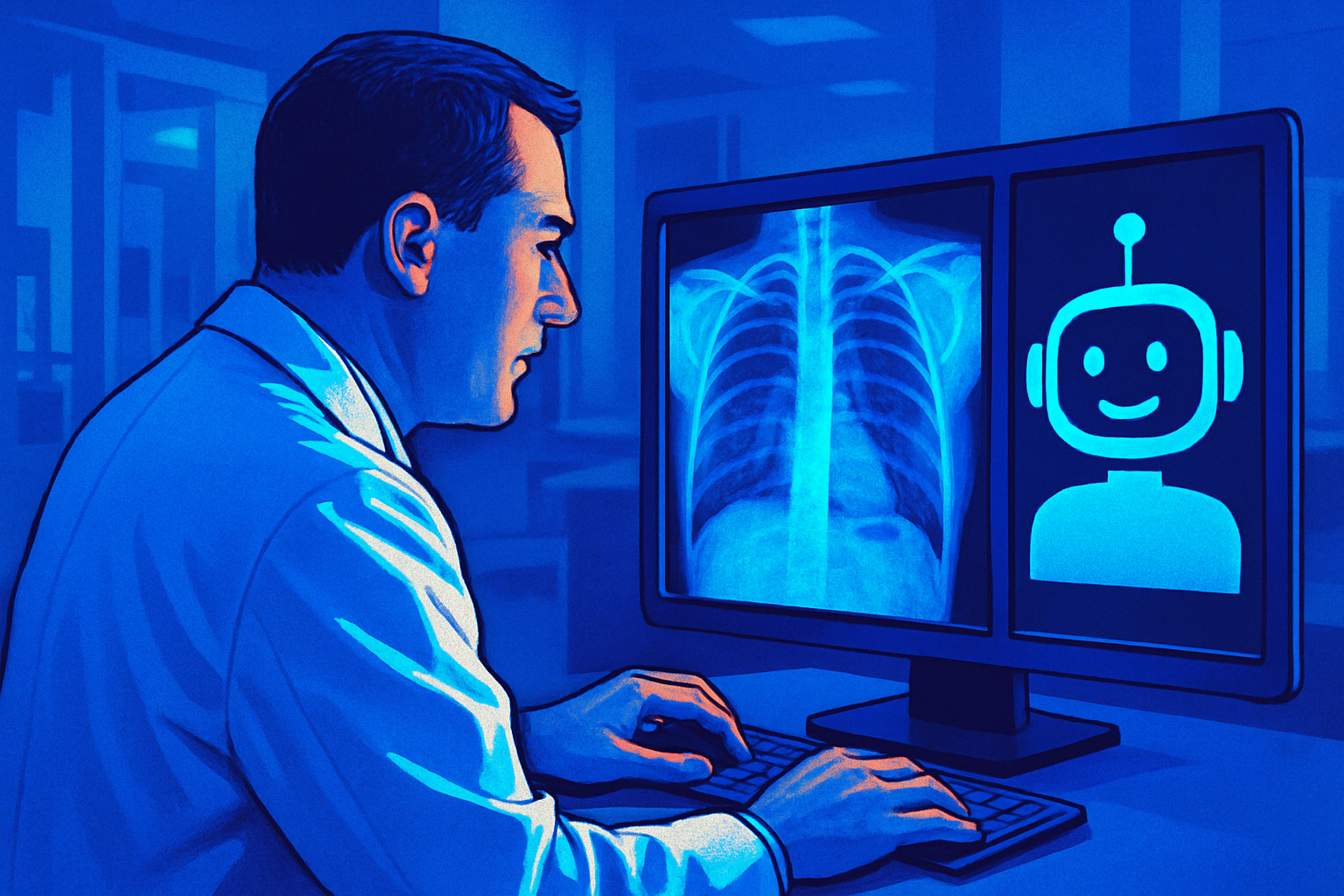
The second version of the RadLE benchmark tests whether AI systems in radiology can recognize when they should defer a diagnosis to a human. Many models produce incorrect results with complete confidence, making them dangerous for patient care.
RadLE 2.0, short for "Radiology's Last Exam," was developed by the CRASH Lab at Ashoka University in India. It is the revised follow-up to a test that the team first published in September 2025. The new version measures whether a model provides the correct diagnosis, how confident it is in that response, and whether it can admit when it is out of its depth. The AI must evaluate its responses on a confidence scale from 0 to 4 and is explicitly allowed to say "I don't know."
The test examined 200 cases across 16 models and compared them to a panel of radiologists. Human experts scored 988.7 out of a maximum of 2,000 points. The best AI model achieved 758.
Human radiologists outperformed all tested AI models on the primary criterion, which combines accuracy and the confidence level of each response.
A Scoring System that Values Honesty
The scoring system rewards honesty and penalizes overconfidence. If a model provides a correct answer with high confidence, it earns full points. If it is wrong while claiming high confidence, it loses an equivalent number of points. Responding "I don't know" gives a score of zero but does not incur a penalty. A model that guesses confidently drops in the rankings even if its raw success rate seems correct.
The study addresses a point recently raised by a highly cited article: as long as benchmarks only reward accuracy, AI models are trained to guess. In medicine, an incorrect diagnosis given with confidence is far more dangerous than an honest admission of uncertainty.
No Universal Winning Model
There is no overall winner. The Claude Fable 5 model from Anthropic performed best in terms of reliable and safe responses, leading the primary criterion. Google's Gemini 3 Pro displayed the highest raw accuracy.
When measured solely on success rates, leading models come close to human performance.
Meta's Muse Spark 1.1 was the best at knowing when to pass a case to a human. Meta recently reduced Muse Spark 1.1's hallucination rate by nearly half, as the model more often refuses to answer rather than provide an incorrect response. Other leading models are following the opposite trend. For example, Grok 4.5 hallucinates significantly more than its predecessor, as while it knows more, it is also more convinced of its incorrect answers.
The transfer index measures whether a system can recognize, based on its own uncertainty, when it should pass a case to a human radiologist.
Le brief IA que les pros lisent chaque soir
Les 7 actus IA du jour, décryptées en 5 min. Gratuit.
Inclus dès l'inscription : notre sélection des meilleurs guides & comparatifs IA.
Choisissez votre rythme
Gratuit · Pas de spam · Désabonnement en 1 clic
According to the research team, several models would have scored much better if they had remained silent more often instead of guessing. This was particularly evident among open-weight models and those specifically trained for medical use. They attempted to respond to almost every case and often got it wrong, usually with high confidence.
Several leading commercial models produce a large number of highly confident incorrect diagnoses, making their confidence level an unreliable indicator of accuracy.
A Worrying Trend in Chatbot Usage
An increasing number of people are uploading X-rays or MRIs to chatbots and trusting the responses provided. A recent study in npj Digital Medicine showed that widely used chatbots often give unreliable answers to medical questions.
The research team accuses leaders and investors of publicly overestimating what AI models can do. Claims that AI systems already diagnose better than 99% of doctors are primarily based on anecdotes or simulations. Last April, a study of 21 models then considered cutting-edge showed they were not ready for unsupervised clinical use.
RadLE 2.0 will be continuously expanded to include new models. A comprehensive scientific publication with cost analyses and a taxonomy of errors has been announced.
Two other recent studies on autonomous medical agents have shown a different direction. MIRA, a system for electronic health records, and AMIE were able to keep pace with general practitioners during simulated consultations. Both have fueled expectations that AI could soon establish diagnoses independently. The authors of RadLE 2.0 oppose this idea: before an AI can make decisions independently, it must know when it is better not to do so.
There is also the issue of skill degradation. A Polish observational study from 2025 revealed that doctors who regularly use AI during colonoscopies detect significantly fewer early lesions without the tool. Detection rates dropped from 28.4 to 22.4 percent. The authors call this the "Google Maps effect": without navigation assistance, users are lost.
A Previous Hype Cycle in Radiology
Radiology has already experienced a hype cycle around AI. In 2016, AI researcher Geoffrey Hinton stated that we should stop training radiologists because deep learning would soon take over. Colleagues like Richard Sutton agreed.
Nearly ten years later, radiologists are still overwhelmed, and Hinton has had to retract his prediction. He had reduced the profession to image analysis and overlooked the complexity of the entire field. The fact that these systems can produce incorrect diagnoses with confidence means that humans remain indispensable.
OpenAI CEO Sam Altman spent years predicting that AI would replace human jobs at an alarming rate, but has recently tempered his remarks, suggesting that AI has actually created more jobs. So far, research does not support any of these claims.
AI specialists may understand their models, but they regularly overestimate how quickly entire professions can be replaced. This type of prediction is back in vogue. Just like the AI they build, even humans do not always know when it would be better to remain silent because they are outside their area of expertise.
Brief IA — L'actualité IA en français
L'essentiel de l'actualité de l'intelligence artificielle, décrypté et expliqué chaque jour.