RAG: Bonus Articles for Explainable NLP Methods
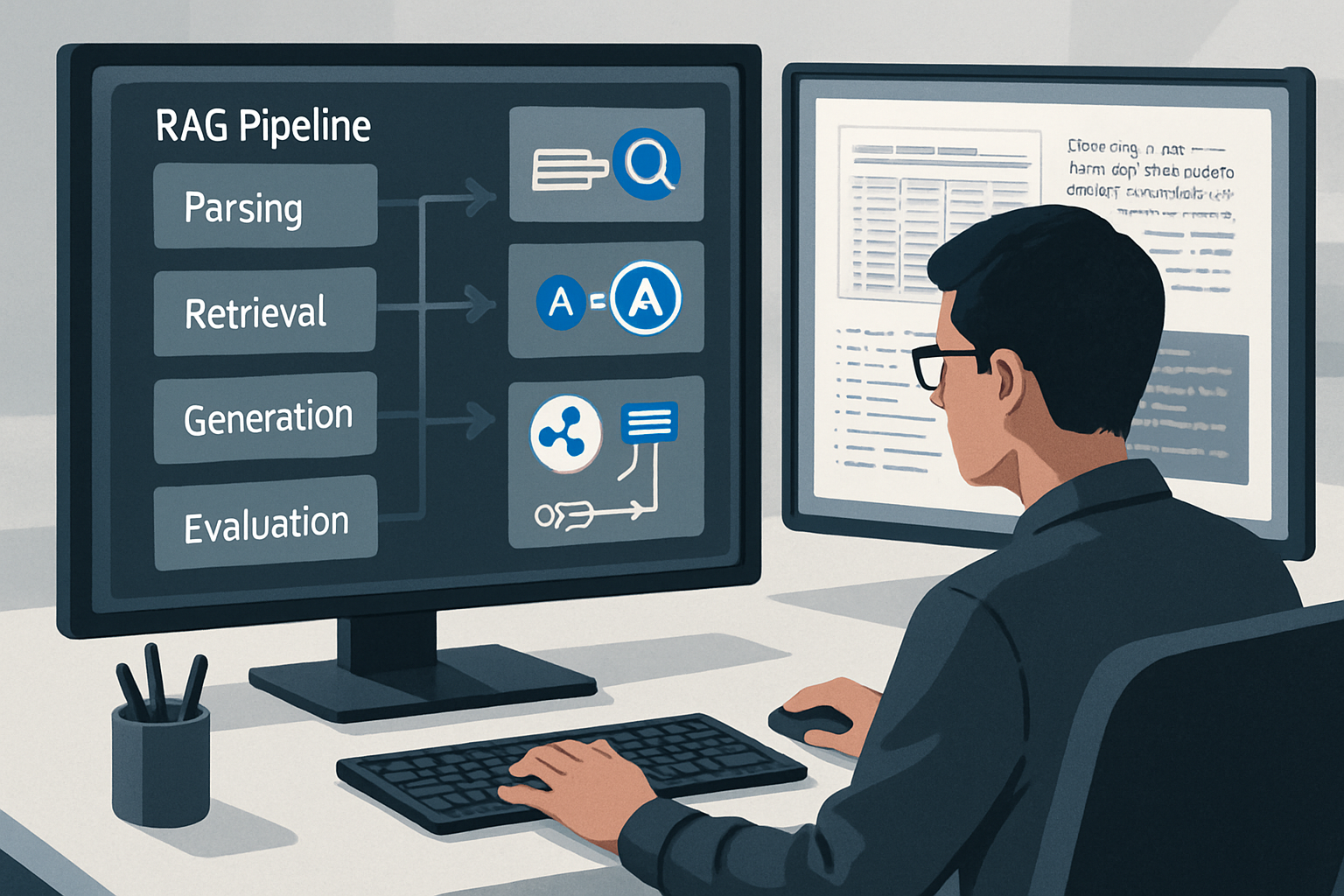
A series dedicated to the complementary aspects of RAG details what engineering requires beyond the LLM prompt. From handling errors and OCR noise to PDF tables and mocks, these bonuses formalize quick, explainable methods evaluated by failure modes, with public references and precise contracts between components.
Justifying the Absence of Response and Testing Without Cheating
When a RAG system indicates "I don't know," a lack of justification is considered almost as problematic as a confident but incorrect answer, which is seen as a bug. Each component of the pipeline must then provide the user with concrete evidence: what was analyzed, the vocabulary searched, the pages consulted, and the reasons why no match was found. For testing, the series emphasizes the importance of faithful mocks: simplifying a type of return for convenience can mask a production bug. Mocks should therefore exactly reproduce the structure of the objects, even if this complicates the setup of tests. This requirement for justification and fidelity applies to each of the four components of the pipeline.
PDF Tables: Avoid Flattening and Adopt Four Levels
Tables present in PDFs are a point of fragility for many RAG pipelines, which often fail without signaling an error. A linear decision tree by table type is insufficient, as the dimensions of the tables intersect. The series recommends a structured representation in four levels, involving an explicit choice during parsing, an adapted retrieval rule, and a table-specific generation contract. Flattening the grid is discouraged in order to preserve the original structure.
Noise, Errors, OCR: Beyond Classic Spell Correction
Noisy text encompasses three main sources: user typos, errors from rapid transcription, and erroneous characters produced by OCR. Classic spell correction methods, such as Levenshtein, BK-tree, Soundex, or SymSpell, only address one of these origins. Embeddings and LLMs are used to absorb the other two types of noise. These disturbances affect both the parsing of the corpus, the formulation of questions, and the retrieval process, which must be capable of handling these variations.
Le brief IA que les pros lisent chaque soir
Les 7 actus IA du jour, décryptées en 5 min. Gratuit.
Inclus dès l'inscription : notre sélection des meilleurs guides & comparatifs IA.
Choisissez votre rythme
Gratuit · Pas de spam · Désabonnement en 1 clic
Bonuses with Public References, Contracts, and Failure Modes
Each bonus relies on public sources, including publications from NIST, articles available on arXiv, corpora with open licenses, or fictional scenarios created for the series. Screenshots without source files are prohibited. Each bonus explicitly positions itself in relation to the four components of the pipeline and their typed and traceable contracts, reporting results by failure mode rather than aggregated numbers. The articles dismiss any promise of a miracle tool, favoring simple code and relational tables. The bonuses are designed to remain valid independently of the main articles, as illustrated by B01 (corrections) and B04 (tables).
Choosing the Useful Level: From Keywords to Embeddings, Before the Prompt
Directly querying an LLM is described as slow, costly, and difficult to explain afterward. Six more economical options are presented: exact match search, single-letter correction, using keywords from an expert lexicon, and embeddings to handle the rest of the vocabulary. The majority of queries find a solution through one of these approaches in a few milliseconds, each capable of specifying the rule employed. This gradation of methods serves to resolve concrete cases such as classifying a query, matching free text with a reference list, extracting data from tables, managing OCR noise, or executing a model locally when the corpus cannot be exported.
Why Bonuses and When to Reverse the Pipeline
An operational RAG pipeline raises engineering questions that the main column cannot address without losing coherence. Four recurring patterns justify the use of bonus articles, which avoid dispersion in social threads or blog comments and allow for a cross-sectional view where the components align on the same concern. The most frequent form of bonus addresses practical concerns that traverse several junctions between components, with proposals for discipline that can be adopted without rewriting the components. The series also discusses alternative forms of the pipeline when the corpus is not a set of adversarial PDFs, for example in the form of FAQs: in these cases, the trade-offs are reversed and the entire pipeline reconfigures, without questioning the basic form.
Brief IA — L'actualité IA en français
L'essentiel de l'actualité de l'intelligence artificielle, décrypté et expliqué chaque jour.