RAG: The Revolution of Language Models for Businesses
Le brief IA que les pros lisent chaque soir
Les 7 actus IA du jour, décryptées en 5 min. Gratuit.
Inclus dès l'inscription : notre sélection des meilleurs guides & comparatifs IA.
Choisis ton rythme
Gratuit · Pas de spam · Désabonnement en 1 clic
The RAG Revolution: A Solution to the Limitations of Language Models
The Challenges of Traditional Language Models
Large-scale language models, such as GPT-4 or Claude, are trained on vast corpora of textual data. However, once their training is complete, their knowledge remains static. This presents two major problems. First, these models do not have access to your specific internal data, such as your company documents, product catalogs, or customer files. When queried about these topics, they can only guess a plausible answer, often incorrect for technical or precise questions.
Second, these models cannot justify their answers. Even when they provide a correct response, they cannot indicate the source of that information, as they do not conduct active research. They generate text based on learned statistical patterns. For sectors like finance, healthcare, or law, where verifiability is crucial, these limitations render LLM responses unreliable. This is where retrieval-augmented generation (RAG) comes in to fill this gap.
Understanding Retrieval-Augmented Generation
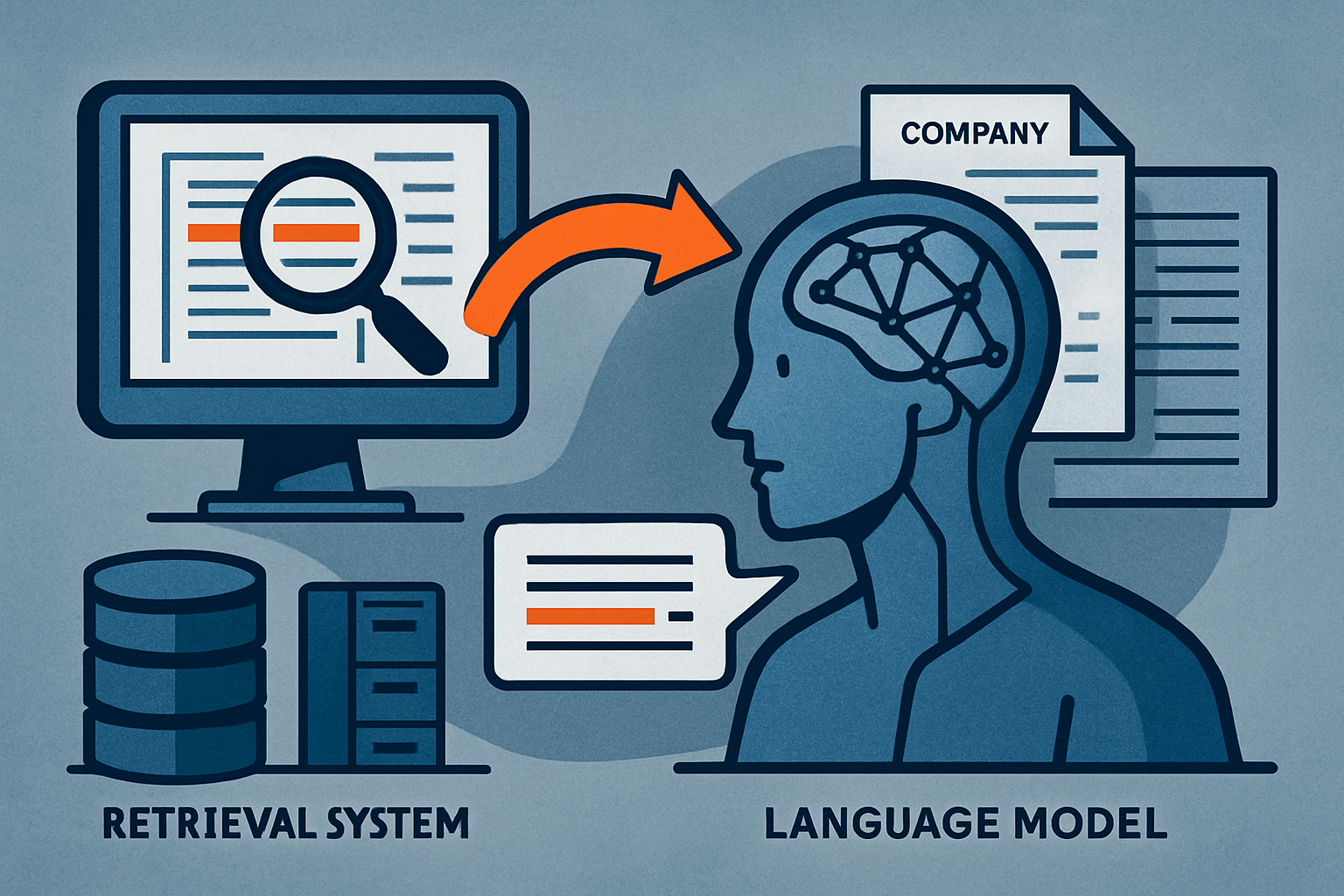
Retrieval-augmented generation is an architecture that combines two essential components: a retrieval system and a generation system. The retrieval system searches through your documents to extract the most relevant passages in response to a posed question. Then, the generation model, or LLM, uses these passages to formulate an answer, rather than relying solely on its internal memory.
In practice, this means that instead of asking the model what it knows about a topic, you first provide it with the relevant information from your data. The model shifts from the task of "recalling a fact" to that of "reading and summarizing evidence," a task where LLMs excel. Additionally, responses generated by RAG can include citations, as the system knows precisely where the information comes from, allowing for quick verification by a human.
The Detailed Functioning of a RAG System
A typical RAG pipeline follows five key steps:
-
Ingestion
Your company documents, whether PDFs, Word files, spreadsheets, scanned forms, HTML pages, or database records, are integrated into the system. A well-designed pipeline must handle a variety of formats, including those that are messy. -
Chunking
Documents are divided into smaller segments called "chunks." This step is crucial because providing an entire document to a model would be inefficient. Good chunking preserves context, while poorly executed chunking can distort the accuracy of responses. For example, cutting a chunk in the middle of a clause in a legal contract can silently remove the exact detail that would have changed the answer. -
Embedding
Each chunk is transformed into a numerical vector, a mathematical representation of its meaning. Chunks dealing with similar topics end up close together in this vector space, facilitating the search for relevant information. -
Storage
The vectors are stored in a vector database, often PostgreSQL with the pgvector extension. This allows for quick and efficient retrieval of relevant chunks while retaining the necessary metadata for citations. Keeping storage on controlled infrastructure rather than on a third-party vector service is often what allows a RAG system to pass the security scrutiny of a bank or hospital. -
Retrieval
When a question is posed, it is converted into a vector, and the system searches for the most relevant chunks in the database. A hybrid approach combining vector search and keyword search is often used to capture both meaning and exact terms. Pure vector search can sometimes miss exact terms, such as a specific product code or clause number, which keyword search reliably captures. -
Generation with Citation
The retrieved chunks are used by the LLM to generate a response, precisely citing the passages that support each part of the answer. This ensures a response grounded in real, verifiable data.
RAG and Fine-Tuning: Complementary Tools
It is important to distinguish RAG from fine-tuning. Fine-tuning involves retraining a model on a specific dataset to teach it a particular style or skill. It is a costly and slow process. In contrast, RAG allows the use of specific data without modifying the model itself, thus offering unparalleled flexibility and adaptability.
Brief IA — L'actualité IA en français
L'essentiel de l'actualité de l'intelligence artificielle, décrypté et expliqué chaque jour.