SAP Enhances AI Personalization with Integrated Data
Le brief IA que les pros lisent chaque soir
Les 7 actus IA du jour, décryptées en 5 min. Gratuit.
Inclus dès l'inscription : notre sélection des meilleurs guides & comparatifs IA.
Choisis ton rythme
Gratuit · Pas de spam · Désabonnement en 1 clic
SAP Unifies Data for Advanced AI Personalization
SAP is committed to transforming how businesses use their commercial data to personalize customer interactions through artificial intelligence. By aligning often fragmented data structures, SAP aims to enable operational personalization at a higher execution level.
Companies are constantly seeking to anticipate their customers' needs and provide relevant interactions across various digital touchpoints. However, the reality of many organizations' internal infrastructure does not support systematic large-scale execution.
Recommendation engines, for instance, often settle for displaying generic product lists because the behavioral data underpinning them remains siloed. Marketing departments, on the other hand, send email communications based on rigid schedules, failing to adapt to individual user habits. Similarly, loyalty programs assign rewards solely based on financial transactions, ignoring broader relational metrics.
While the technical ambition exists, the fundamental architecture remains incomplete. Data, although valuable, resides in disconnected silos. AI capabilities, meanwhile, are often underutilized within the technology stack. Organizations lack the operational discipline necessary for continuous experimentation. To address these deployment issues, SAP has designed the Advanced Success Plan for its SAP Customer Experience solutions.
Three Essential Layers for Successful AI Personalization
Advanced AI personalization cannot be activated simply by flipping configuration switches. Companies must adopt a systematic approach by building three interconnected operational layers: data, decision-making, and delivery.
-
Data: This layer forms the foundational architecture required. Enterprise systems must aggregate unified, real-time customer profiles while strictly adhering to user consent. These profiles consolidate information from comprehensive business transactions, engagement histories, active browsing behaviors, customer service tickets, and ongoing loyalty activities. AI models require these complete behavioral data points to function correctly; without this aggregated data, algorithms operate on flawed inputs.
-
Decision-Making: This layer transforms behavioral data points into actionable directives. AI algorithms analyze incoming data streams to determine the optimal product to display, select the exact promotional offer to present, and calculate the precise moment to initiate contact. This layer demands rigorous governance frameworks. System administrators must define operational parameters that dictate when the automated algorithm controls the output and when human operators can intervene.
-
Delivery: This layer executes the personalized experience and presents it to the customer. The system delivers these personalized interactions across the digital storefront, directly into email inboxes, via mobile push notifications, and through loyalty program interfaces. The enterprise architecture requires precise orchestration across these channels to ensure that outgoing communication aligns with the customer's live context.
The Advanced Success Plan simultaneously targets these three layers, providing expert technical guidance and governance structures to help organizations transition from disconnected point solutions to an integrated operational model.
SAP Commerce Cloud: The Engine for Large-Scale Personalization
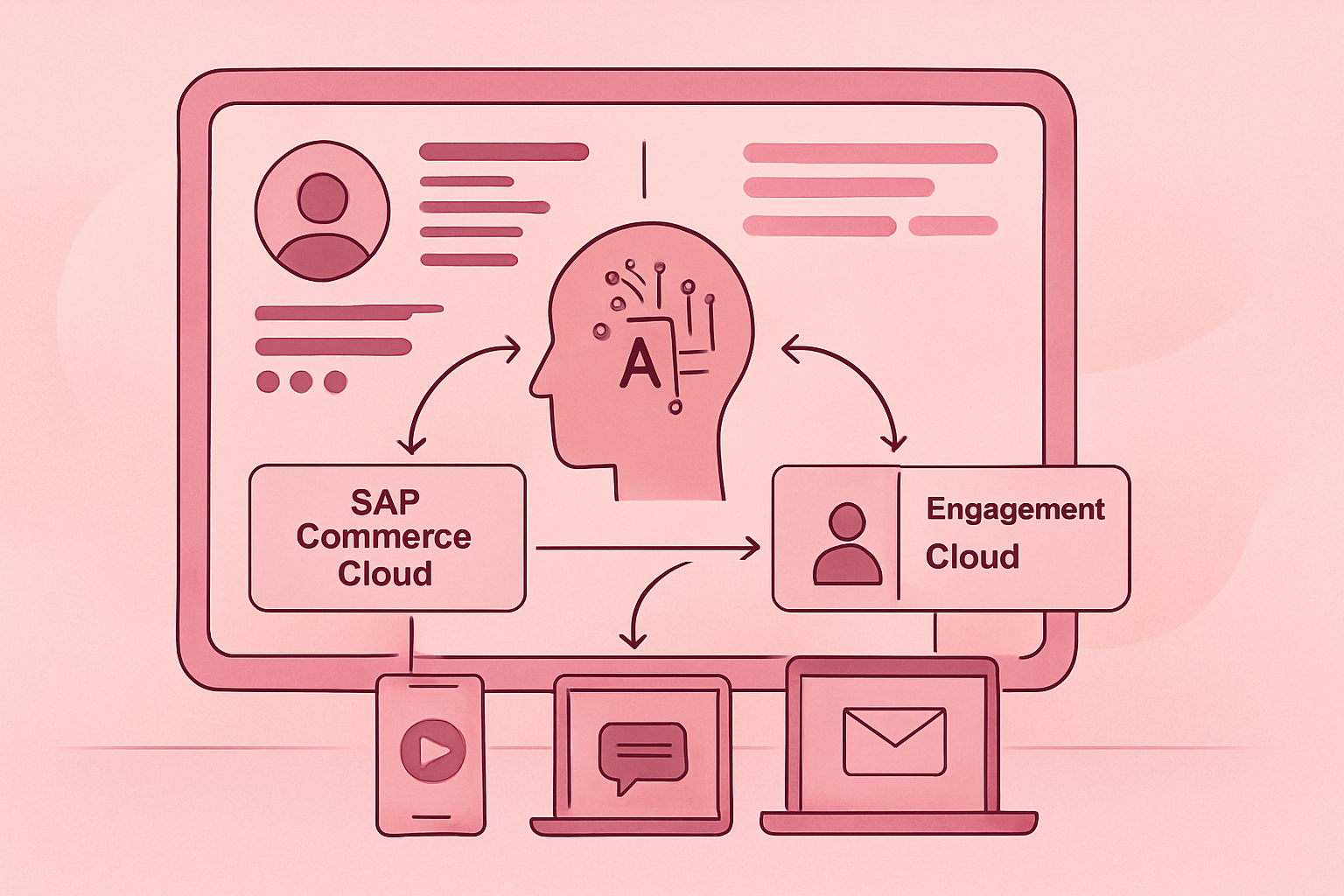
SAP Commerce Cloud plays a key role as the execution engine for large-scale personalization. This software offers an AI-assisted product recommendation system that displays relevant inventory to individual visitors at specific moments in their shopping journey. The engine highlights trending merchandise, related catalog items, and complementary accessories designed to drive cross-selling and upselling.
The system avoids static manual merchandising configurations by evaluating behavioral inputs in real-time. This automated assessment enhances conversion performance and increases product discovery at a volume that human merchandising teams cannot replicate manually.
However, administrators using SAP Commerce Cloud often encounter challenges in activating these advanced features due to predictable technical barriers. Poor data quality can degrade the accuracy of recommendation models. Integration complexities can sever data connections between the storefront application and upstream customer profile databases. Marketing departments often lack the necessary internal testing frameworks to adjust and optimize algorithms.
The Advanced Success Plan offers targeted technical interventions to eliminate these obstacles. Technical teams conduct data readiness assessments to measure the quality of foundational information and map the integration pathways needed to transmit clean behavioral data to the personalization engine. Adoption accelerators install structured testing workflows, enabling marketing operators to define hypotheses, execute A/B tests, and integrate successful changes into the platform's permanent configurations.
The result is that the digital storefront evolves into an adaptive system that learns from incoming data rather than operating on static initial parameters.
Automating Customer Lifecycle with SAP Engagement Cloud
SAP Engagement Cloud, powered by the SAP Emarsys platform, extends this personalization framework beyond the digital storefront to cover the entire customer lifecycle. The system integrates transactional data from SAP Commerce Cloud and merges it with engagement histories to generate multichannel communications targeting individual users rather than broad audience segments.
The AI-assisted send-time optimization feature enables this individualized approach. The algorithm abandons fixed transmission schedules to analyze the unique behavioral patterns of each contact. The system disregards standard timezone, language, and regional constraints to send messages at the exact second when the individual user shows the highest statistical likelihood of engagement. This process automates personalized communication within a scalable operational workflow.
Marketing departments pair this optimization tool with SAP Emarsys's AI-assisted campaign translator and omnichannel orchestration systems to move away from static campaign creation. Teams orchestrate dynamic automated journeys where the software continuously evaluates which user actions should trigger specific communications. The system modifies these interactions entirely based on response metrics.
The native technical integration linking SAP Commerce Cloud and SAP Engagement Cloud accelerates the deployment timeline. Merging business activity with external engagement data increases overall conversion rates, elevates purchase frequency, and extends average order value. Disconnected and independent systems cannot achieve these financial metrics.
The Advanced Success Plan secures this joint platform value by coordinating integration architecture, establishing data governance protocols, and tracking adoption milestones across both environments.
Implementing Results-Based Governance Models
Teams often mistakenly classify personalization initiatives as one-off software implementations. The SAP framework restructures these deployments into continuous improvement operations.
SAP's plan imposes results-based governance by establishing target KPIs. Stakeholders track increases in conversion rates, repeat purchase volume, engagement open rates, and calculate average order values. Project managers build dedicated workflows designed to advance these metrics.
Implementation specialists follow prescriptive adoption models organized into structured manuals. These manuals provide the technical steps necessary to activate AI-assisted recommendations, configure send-time optimization logic, and deploy next-action algorithms through quantified gates. The program offers ongoing role-based enablement and coaching directly to data engineers, product owners, and campaign managers. This targeted training fills internal skill gaps that typically cause slowdowns or regressions in personalization operations.
Proactive telemetry systems monitor live deployment. Automated adoption checks scan the platform to identify underperforming configurations. AI-guided best practice alerts inform system administrators of necessary adjustments before poor configurations impact business revenue.
The financial justification for these system upgrades relies entirely on verifiable operational data. Administrators of SAP Commerce Cloud track the value of operationalized hyper-personalization through direct metrics from the storefront. Upgraded systems report higher transaction conversion rates generated by AI-surfaced recommendations, increased average order values secured by automated cross-selling, and improved product discovery rates that reduce site abandonment.
Operators of SAP Engagement Cloud measure the system's value through communication quality metrics. Upgraded systems record higher open and click rates, driven by relevance to the individual user. Automated delivery timing enhances the overall return on investment of campaigns. Loyalty programs generate deeper interaction metrics based on the strength of the relationship rather than mere transaction volume.
The integration of unified data and automated decision-making restructures hyper-personalization from a static concept into an automated financial growth mechanism that measurably improves over time.
Brief IA — L'actualité IA en français
L'essentiel de l'actualité de l'intelligence artificielle, décrypté et expliqué chaque jour.