Spellbook Frames AI: D+ Memo and Handwritten Client Notes
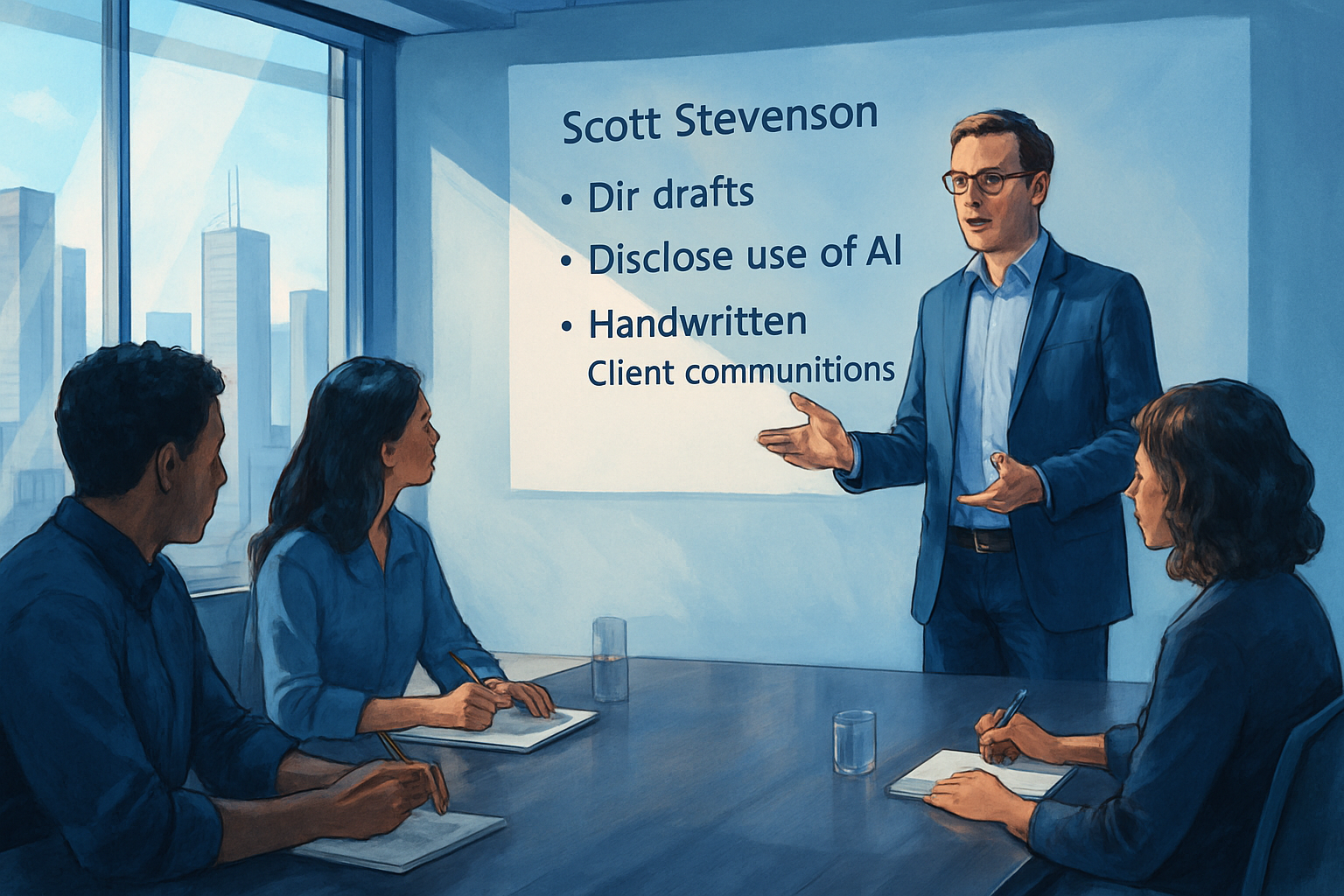
Spellbook sets clear limits on the use of AI in writing. A memo from its CEO Scott Stevenson to the over 200 employees mandates handwritten client messages, transparency regarding the use of tools, and "D+" versions for internal ideas.
Handwritten External Communications and Assumed Responsibility
Exchanges with clients must be handwritten. Spellbook wants its 5,000 clients to perceive human attention in every interaction. The policy specifies that any text sent engages the responsibility of its author and must be carefully proofread, as it will be treated as personal work. Scott Stevenson compares this requirement to the responsibility of a lawyer submitting an argument supported by hallucinated case law. The goal is for communications to reflect authentic human attention.
For Internal Use: Transparency, "D+", and No AI at the Core of Proposals
Internally, employees must indicate whether a document or message has been written with AI to help the reader interpret it correctly. AI should not be used for the main body of project proposals, with authentic reasoning needing to come first. It can be used for supplementary elements like spreadsheets and tables, but not at the core of the argumentation. In case of doubt, a "D+" version is requested to initiate discussion with concise points; Scott Stevenson prefers five succinct points over five well-polished but hollow pages. He wants to receive ideas in their raw state and asks to avoid overly polished prose.
Le brief IA que les pros lisent chaque soir
Les 7 actus IA du jour, décryptées en 5 min. Gratuit.
Inclus dès l'inscription : notre sélection des meilleurs guides & comparatifs IA.
Choisissez votre rythme
Gratuit · Pas de spam · Désabonnement en 1 clic
What Remains Permitted and the Reasons Provided by Management
Scott Stevenson believes that AI is useful mainly for specific tasks like coding and contract review, and that it is not effective for unconstrained long-form writing at this time. He describes common pitfalls of generated texts: excessive length with few ideas, repetitions that undermine trust, and sometimes unfounded information, with superficial brilliance produced by prompts. He also finds AI writing increasingly recognizable. This concern echoes the unclear content seen on social media, and other companies like Synthesia warn of a verbose and time-consuming "AI sloppification." The memo, recently sent to the over 200 employees of the Toronto-based company, formalizes these guidelines. Spellbook, led by its co-founder Scott Stevenson and specializing in AI for contracts, thus regulates the use of models within the team.
Brief IA — L'actualité IA en français
L'essentiel de l'actualité de l'intelligence artificielle, décrypté et expliqué chaque jour.