Stephen Huang: Apple Engineer Launches Tranxform AI
Le brief IA que les pros lisent chaque soir
Les 7 actus IA du jour, décryptées en 5 min. Gratuit.
Inclus dès l'inscription : notre sélection des meilleurs guides & comparatifs IA.
Choisis ton rythme
Gratuit · Pas de spam · Désabonnement en 1 clic
Stephen Huang: An Unconventional Path to AI Innovation
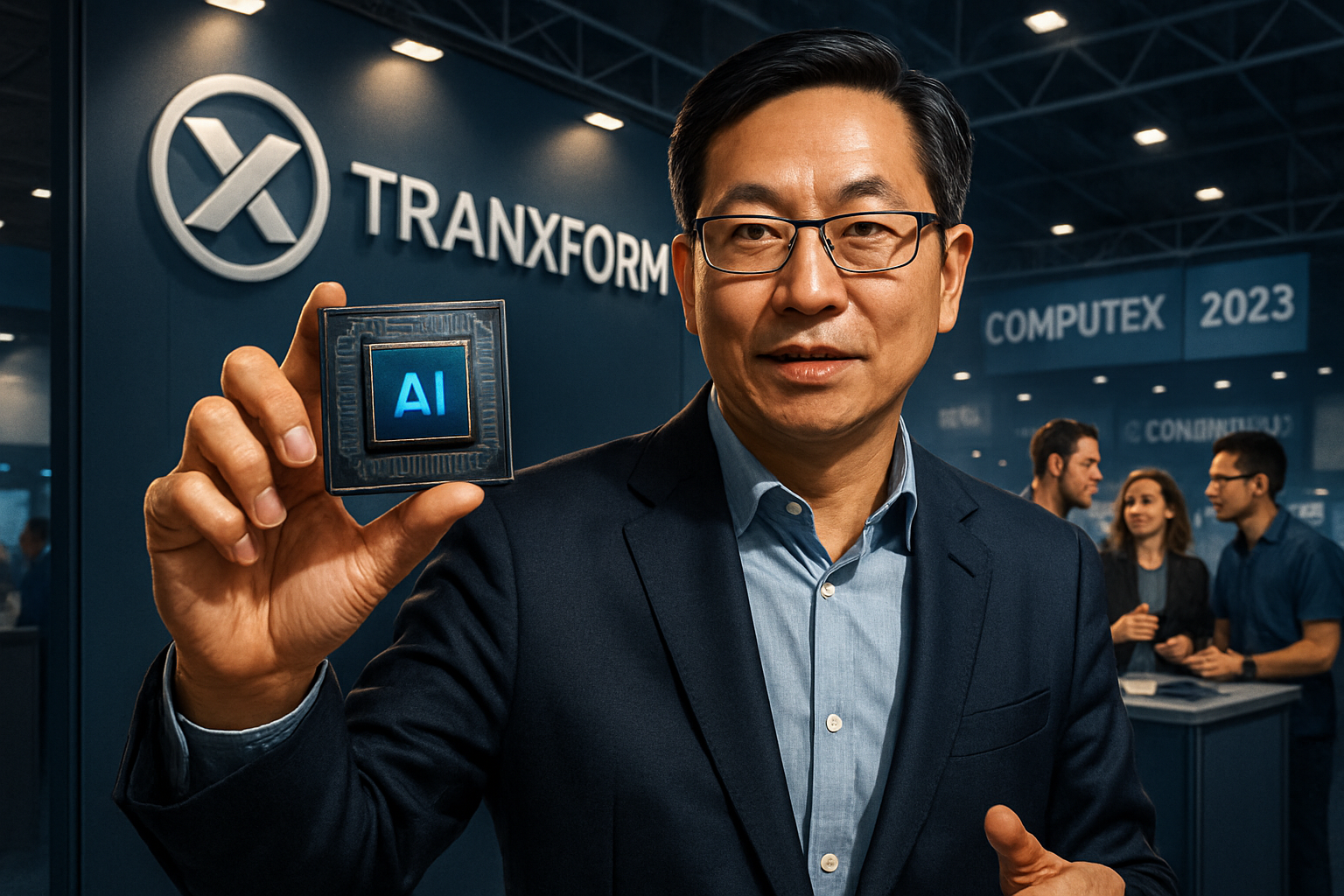
Stephen Huang, a veteran of the tech industry, recently drew attention at the Computex trade show. At 55 years old, after spending decades working in Silicon Valley, Huang decided to launch his own AI chip company, Tranxform. This startup, based in Taiwan, focuses on developing more efficient AI processors while attracting top talent to the region. Huang emphasizes that, unlike other tech sectors, AI hardware values experience and depth of knowledge.
Huang has dedicated a significant portion of his career to chip design, having worked on projects as varied as MediaTek's GPUs, Apple's Face ID technology, and AI chips at Amazon. The launch of ChatGPT was a turning point for him, convincing him that the time had come to realize his long-held project. "I felt the market had arrived," he shared, explaining his decision to embark on this new adventure at an age when many consider retirement.
Tranxform: A Vision for the Future of AI Chips
In 2024, Huang founded Tranxform AI, a Taiwanese company dedicated to creating energy-efficient processors capable of running AI models outside of large data centers. Currently, Tranxform employs around 40 people and is set to launch its first chip next year. Huang is part of a new wave of entrepreneurs exploring the opportunities presented by the rise of AI. Unlike others who focus on language models, he leverages his expertise in chip design to build his business.
Huang does not see his age as a disadvantage. He cites the example of Morris Chang, founder of Taiwan Semiconductor Manufacturing Company, who created the world's largest contract chip manufacturer at 55. According to Huang, experience is crucial in the semiconductor field, where designing system-on-chips requires mastery of the trade-offs between hardware and software. "To build a good SoC, you need experience," he asserts.
The Challenges and Opportunities of Entrepreneurship
Venturing into entrepreneurship was not an easy decision for Huang. Before founding Tranxform, he enjoyed a stable career and a comfortable income in the United States. Starting the company involved taking a considerable risk and spending most of his time in Taiwan, a decision that was initially difficult for his family to accept. However, as Tranxform progressed, his family began to support his project. "Today, they are proud of what we have accomplished," he says.
Timing played in his favor, as his two sons became independent just as he was founding Tranxform. One works in the tech industry, while the other has just completed his university studies. "Their independence allowed me to dedicate the time and energy needed to build Tranxform," Huang explains.
A Growing Market
Huang is convinced that the risk was worth it, as the demand for specialized AI hardware is on the rise. Companies are seeking faster and more energy-efficient solutions to run increasingly complex models. This optimism is shared by investors, who are pouring capital into the AI hardware sector. According to PitchBook, venture capital funding for AI chip startups increased by 70%, reaching $16.2 billion in 2025. However, the number of transactions has decreased, with investors focusing on a smaller number of promising companies.
In 2023, funding had already reached $9.9 billion by June 22, with 87 transactions recorded, according to PitchBook.
A Strategic Return to Taiwan
While AI pushed Huang toward entrepreneurship, recruitment challenges in Silicon Valley prompted him to choose Taiwan as the location for his company. He found that startups struggle to compete with tech giants for talent. "We kept training people, and they were poached," he recalls.
Huang therefore chose to settle in Hsinchu, a major hub for the chip industry in Taiwan, where he hoped to build a more stable engineering team. Among his recruits is Way-Shing Lee, a former classmate, who joined Tranxform as Chief Technology Officer after retiring from Qualcomm.
Today, the startup life has replaced Huang's previous career stability with constant challenges: fundraising, recruiting, meeting with clients, and solving technical problems. "Starting a business is very difficult," he admits. "You have to find business partners, sell your story, and secure funding."
Tranxform is currently preparing for a new funding round, although Huang did not wish to disclose details. The company is still in its early stages regarding licensing and generates little revenue, but Huang remains optimistic about future opportunities in AI. "The AI industry is probably just getting started," he concludes.
Brief IA — L'actualité IA en français
L'essentiel de l'actualité de l'intelligence artificielle, décrypté et expliqué chaque jour.