Substack and Pangram: The AI Detection Tool Put to the Test
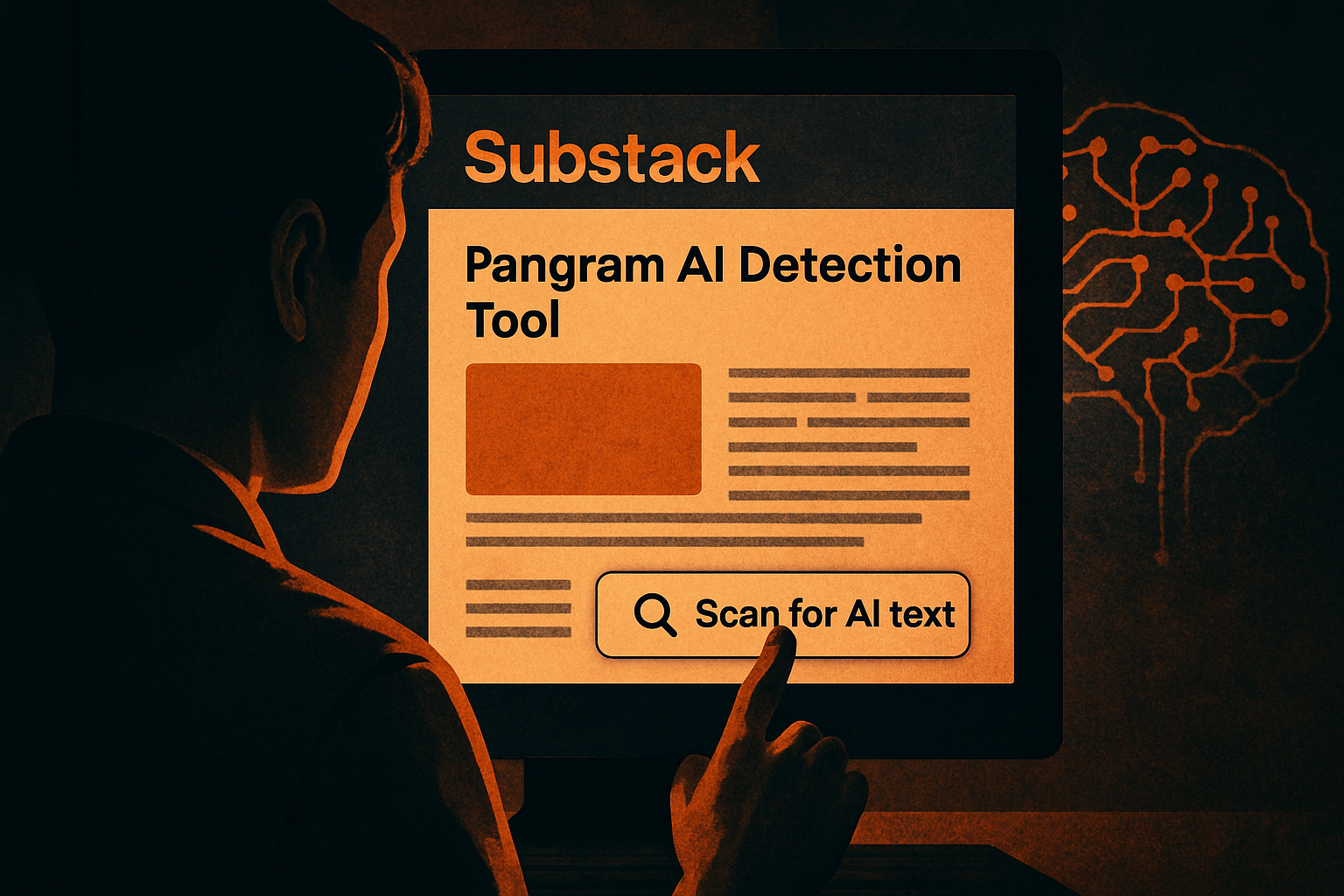
Substack Partners with Pangram to Detect AI
In an increasingly digital world, the question of the origin of the content people consume becomes crucial. Is it the product of a human mind or artificial intelligence? Substack, a well-known publishing platform, has decided to shed some light on this issue by collaborating with Pangram, an AI detection tool. The goal is to help readers discern the extent of AI involvement in the content they read on the platform.
This tool is accessible to all Substack subscribers and applies to posts, notes, comments, and replies, provided they exceed 100 words. Creators also have the option to analyze their drafts with Pangram to assess the presence of AI and can provide a statement explaining their writing process, according to information provided by Substack.
Users of the web and iOS versions of Substack can now test the features of Pangram, while those using Android will have to wait a bit longer.
In a blog post announcing this new feature, Chris Best, co-founder and CEO of Substack, expressed his intention to counter the phenomenon of "Claudefishing." This term refers to the situation where readers consume content without realizing it has been generated by AI.
“When readers have to wonder if what they’re reading is real, it undermines trust in the author and threatens the livelihood of writers — including those who use AI tools thoughtfully to produce works they believe in,” he wrote.
The Scope of AI in Online Content
Pangram estimates that about 40% of text on certain social media platforms is generated by AI, and this figure rises to two-thirds for the professional networking site LinkedIn. Furthermore, Graphite, an agency specializing in AI growth, recently published a white paper indicating that AI now produces as many online articles as human authors. A survey conducted by Gartner revealed that 68% of people question the authenticity of the content they consume, and half of consumers prefer brands that do not use AI in their marketing.
Personal Experimentation with the Tool
A user who had recently joined Substack wanted to test Pangram's new AI detection tool. The tool applies to posts, notes, comments, and replies, and this user chose to use posts as a testing ground. First, he logged into his Substack account and published a new article. He copied and pasted a text he had written himself, without the help of AI, into the Substack post and published it.
Le brief IA que les pros lisent chaque soir
Les 7 actus IA du jour, décryptées en 5 min. Gratuit.
Inclus dès l'inscription : notre sélection des meilleurs guides & comparatifs IA.
Choisissez votre rythme
Gratuit · Pas de spam · Désabonnement en 1 clic
A few minutes later, he checked the live post. In the three-dot menu located at the top right of the page, an option "Scan for AI text" was available. Clicking on it opened a window, accurately indicating that the post was "Entirely written by a human." A line appeared below, specifying the percentage of text generated by AI, assisted by AI, or entirely human.
Next, he edited the same post by adding a long paragraph generated by AI via ChatGPT. During the "Scan for AI text," the tool reported that 10% of the post was written by AI, which was a fairly accurate estimate.
He then published a post entirely generated by AI, and the scan correctly identified it as being 100% AI-generated.
For another test, he added a few AI-generated sentences to an otherwise purely human post, and the scan flagged it as being 100% human-generated. Close, but not quite right. Thus, the Pangram tool performed well for these rudimentary experiments.
The Challenges of False Positives
Although the user was generally satisfied with the performance of Substack's AI detection tool on his own content, he was surprised to learn that one of his favorite podcaster-bloggers seemed to have used AI exclusively for their latest article. Other verified writers had used texts entirely written by humans.
In his announcement, Chris Best acknowledged that the AI detection tool is "not perfect," but cited independent research showing that Pangram's software is 97.5% accurate in detecting text that is entirely AI-generated. The University of Maryland found that Pangram was 99.3% accurate in identifying "humanized AI-generated text," meaning content generated by AI that has been rewritten or paraphrased by a human.
Substack writers who do not use AI are naturally concerned about the risk of being incorrectly labeled as AI-assisted authors. The risk of false positives is therefore a significant issue. Substack stated that creators can scan their content to see if it will be labeled as containing AI while it is still in draft form. If Pangram incorrectly identifies AI text, the creator can report the error to Substack and have the false scan removed.
To promote greater transparency, publishers can now include a "How I Do This" statement if they want readers to know how much, if any, AI they have used in their content. Best stated that Pangram cannot detect if AI has been used to gather information or as a source for written pieces.
“We are not against the use of AI to assist in work, and we believe people should be free to choose the tools they use to express themselves,” Best said. “But people should know what they’re getting.”
Brief IA — L'actualité IA en français
L'essentiel de l'actualité de l'intelligence artificielle, décrypté et expliqué chaque jour.