TIDAL Strikes Hard: End of Royalties for AI Music by 2026
Le brief IA que les pros lisent chaque soir
Les 7 actus IA du jour, décryptées en 5 min. Gratuit.
Inclus dès l'inscription : notre sélection des meilleurs guides & comparatifs IA.
Choisis ton rythme
Gratuit · Pas de spam · Désabonnement en 1 clic
TIDAL Ends Royalties for AI-Generated Music
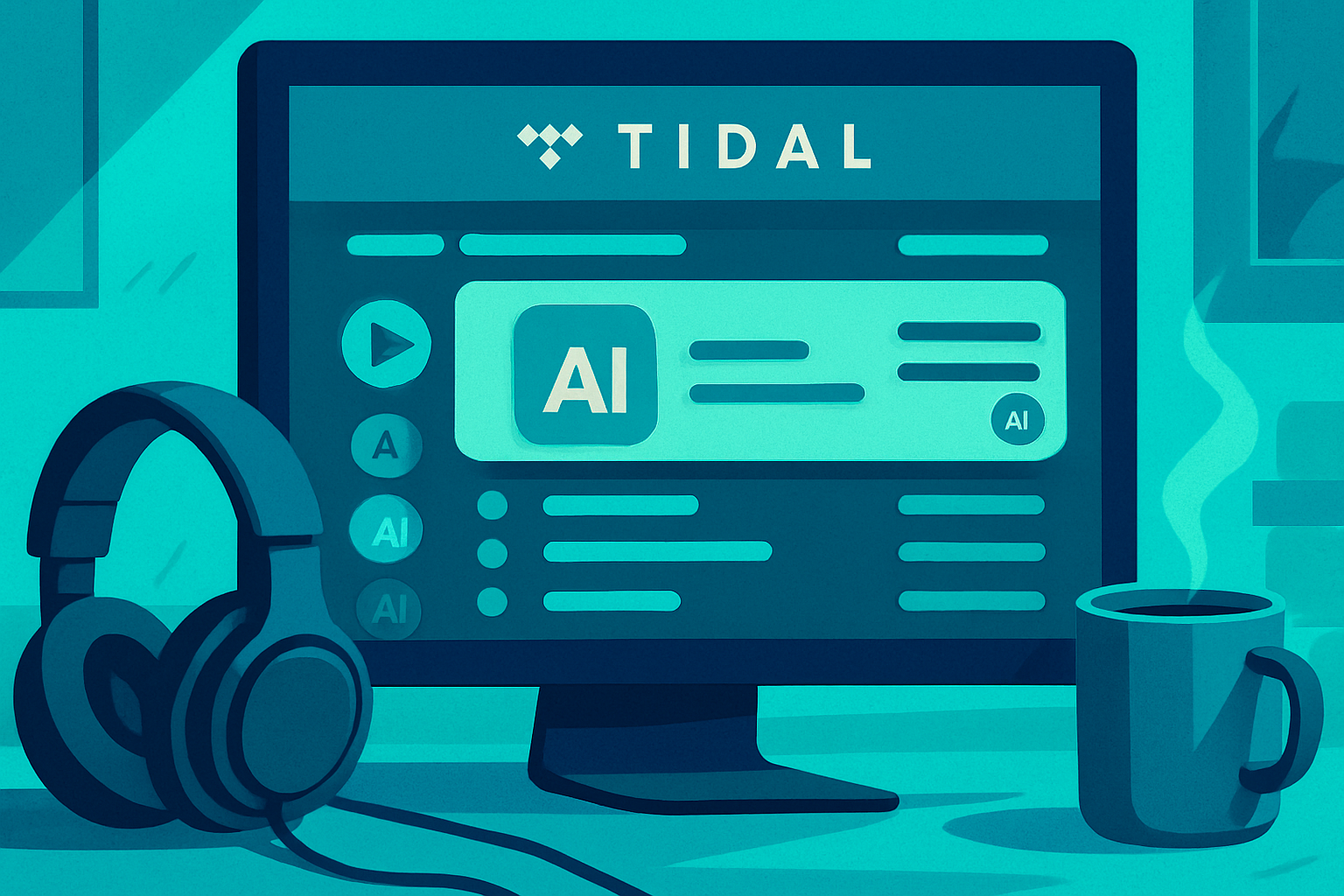
TIDAL has made a radical decision that will take effect on July 15, 2026: tracks that are entirely generated by artificial intelligence will no longer be monetizable on its platform. This means they will not receive royalties and will not benefit from direct sales to fans. This policy also applies to Tidal Upload, the service that allows independent artists to publish their music. To ensure transparency, each track identified as fully synthetic will be accompanied by an “AI” badge visible to listeners. Additionally, TIDAL will implement automated tools to remove AI content that impersonates existing artists.
Tony Gervino, Executive Vice President and Editor-in-Chief of TIDAL, emphasized that this initiative is not aimed at “criticizing technological progress,” but rather at protecting “organic creativity” and the revenues that come from it.
A Disruptive Policy
TIDAL's decision stands out for its firmness. While other streaming platforms have opted for transparency by labeling and informing users about the origins of tracks, TIDAL chooses to cut off revenue from AI-generated tracks. Spotify, for example, has adjusted its policy to better filter spam and label AI tracks, while acknowledging that these tools are an integral part of the creative process. Apple Music has taken a similar approach, leaving it to labels and distributors to declare the use of AI. In contrast, TIDAL allows no room for voluntary declaration or nuance: no royalties for AI music.
This policy marks a significant difference from its competitors. According to TechCrunch, TIDAL has historically paid artists better than Spotify. Thus, cutting off revenue from AI tracks is not just a symbolic gesture, but a tangible loss for those who relied on this model. The company describes its policy as a “living document,” ready to be adjusted as detection tools evolve. The goal is to extend labeling to tracks that are “substantially” generated by AI as soon as the technology allows.
Pressures on the Music Market
The music market is under pressure due to the rise of AI-generated content. Deezer has revealed that 44% of new tracks uploaded daily to its platform are generated by AI, illustrating the scale of the phenomenon. The French platform has tightened its policy by excluding these titles from recommendations and editorial playlists while offering its detection tools to competitors. Qobuz has also taken a stance in this debate. While the industry seems to be converging towards regulation, the approaches vary in terms of speed and radicality.
For now, TIDAL is the only platform to deprive AI tracks of financial revenue. Spotify, which has strengthened its tools to protect artists from AI, maintains a more open position: any music, regardless of its creation method, can earn royalties if it is licensed. The question posed by TIDAL is therefore: will the removal of financial revenue be more effective than labeling in curbing the influx of synthetic content? That is the gamble the platform has chosen to take.
By choosing to cut royalties, TIDAL is stepping onto ground that its competitors have avoided: the issue of money. Informing through labeling is one thing, but depriving of revenue is a choice of camp. It remains to be seen whether this approach will convince artists to migrate to TIDAL or if it will remain a niche stance in a market dominated by less decisive players. If this measure proves effective in reducing the flow of synthetic music, other platforms may be forced to reconsider their position.
Brief IA — L'actualité IA en français
L'essentiel de l'actualité de l'intelligence artificielle, décrypté et expliqué chaque jour.