WeatherNext 3 Targets Energy with Hourly Forecasts
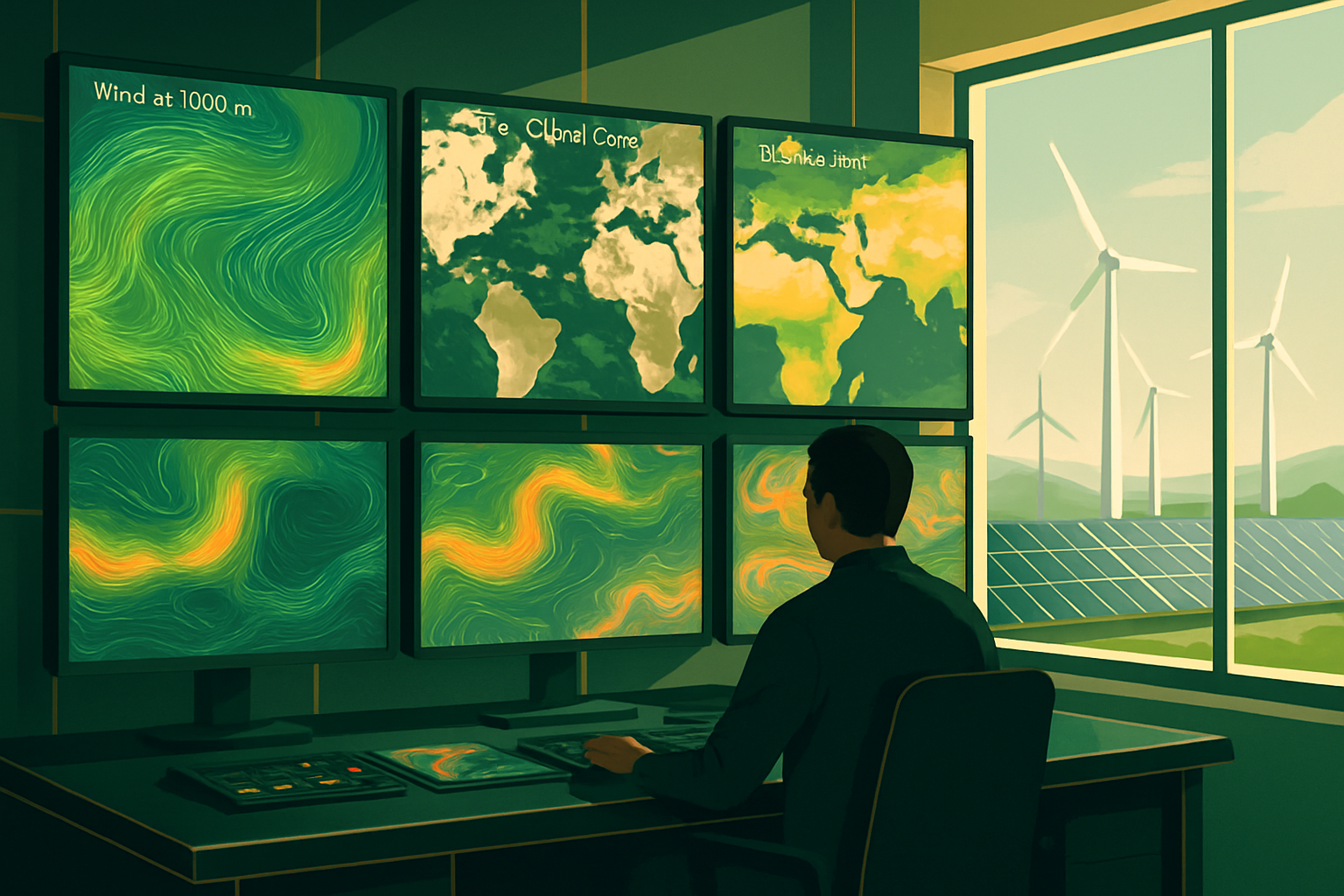
Google launches WeatherNext 3, an AI weather model that forecasts wind at 100 meters, cloud cover, and sunlight with hourly updates. The tool arrives in the Cloud and Maps ecosystem, with variables designed for wind and solar energy. However, no pricing grid or independent validation accompanies the launch.
Lack of Validation and Unclear Access Conditions
Google has not published any independent third-party validation at launch. The company refers to live assessments from Brightband, citing a ranking to support the claim that WeatherNext 3 is the most accurate global model to date. No pricing for enterprise access has been disclosed, and it is unclear whether access via BigQuery or Earth Engine falls under standard Cloud fees or requires a separate license. For a public service, the cost will weigh heavily before any claims of accuracy are examined. On the technical side, reports indicate that the data lag remains three to four hours, down from about seven previously, suggesting that reliance on numerical forecasting has been reduced but not eliminated.
Announced Method and Reported Improvements
WeatherNext 3 is presented as learning from real observations rather than simulations. The previous generation and most AI models rely on numerical forecasting outputs with a lag of about six hours, which can introduce bias on very dynamic variables. The new system ingests live geostationary images and station readings, with hourly satellite mosaics combined with historical analyses. According to Ilan Price, the gain comes from using the most recent information without waiting for the next analysis. Google reports gains of "up to" 60% compared to the IMERG satellite product, 30% against MRMS radars, and 10% against rain gauges for early horizons, in probabilistic scoring. The claim of a 50% improvement in precipitation pertains to forecasts of one day or more, with these percentages based on distinct references and representing best-case scenarios.
Enterprise Access via BigQuery, Earth Engine, and Cloud Storage
Forecasts can be queried directly in BigQuery, available as a layer in Earth Engine, and downloadable in bulk via Google Cloud Storage, without client-side model configuration. Meanwhile, the public layer is activated in Google Search, the Gemini app, Google Maps, and the Google Maps Platform Weather API.
Le brief IA que les pros lisent chaque soir
Les 7 actus IA du jour, décryptées en 5 min. Gratuit.
Inclus dès l'inscription : notre sélection des meilleurs guides & comparatifs IA.
Choisissez votre rythme
Gratuit · Pas de spam · Désabonnement en 1 clic
Energy Variables and Hourly Cadence Compared to WeatherNext 2
The release of WeatherNext 3, dated September 3, marks the addition of essential variables for the energy sector: wind speed measured at 100 meters, cloud cover, and surface sunlight, all updated hourly. This model offers global forecasts with a resolution of up to five kilometers for various surface variables, including temperature and humidity. In its previous version, WeatherNext 2, forecasts were made on a 25-kilometer grid with updates every six hours. Google specifies that these variables are intended to facilitate the estimation of wind and solar production and to synchronize it with demand. Specialized providers are already marketing this type of data to market players, and the arrival of WeatherNext 3 now positions Google in this segment.
Strained Networks: Renewables on the Rise and Data Centers
Operators are managing a system that is more difficult to forecast. On the production side, renewables dominate capacity additions: S&P Global Market Intelligence projects that solar and storage will be the main sources this year, with 51.2 GW of solar and 25.7 GW of storage out of more than 90 GW of additions. Since wind and solar produce according to the weather, each additional gigawatt increases the demand for short-term forecasts. On the consumption side, S&P Global links the recent rise in demand to the proliferation of data centers in North America, prompting utilities to raise their forecasts. Deloitte anticipates about 26% growth in peak demand by 2035, with data center demand potentially reaching 176 GW, five times that of 2024. Underestimating wind production forces urgent purchases, often from costly standby gas plants; overestimating leads to paying for wind/solar curtailments. In this context, Google, a member of the hyperscalers responsible for part of the new load and a signatory of multi-gigawatt renewable energy purchase agreements, has a direct interest in reliable forecasts to match clean energy with variable load.
Competition and the AI vs. Physical Models Debate
The weather forecasting market for energy is already crowded, with Vaisala, Solcast, DNV's WindGEMINI, and IBM's HyperWatch. Jua claims that its EPT-2 model outperforms Microsoft Aurora and the former GraphCast in accuracy, with 24 updates per day compared to the typical four, according to her. Google’s advantage lies in its distribution: the same forecast is available as a BigQuery table, Earth Engine layer, Google Maps Platform API, and default response in Search. The hourly cadence reduces the frequency advantage that some specialists previously exploited. On the technical side, Jua argues that physics-based models like ECMWF's HRES remain superior during extremes due to the explicitly encoded physical laws, whereas AI models learn from past data.
Brief IA — L'actualité IA en français
L'essentiel de l'actualité de l'intelligence artificielle, décrypté et expliqué chaque jour.