World Labs unveils Atlas, 3D AI in early access
Atlas, a new model from World Labs co-founded by Fei-Fei Li, claims to achieve superior results compared to specialized systems in controlled generation tests and 3D reconstruction. Human evaluators preferred it up to 93% of the time in various cases, and an early access program is open to partners. Designed as an omni-model rooted in 3D, Atlas produces video at 1440p, native 3D outputs, and simulations for robotics.
Human Preferences Up to 93% and Open Early Access
World Labs specifies that there is no single reference to measure all of Atlas's capabilities and relies on two test batteries. In camera-controlled generation, evaluated by external judges, as well as for 3D reconstruction from a limited number of views, the company claims that Atlas outperforms specialized models. According to comparisons made by human evaluators, Atlas was preferred in 75% of cases against MiniMax H3, in 81% against Gemini Omni Flash, in 86% against Happy Horse 1.1, and in 93% against Seedance 2.5. For reconstruction, Atlas shows a median error of 25.3, ahead of Pi3X and VGGT-Ω 1B. The model is accessible through an early access program reserved for selected partners. World Labs states that Atlas's performance improves with more training computation and plans to integrate Atlas into upcoming versions of Marble and other products. The company believes that Atlas surpasses specialized models and suggests that this advantage may render some of them obsolete.
Native 3D Outputs, Bullet Time Effect, and Data for Robots
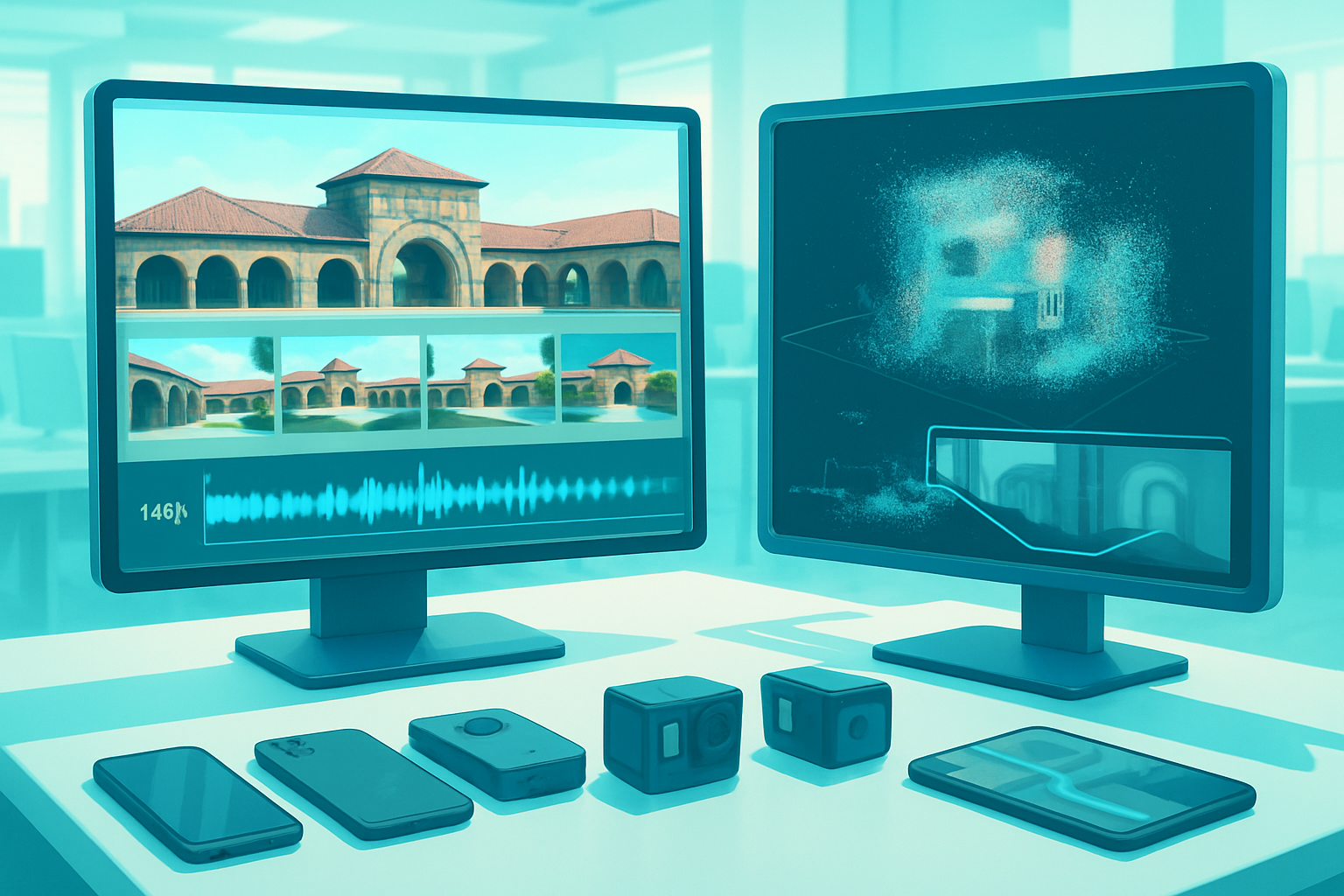
Atlas generates real 3D data by processing depth alongside RGB information and supports formats such as point clouds and 3D Gaussian splats. In simulator mode, it models space and time together and can produce a "bullet time" effect from sequences captured by just a few cameras, with demonstrations conducted using smartphones and action cameras. For robotics, Atlas serves as a tool for transitioning from reality to simulation: it reconstructs a room and generates the images and depth data that a simulated robot's sensors would perceive along its path. From just a few photos, it is possible to simulate and vary grasping and movement tasks by modifying objects, positions, lighting, or backgrounds, thus producing diverse training datasets without needing to capture every real situation.
Le brief IA que les pros lisent chaque soir
Les 7 actus IA du jour, décryptées en 5 min. Gratuit.
Inclus dès l'inscription : notre sélection des meilleurs guides & comparatifs IA.
Choisissez votre rythme
Gratuit · Pas de spam · Désabonnement en 1 clic
Atlas Creates New 3D Views from Provided Images
In camera-controlled generation, Atlas uses one or more images to create new views at freely chosen locations and orientations. Camera movement is provided as explicit geometric information rather than described by textual instruction. World Labs indicates that the model can generate up to one minute of video in 1440p and emphasizes the user's ability to control each shot. For spatial reconstruction, Atlas recomposes real scenes from a limited number of photos without requiring specialized equipment, and its performance increases with the number of images provided. According to the company, two or three images may already be sufficient to achieve high fidelity, and the system also accepts more than a hundred inputs. A demonstration shows the gradual assembly of Stanford's Main Quad from two to 25 photos taken from the ground, as well as the generation of aerial views above the campus.
An Omni-Model Rooted in 3D for "Spatial Intelligence"
World Labs describes Atlas as an omni-model trained from the outset on texts, images, videos, and 3D data. Each input data corresponds to a precise location in space, rather than a linear sequence, which the company refers to as "spatial context" and presents as a distinction from strictly linguistic or video models. Atlas is the first model developed at scale by the company to meet the stated ambition of "spatial intelligence," meaning the ability to comprehend 3D space comparable to that of humans. This model is capable of generating, reconstructing, and simulating 3D scenes from a small number of images.
Focus on 3D Worlds: World Labs' Trajectory and Scientific Framework
An initial system, presented at the end of 2024, allowed users to navigate a few virtual meters before encountering invisible boundaries, followed by the launch of Marble in November 2025. World Labs, founded in 2024 by Fei-Fei Li — the creator of ImageNet and former head of AI at Google Cloud between 2017 and 2018 — marketed its product with the support of Andreessen Horowitz, AMD, Intel, and Nvidia. In February 2026, the company raised $1 billion from Autodesk, Andreessen Horowitz, Nvidia, and AMD, following earlier discussions mentioned around a valuation of $5 billion. Fei-Fei Li also criticized 1D/2D sequential architectures for spatial tasks in November 2025 and advocated for tokenization, context, and memory mechanisms aware of 3D or 4D dimensions. In the scientific community, the concept of a "world model" remains debated, while an international team led by Peking University proposed in April 2026 via OpenWorldLib a unified definition excluding purely text-to-video models and considering 3D reconstruction and simulators as fundamental building blocks.
Brief IA — L'actualité IA en français
L'essentiel de l'actualité de l'intelligence artificielle, décrypté et expliqué chaque jour.