In Marseille, Syniaps is building the memory that enterprise AI lacks
In partnership with Syniaps.
Before a sales meeting, the AI agent had already written up the person on the other side of the table: the purpose of the call, the angle he would probably take, the questions he would ask, and a summary of the email exchanges, price negotiation included. Nobody had asked for it. It had done the work overnight, because a meeting was in the calendar and the emails were sitting in the inbox.
This AI agent is called Syniaps. It is published in Marseille by a company founded in September 2025, and it rests on a bet few vendors state so plainly: enterprise AI is not won in the conversation, but in the memory.
The real cost of the chatbot
Three years after ChatGPT, most French companies have adopted AI in a single form: the chat window. Anyone who uses it seriously knows the result. The tool knows nothing about the customers, the contracts or last month's decisions, and a good half of the time goes into re-explaining a context it will forget the moment the tab closes. Every employee starts again alone. Nothing compounds.
That cost is invisible because it is spread thin. It appears on no invoice, yet it explains why so many deployments stall once the enthusiasm of the first weeks wears off.
The market has split into two families, neither of which answers the problem. On one side, the general assistants, ChatGPT, Claude, Gemini, excellent for an individual and amnesiac for an organisation. On the other, the agent platforms built for large accounts, Microsoft Copilot Studio, Gemini Enterprise or Dust, which assume an IT department, a budget and a project. In between sit all the companies that fit neither box. Syniaps addresses them without a size requirement, from the sole trader running a business alone to the several-hundred-person firm, whether or not it has an IT department to spare.
Syniaps targets that gap, and attacks the problem from the other end. Rather than offering a better window, it plugs in upstream: email, calendar, storage, line-of-business tools. Gmail, Outlook, OneDrive, Drive and Dropbox synchronise continuously and in both directions, and the vendor claims more than 7,500 connectors in its catalogue. No migration is required, no folder needs tidying: the tool comes and reads what already exists, where it already sits.
What the memory builds
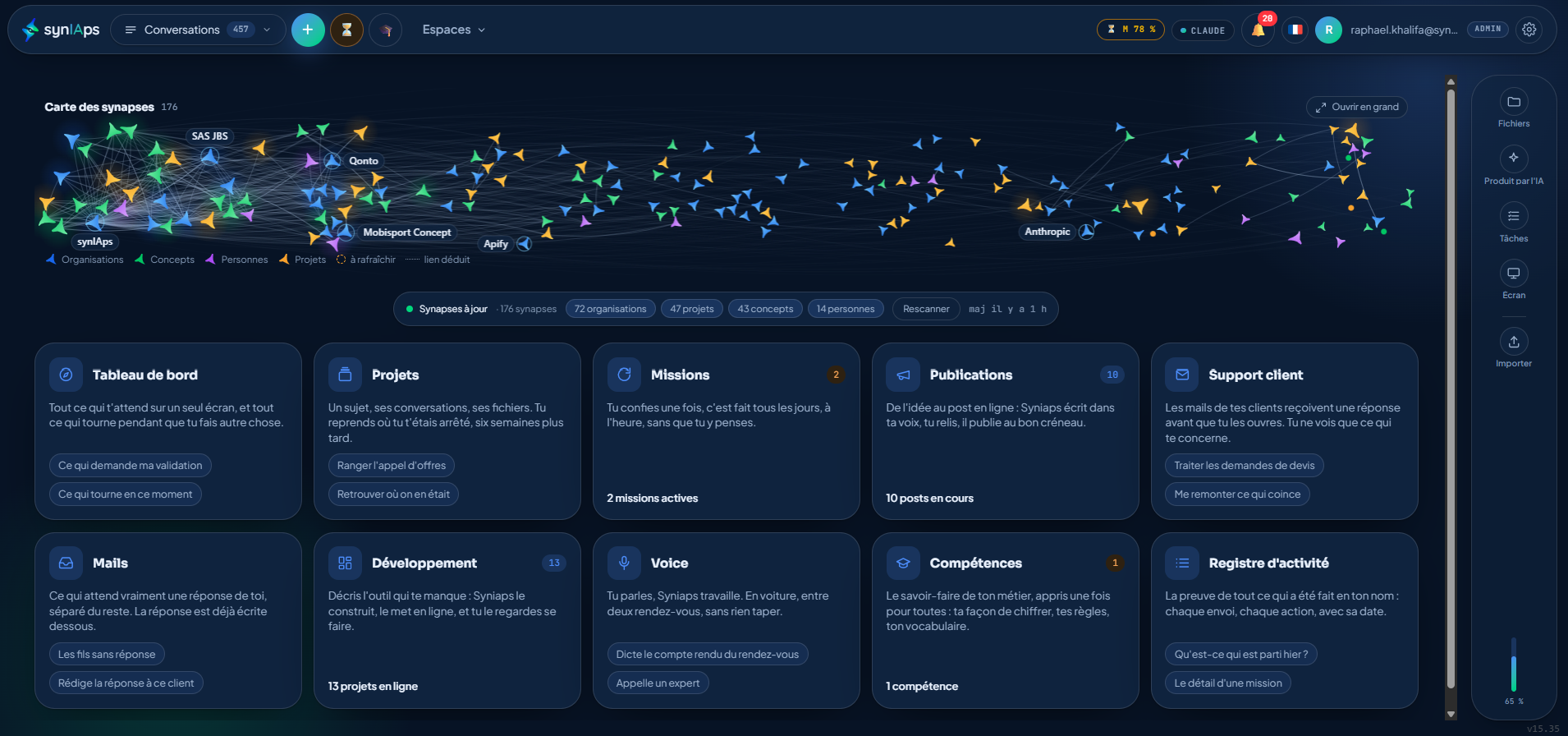
Every document that arrives becomes a record linked to the others. A client, a contract, a project, a person. On a demonstration workspace, 2,506 records were woven together this way.
The foundation is a semantic search engine, what the industry calls a RAG. As soon as a folder is connected, Syniaps indexes its contents by meaning, in a database that belongs to the company and sits on its own dedicated server: it finds the right passage in a fraction of a second, even when the question is worded differently, without a document ever leaving for a third-party service. The synapses sit on top, and that is where the difference lies: they compile the facts that matter, link them together and keep them current. One retrieves, the others enrich. The distinction matters when you start: the engine is operational within a minute of connecting your storage, and the synapses enrich it afterwards. A map that is still incomplete in the first week therefore blocks nothing. A company that already runs its own engine can connect it directly, without duplicating the infrastructure, and any document added later joins the memory unattended.
The application home screen shows the workspaces and the synapse map: every document becomes a record linked to the others.
The weaving does not wait for the office to close: depending on the setting chosen, it runs night and day. By default, every night, the system goes back over everything it has been given and rebuilds its map. It takes the opportunity to consolidate the skills it has been taught and to arbitrate their contradictions: when two rules clash and the right one is obvious, it decides alone; otherwise it asks the question the next morning. Raphaël Khalifa, its founder, sums up this default mode with an image no marketing department fed him: at night, it sleeps, it dreams.
The gap with a search engine appears as soon as you move past simple questions. Asked about the company's most recent purchase invoice, the agent finds it, with its date and amount, which a good index would also do. Then it adds a remark nobody requested: the invoice is made out to an individual rather than to the company, and carries no VAT number. Even once paid, it will open no right to reclaim VAT.
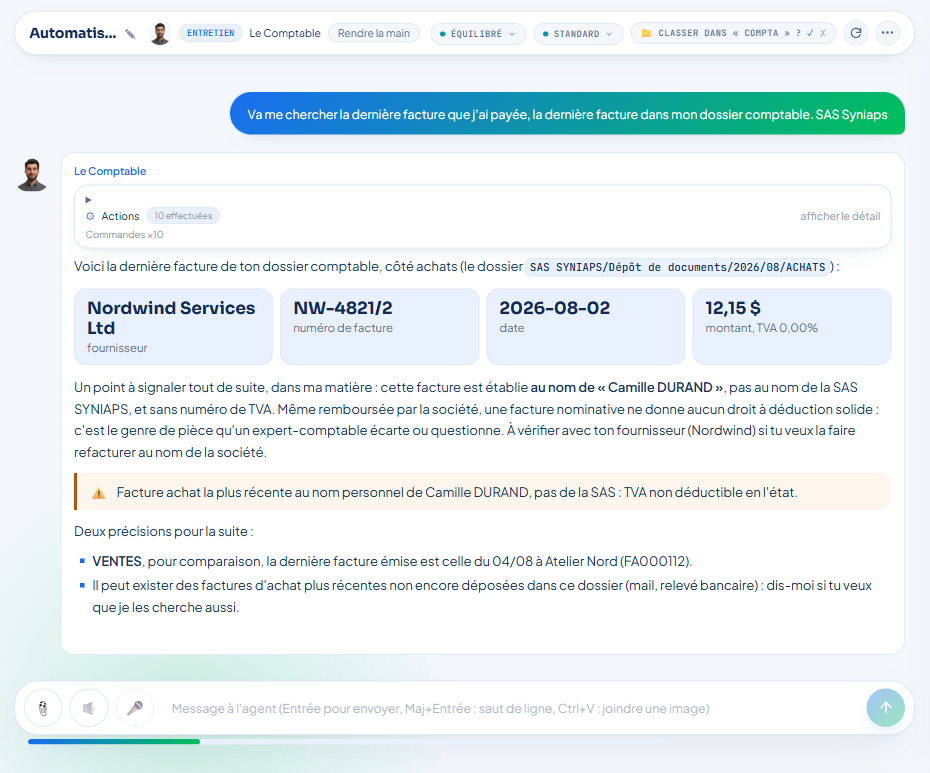 The agent does not stop at finding the invoice: it flags that the document is not deductible as it stands, and says why.
That is exactly the document an accountant sets aside, and any director who has closed a set of accounts knows what that warning is worth in January rather than in April. The tool states its own limit in the same breath: it prepares for the accountant, it does not file.
Expense claims are more telling still. A photo of a receipt taken on the fly, never entered anywhere, is retrieved in two seconds with the right date and the right amount: the night before, the system had opened it, read it, dated it, filed it, then attached it to the month's expenses. Character recognition, included from the entry-level plan, reads scans and handwritten pages alike.
A memory of this kind does not only answer questions whose answer is written down somewhere. It answers those whose answer exists only in the links between documents.
A working day handed to the machine
A knowledge base, however fine, stays passive. The second floor of Syniaps is called missions, and this is where the product genuinely parts company with consumer assistants.
Six of them were running permanently on the founder's workspace, and they sketch out rather well what a week of company work looks like once it is delegated to an AI system. Sales invoices are collected every morning at eight from the accounting portal and filed in the month's folder. At nine, the shared inbox is sorted, the noise set aside, the messages that need an answer summarised. On the 2nd of the month, bank entries are reconciled against invoices and discrepancies raised before closing. After every meeting, the minutes are written. Expense receipts dropped into a folder are renamed according to the accountant's conventions and pushed into the Dropbox he shares with them. On the 1st, the website is reviewed, load times and broken links included.
A mission described once then runs on its own, at the chosen hour, without being restarted. Voice input shows clearly what the vendor calls a finished mission: saying out loud what you want to happen is enough to launch it, with no configuration screen and no form to fill in. The next day, a simple question about the day's missions returns the list of what ran, with the time and the outcome of each, followed by the list of what is still waiting for approval.
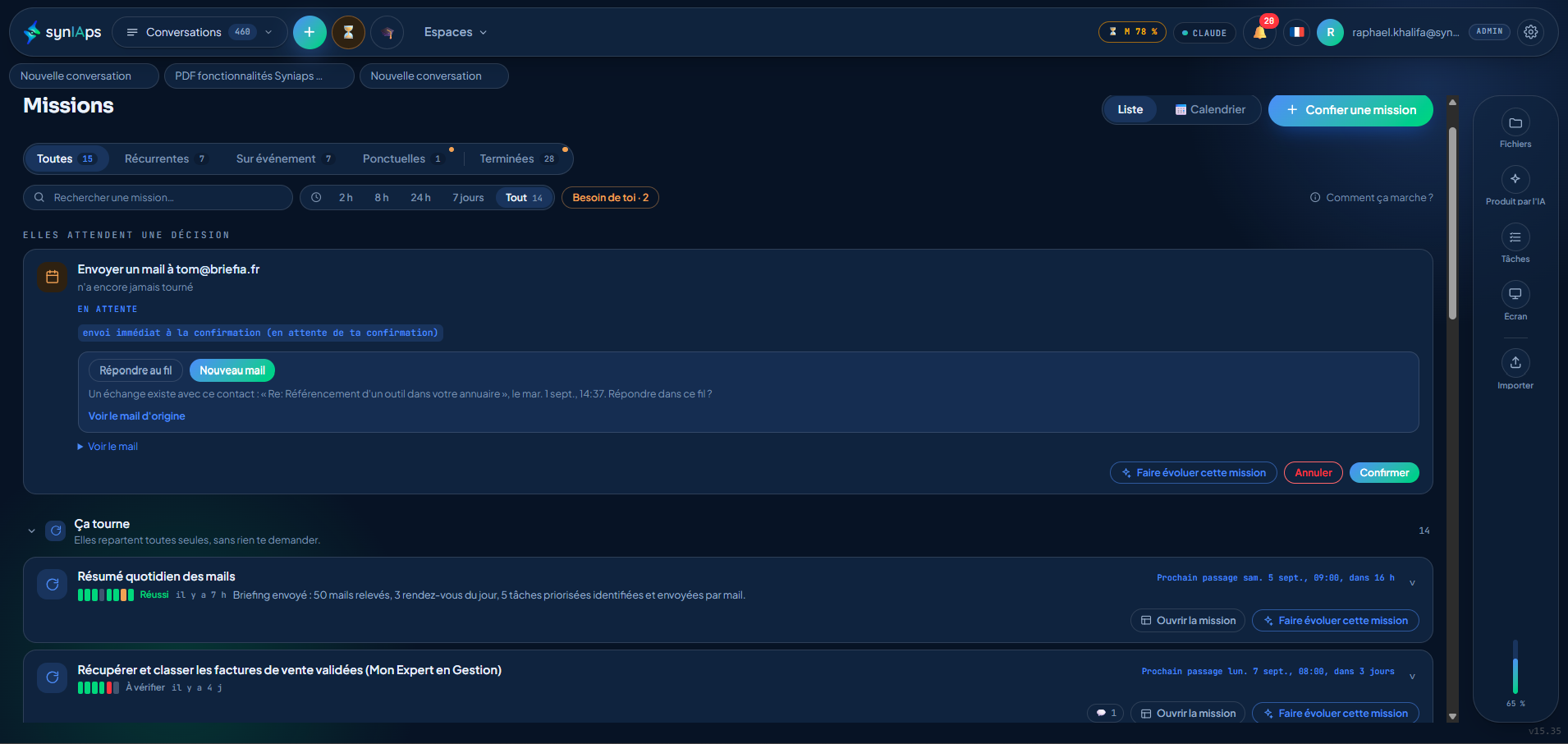 The day's missions: what ran, at what time, and what is still waiting for approval.
All of it happens server-side, nights and weekends included, even with the computer switched off.
Outbound sales follow the same logic and give the best measure of what plain-language instruction changes. The LinkedIn campaign runs by itself, sixty messages a day at most, one every three minutes. There is no dashboard setting behind that: a sentence dictated to the tool, reason included, do not get banned from the platform. The same agent reads a contact's LinkedIn profile before writing to them, prepares draft replies for incoming email and acknowledges messages arriving on WhatsApp.
Content production closes the loop. Ideas become drafts, drafts go for approval, and posts go out on their own at the scheduled time on LinkedIn, Instagram or Facebook. One request made during the demonstration captures the shift better than any pitch: produce a one-minute video, a presentation website, and the visuals to illustrate it. A single instruction, three deliverables of entirely different kinds.
Then there is customer support, wired to the contact inbox. The message arrives, the agent looks for the answer in the company's own documents and replies in the thread, sourced, signed in the director's name. Anything that commits the company, a dispute, a refund, a cancellation, personal data, leaves the automatic path and goes to a human.
What happens when the machine gets it wrong
This is the question that decides adoption or refusal, and the Syniaps answer is structural before it is declarative. The agent does not check its own work: verification happens in the platform, outside it. An agent that polices itself validates its mistakes with the same confidence as its successes.
Validation cards come on top. Before acting on a website, sending an email to a third party, publishing or paying an invoice, the action is prepared and then held for a human gesture. The control can be lifted on personal messages while remaining in place on business ones.
Le brief IA que les pros lisent chaque soir
Les 7 actus IA du jour, décryptées en 5 min. Gratuit.
Inclus dès l'inscription : notre sélection des meilleurs guides & comparatifs IA.
Choisissez votre rythme
Gratuit · Pas de spam · Désabonnement en 1 clic
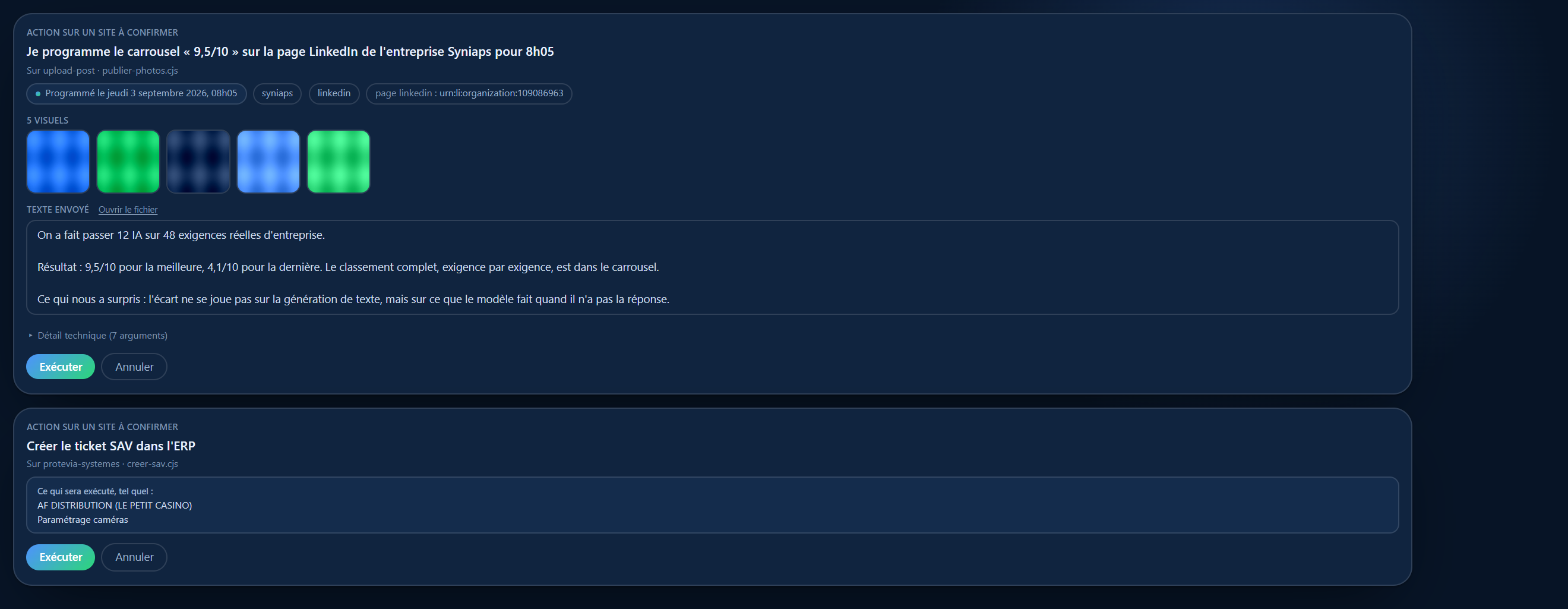 Before acting on an external site, the agent stops and asks for explicit confirmation.
The same mechanism fires when an expert agent wants to join a conversation in progress, or when the memory of an exchange approaches its limit: the user is warned rather than presented with a fait accompli.
The same logic governs permissions. The director opens the accounts personally and assigns each person a profile in one of three regimes, open, framed or strict, with their own skills and folders. Everyone keeps a private vault while the memory foundation stays shared: an intern does not get the same AI as the sales director, but both draw on the same company knowledge.
When the business software has no API
These automations usually hit an obstacle every IT department knows: most line-of-business software exposes no programming interface at all, and is therefore out of reach.
Syniaps connects anyway. It asks for a username and a password, then navigates the site as an employee would. What follows is cleverer: during that first pass, it records the technical requests its own navigation triggers, and on subsequent runs it no longer imitates anyone, it calls directly. It learns the route once, then does without it. Credentials stay in a vault on the client's server, so the connection work done by one person benefits the whole team.
Raphaël Khalifa compares that first pass to an intern arriving in front of an unfamiliar tool: it explores, and it may well come back saying it could not find its way.
The most telling demonstration touches day-to-day management. The accounting software used internally exposes no interface either: the agent signs in like any other user, edits an invoice, works the screen in the operator's place, and runs entire missions there, without a single technical shortcut having been built for it. The same logic applies on the Microsoft Azure console, where saying out loud what you want switched on or off is enough to make the change. A non-specialist can therefore configure a platform with a reputation for hostility without mastering its vocabulary. The reach goes beyond the example: any company ERP, any supplier portal becomes addressable.
Correct it once, for good
This may be the most underestimated mechanism in the product, and the one that decides whether it survives past the first months.
Asked to prepare the day's meetings, the agent produced a first, incomplete version. Its founder corrected it, then explicitly asked for the skill to be updated. Since then, meeting preparation happens on its own and correctly, with nothing to re-explain. Meeting minutes followed the same path: points covered, decisions, next steps, then the follow-up email written and sent in the same movement.
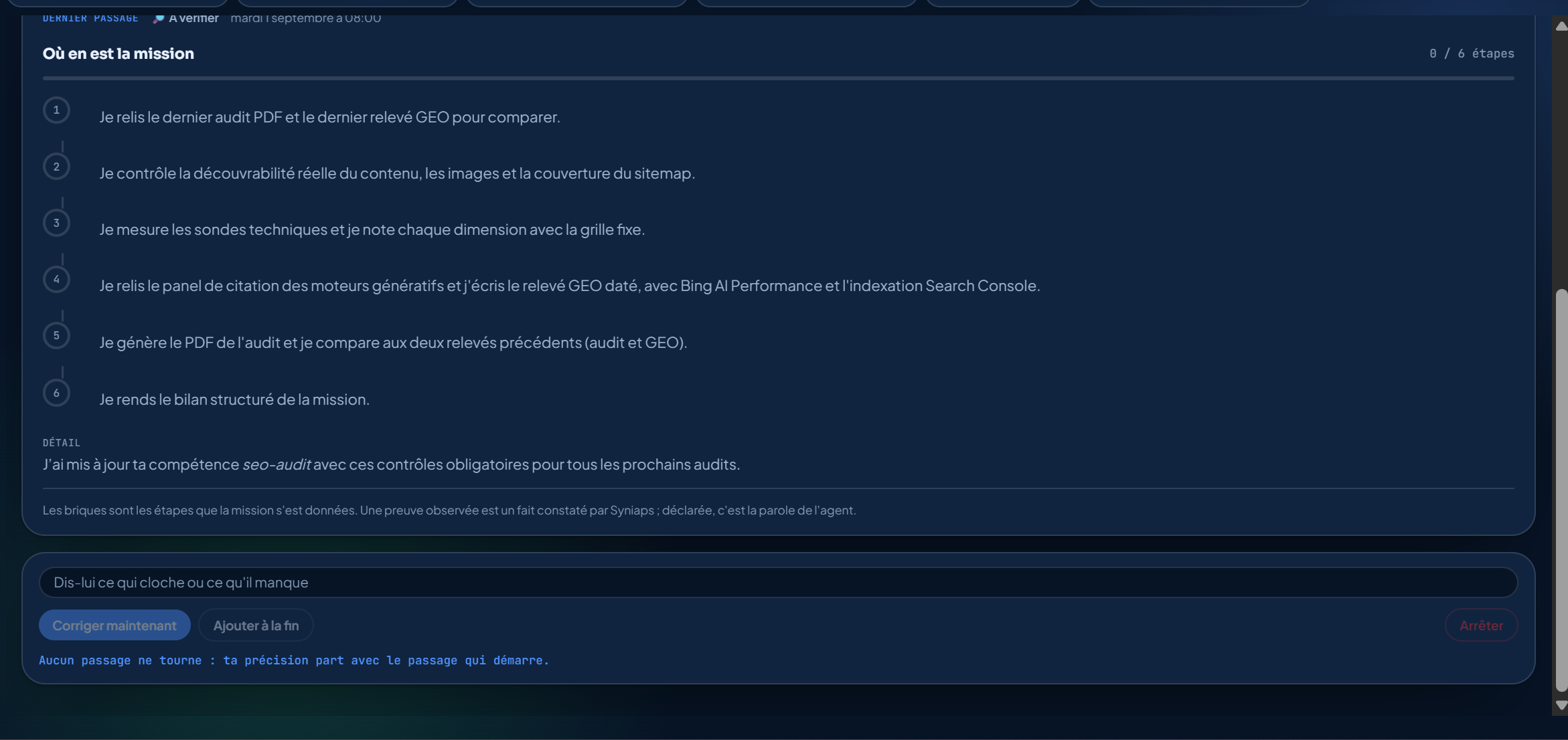 Every mission unfolds in visible steps that can be picked up and corrected: the correction becomes an acquired skill.
A tool that remembers a correction spares the company the main disappointment of AI projects, that of repeating the same instructions every week. It also produces an unexpected effect on onboarding. When a client asked for a training workshop, the founder preferred to put the question to Syniaps; the next day, she had built her automation herself. The AI agent is its own user manual.
Ten experts rather than a menu
The product does not present itself as a list of features but as an org chart. Ten experts are embodied in it, each in their own field: finance, sales, marketing, communication, human resources, general services, legal, digital, production and delivery, and quality. Each has its own scope and deliverables, and each can ask to join a conversation in progress when the subject concerns it.
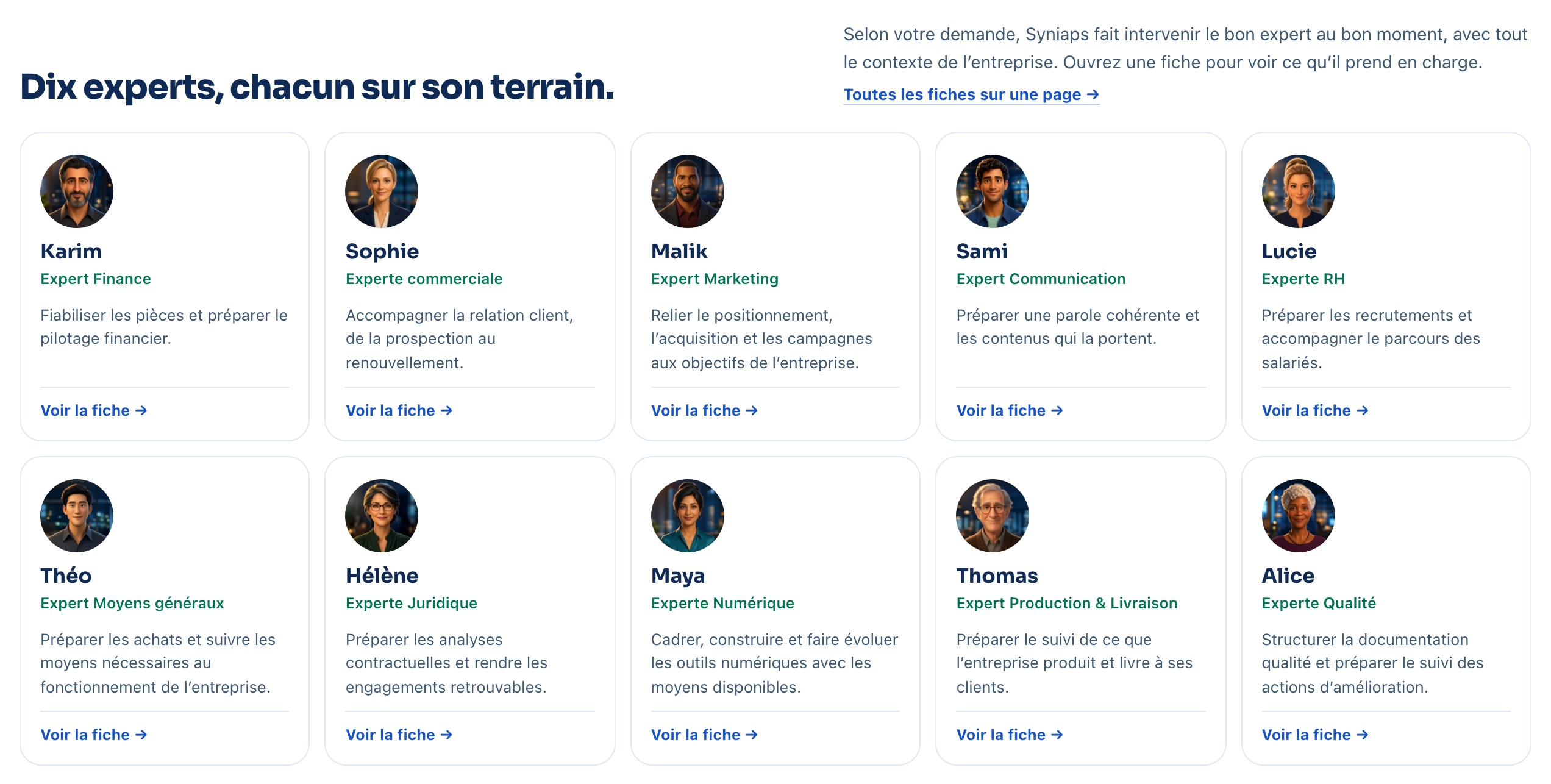 "Ten experts, each in their own field": the Syniaps experts, from finance to quality, each with its own profile.
Voice input carries the logic all the way, and it is the most unexpected function in the product. You call Syniaps, an assistant named Claire picks up, and the experts take over depending on the subject: Malik for marketing, Vincent for search, Hélène for legal, Karim for accounting. Each has a face, chosen from a library of some fifty portraits.
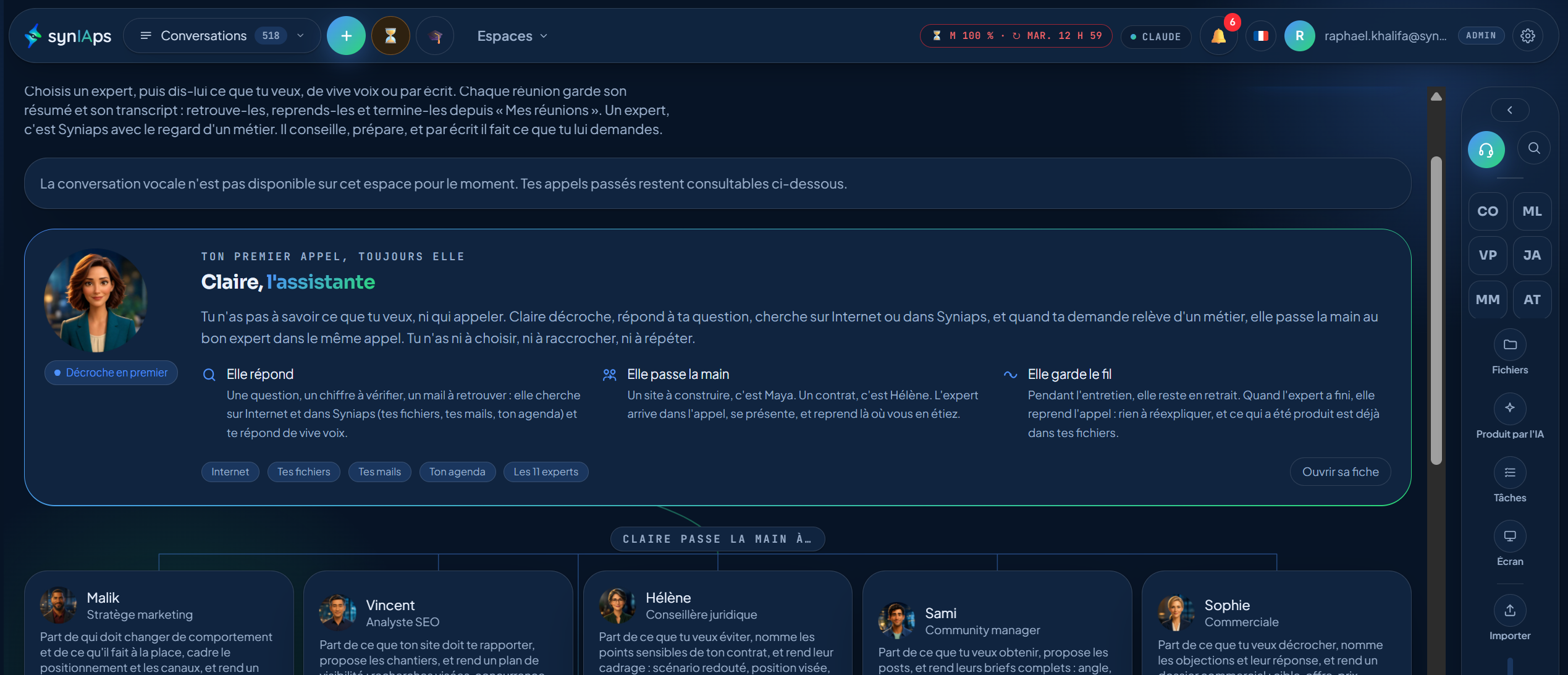 Claire picks up first, then hands over to the expert for the subject, within the same call.
Crucially, this is not dictation. Ask about search visibility and the expert wants the objective, the competitors to watch, the priorities, the deadline, running through a professional's checklist before writing the full brief itself. The product solves a problem few companies know how to name: most get nothing out of artificial intelligence because they do not know what to ask it for.
The best measure of that accessibility does not come from the professional world at all. The founder's son, eight years old, wanted a game on Roblox. He talked to the Architect, which drew a specification out of him, and the game runs on PlayStation today.
And when the software simply does not exist
That game is not an isolated curiosity. It is the same mechanism, applied this time to the company: you describe a need in plain language, you answer a few questions, and out comes a working application.
What separates Syniaps from the app factories that appeared this year lies in what happens next. The tool it produces is not a folder of code to deploy somewhere: it is hosted on the platform, and online as soon as it is ready. No server to rent, no release to schedule, no developer to pull in just to make available a tool the team needs next week.
The vendor demonstrated this on its stand at the French Tech trade show. The visitor answers three questions, what takes up most of their time, what they would automate first, what they would like built, and construction starts during the conversation. By the end of it they receive, by email, a site built for their trade out of what they have just declared.
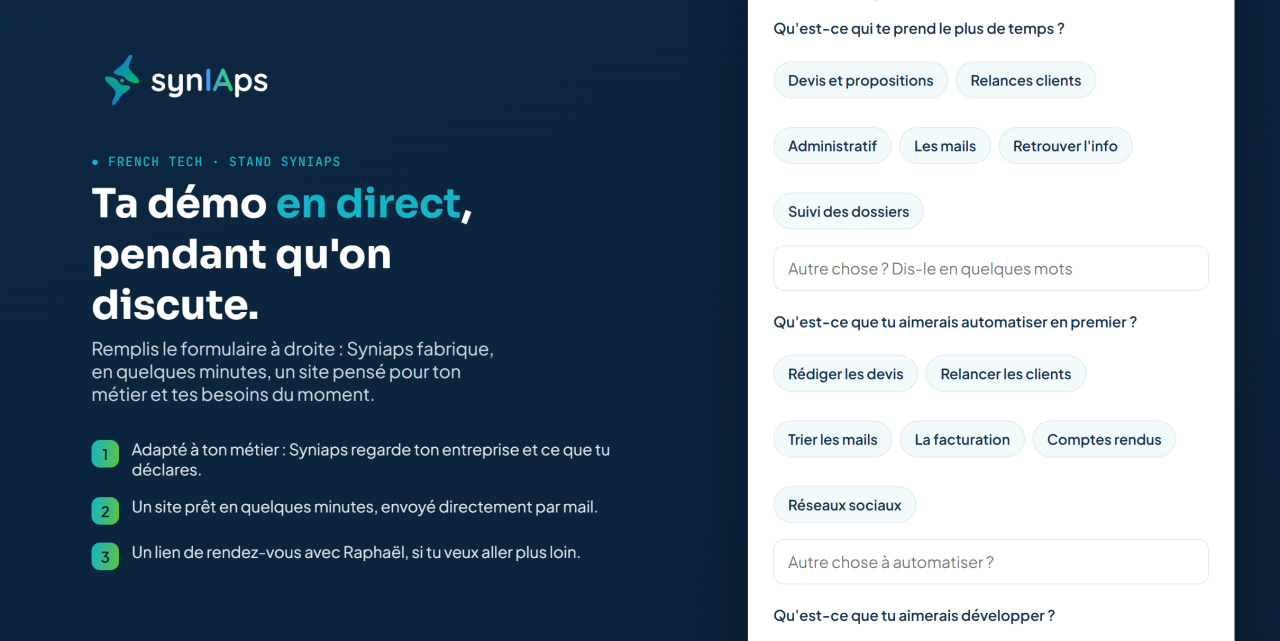 The trade show demo page: three questions, and construction starts during the conversation.
The point is not the speed record, it is the trade-off it shifts. A prospect tracker, a registration form, an internal dashboard: those tools are missing not because they are hard to write, but because no IT department opens a project for a three-week need. When the cost of trying drops to that of a conversation, the arithmetic changes.
Try Syniaps for thirty daysNo commitment, no card charged. Dedicated server, hosted in France.
Pricing that follows the memory, not the size of the company
The offer is not cut for one segment of business in particular: what separates the four monthly plans is the volume of memory required, not the size of the organisation subscribing. Axon at 165 euros excluding tax for a single person and 10 gigabytes, then Neuron at 299, Synaps at 399, the most subscribed, and Cortex at 499 for large volumes, with a 15% discount on an annual commitment. Companies will want to watch one line: beyond the entry plan, each additional user costs 100 euros a month. The trial runs for thirty days, with no commitment and no card charged.
What really sets the offer apart is not in the price grid. Every client company gets its own machine, dedicated, hosted in France, whose resources grow with the plan and whose storage extends without interruption of service. Not an account on a shared server: a dedicated server. Encrypted backups go to OVH, in France as well, which the company's legal notices confirm. The company also states that it never trains a model on its clients' data.
That architecture answers the question every vendor building on models it does not own has to face: what happens the day the supplier changes the rules? At Syniaps, the engines are interchangeable, including mid-conversation, and what survives the switch is the memory, the rules, the missions and the connections. The argument holds. It will only be proven the day an engine actually has to be changed, and that day has not come.
Pricing, features and alternatives are gathered on Syniaps's page in our AI tools directory, in French.
 Raphaël Khalifa, founder of Syniaps, in Marseille.
What the vendor says about its first customers
Syniaps is a young product, open for a few months, and the company prefers to put forward a usage figure rather than a licence count: 80% of the companies that have tried it have, according to the vendor, folded it into their day-to-day operations.
The Syniaps bet will be settled above all on the trust a small organisation is willing to place in an AI system for missions it has until now kept under its own eyes. On that point, the memory itself is available instantly: it is the link between records, what brings a client close to their contract or a person close to their organisation, that builds up shortly afterwards.
Nor does the tool ask for a blank cheque: every mission stays inspectable in detail, step by step, with a dashboard tracking what is running, what has just finished and the result. Nothing escapes the director's eye, it simply moves from the screen to a tracking board.
The company will find in the product an argument few vendors can make: the business selling it uses it to sell itself, down to preparing the briefs for its own sales meetings.
The editors' verdict
We see a lot of tools promising to save time. Syniaps does something else: it takes work away.
The difference lies in the memory. Retrieving a document, plenty of tools can do. Pointing out that an invoice is made out to an individual and will therefore open no right to reclaim VAT is the move of a colleague who knows the house. We have rarely seen software reach that level of understanding of a business so quickly.
What wins you over next is that the correction sticks. You take the agent up on something once, ask it to record the lesson, and the mission runs straight the following time. Plenty of AI projects die from the sheer fatigue of re-explaining things every week; here the question does not arise.
Then there is the way it works around the absence of an API. Signing into accounting software the way an employee would, learning the route once, then doing without it: it is the most concrete answer we have read to the lock that keeps most French companies away from automation. All at once, the software estate everyone assumed was out of reach becomes addressable again.
The product is young, the team is in Marseille, and the ambition goes well beyond what the price grid suggests. It is the kind of software you want to come back to in a year to see how far it got. In the meantime, thirty days is enough to form a view, and the memory starts building from the moment the storage is connected.
Try Syniaps for thirty daysSyniaps is published in Marseille by a company founded in September 2025. The trial starts from their site.
Brief IA — L'actualité IA en français
L'essentiel de l'actualité de l'intelligence artificielle, décrypté et expliqué chaque jour.