A2UI: Google's Ambition for a Unified Agent UI
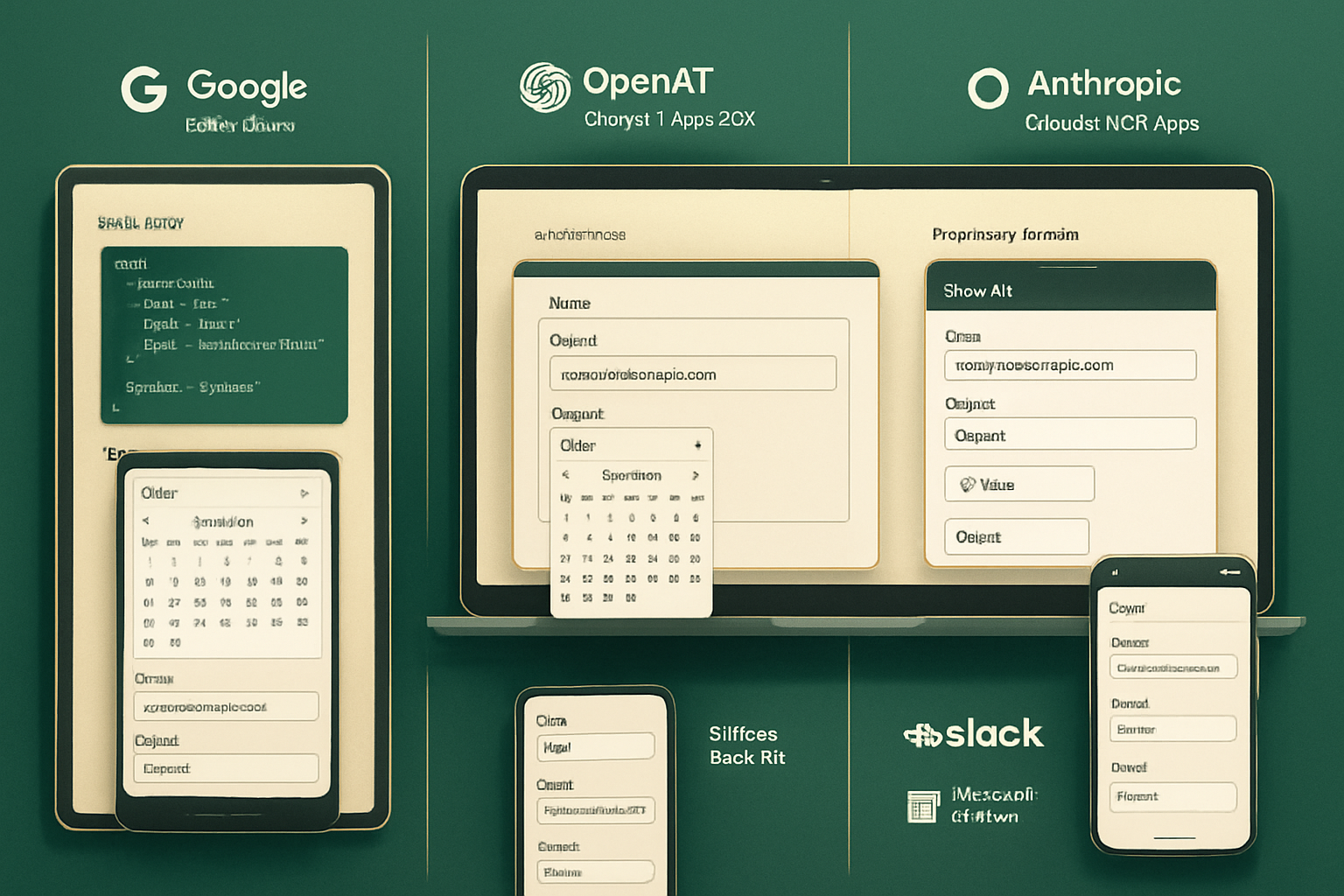
Major clients of AI agents are multiplying rendering methods, from declarative JSON to sandboxed pages. Google is promoting A2UI, a specification introduced in December 2025 that is not owned by any vendor, while Slack and Microsoft rely on their proprietary formats. Here’s an overview of the approaches, their adoption, and known technical constraints.
The Cost of the Canvas and the Dispersion of Approaches
While the discussion thread with an input field and a stop button has now stabilized into a form rendered similarly across clients, the canvas concentrates costs. Google offers Dynamic View in Gemini, OpenAI has Canvas in ChatGPT, and Microsoft renders application interfaces from the Copilot chat to Teams, Outlook, Word, and Excel. In a November 2025 assessment conducted by Google, sites designed by human experts ranked higher than those generated, and generation can take a minute or more. The assembly at execution assumes a list of shared components, which each vendor currently maintains separately. Meanwhile, the only way to maintain control over the appearance on the server side is to deliver a page that becomes a webview on mobile, while declarative options leave styling to the client.
Two Technical Paths: Declarative JSON or Sandboxed Page
One path uses application/a2ui+json and renders locally via an embedded engine, with Google releasing three combination models in June 2026. In this context, OpenAI ChatGPT renders applications via the Apps SDK, and the editor provides the CSS, while Anthropic Claude hosts MCP applications and displays their artifacts with its own rendering. The other path delivers a page in a sandboxed iframe (text/html;profile=mcp-app). This page does not become a SwiftUI sheet or Jetpack Compose and translates on mobile to a webview, with non-native scrolling, an unsuitable keyboard, Dynamic Type ignored, and a distinct VoiceOver reading order. Integrating an A2UI engine into such a page brings the vocabulary of components but not native widgets.
What A2UI Offers and Who is Already Using It
Introduced in December 2025, A2UI presents itself as a declarative format where the agent sends a JSON listing components that the client already knows from its catalog, without markup or styles transmitted. Its version 1.0, still a candidate, adopts constructions reminiscent of HTML from 1999 and is presented as a non-proprietary proposal. Three applications render it without a bundled engine, relying on multiple options. Google Gemini Enterprise displays a standard set of A2UI components with a style defined by Google; Google Opal uses it for mini-applications described in natural language, and OpenClaw Canvas renders interfaces built by the agent on connected devices with a style managed on the plugin side. At the developer level, Google’s ADK Web, Flutter GenUI SDK (alpha), CopilotKit AG-UI, and Vercel json-render exist but with little reported activity. Claude and ChatGPT offer mechanisms resembling A2UI via iframes. The list of community renderings covers SwiftUI, Jetpack Compose, React Native, Vue, and Lynx. Version 1.0 removed theme properties from payloads, with a button only carrying a primary variant, and documentation recommends checking compatibility as many mobile renderings are maintained voluntarily.
Le brief IA que les pros lisent chaque soir
Les 7 actus IA du jour, décryptées en 5 min. Gratuit.
Inclus dès l'inscription : notre sélection des meilleurs guides & comparatifs IA.
Choisissez votre rythme
Gratuit · Pas de spam · Désabonnement en 1 clic
Facing Established Proprietary Formats
Proprietary solutions exist and are deployed at scale. Slack relies on Block Kit, structured in blocks, elements, and composition objects in JSON, where the server sends the structure that Slack renders in messages, modals, and home tabs, with ceilings of 50 blocks per message and 100 per modal. Microsoft favors Adaptive Cards, platform-independent UI snippets written in JSON, rendered by seven official SDKs (JavaScript, .NET, .NET WPF, .NET HTML, Windows UWP, Android, iOS) and a community-supported React Native; Teams documents a vast taxonomy of cards, and styling is governed by the host configuration. These systems are under the control of their publishers; Microsoft employs seven of its eight maintainers on the rendering side.
A Historical Context of Fragmentation and Consolidation
The late 1990s saw Netscape and Microsoft proliferate incompatible tags like document.layers and document.all, forcing sites to embed browser detection and separate layouts. Internet Explorer 6 then dominated, and web progress slowed for five years, before Firefox refocused on specifications and Chrome arrived in 2008. Chrome accounts for nearly 68% of the browser market according to Statcounter in July 2026. Today’s agent UIs aggregate clients like ChatGPT, Claude, Gemini, Copilot, and Slack, along with Grok and Perplexity. Without a standard, developers must maintain separate implementations or adapters depending on the host. MCP-UI mentions Postman, Hugging Face, Shopify, and ElevenLabs as adopters, and adapters already exist.
What Some Consumer Clients Do Not Cover
On the consumer side, Google Gemini does not support these mechanisms in its consumer client and relies on an interface generated on demand by the model. In contrast, xAI Grok does not display a format interface and exposes tools without a dedicated surface. In declarative approaches, a component absent from the host system cannot appear, which A2UI 1.0 formalizes by defining surfaces, components, and catalogs as JSON pointing to pieces owned by the client, presented by Google as a declarative data format rather than executable code.
Brief IA — L'actualité IA en français
L'essentiel de l'actualité de l'intelligence artificielle, décrypté et expliqué chaque jour.