AgenticSTS: AI Excels at Slay the Spire 2
AgenticSTS: AI Excels at Slay the Spire 2
AI agents are achieving victories in Slay the Spire 2 after researchers replaced the growing chat logs with a structured memory.
State-of-the-art models have repeatedly failed in the digital card game Slay the Spire 2. A new memory architecture shows that the problem lies not so much in the model itself, but in what it retains from previous moves.
A New Approach to Memory
What percentage of its past conversations should an AI agent even see when pursuing a goal through hundreds of decisions? The AgenticSTS project, developed at Alaya Lab in collaboration with Shanghai Jiao Tong University and other institutions, flips the usual answer on its head. The agent never sees its own chat log but reconstructs each decision from a fixed catalog of carefully organized information.
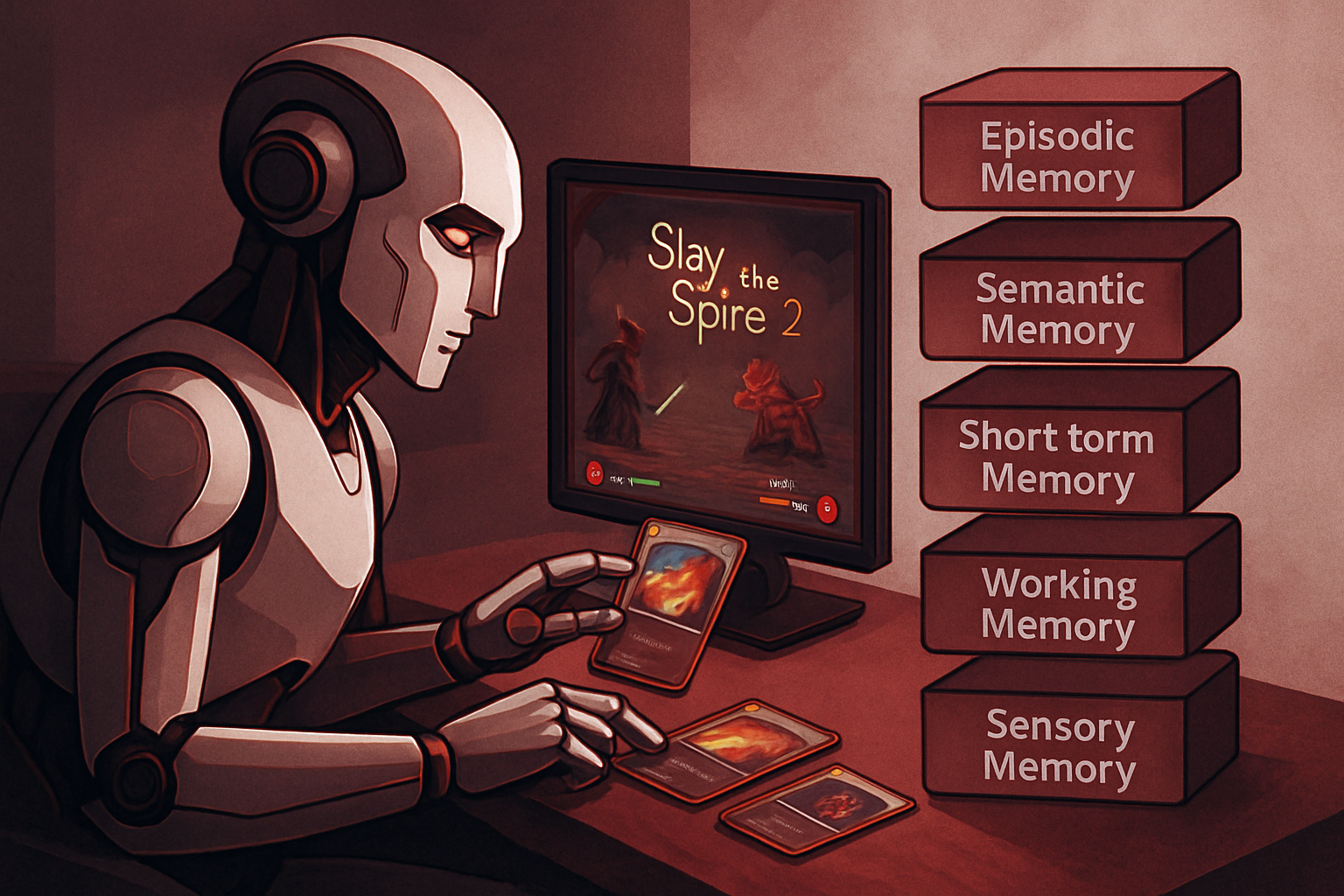
AgenticSTS does not maintain an ever-expanding log. It reconstructs each decision from five layers of organized memory.
A Test with Slay the Spire 2
The researchers chose the deck-building roguelike Slay the Spire 2 as their testing ground. A single game involves hundreds of decisions, ranging from card choices and combat planning to route selection on the map and item purchases. The rules are entirely text-based, randomness is high, and games are lengthy. According to the developers, human players win 16% of the time at the easiest difficulty level, A0. The state-of-the-art models used in the AGI-Eval assessment did not win any games across five tested configurations. The game is challenging but open enough for architectural differences to manifest clearly.
An Effective Memory Structure
Typical LLM agents like ReAct or Reflexion add past observations, tool calls, and self-reflections to the next prompt. The context grows at each step until the window overflows or the model's attention dilutes. AgenticSTS does the opposite. For each decision, the prompt is constructed from five clearly separated locations.
The five locations in detail:
- L1: fixed protocol instructions
- L2: state schemas with currently valid actions
- L3: retrieved game rules
- L4: summaries of previous games
- L5: strategic skills triggered for specific situations
Anything the agent wishes to retain from a previous decision must first be written into one of these storage areas. This keeps the prompt short, regardless of how long a game lasts, and since each layer is addressed separately, researchers can identify which component actually enhances performance.
Le brief IA que les pros lisent chaque soir
Les 7 actus IA du jour, décryptées en 5 min. Gratuit.
Inclus dès l'inscription : notre sélection des meilleurs guides & comparatifs IA.
Choisis ton rythme
Gratuit · Pas de spam · Désabonnement en 1 clic
A Skills Library That Doubles the Win Rate
For the main comparison, the team ran five configurations against each other, with ten games each at the easiest difficulty level, A0. Without any memory layer, the agent wins 3 out of 10 games. Once the skills library L5 is activated, storing tactical rules for recurring situations, the win rate climbs to 6 out of 10. This remains true whether the skills were written manually or generated from models.
When the agent continues to learn between games, it reaches Ascension levels A6 to A8. Without this memory, it caps out at A2 to A4.
Token Costs Reveal the Real Gap
More interesting than the adjustments made to the team's own codebase is the comparison with two publicly available Slay the Spire 2 agents that follow the classic growing transcript model, STS2MCP and CharTyr. All agents used Gemini 3.1 Pro for strategic decisions. None of the competitors won any of their 5 games.
The cost figures are even more striking: for every point scored by the two competitors, they send 66 to 90 times more tokens to the language model than AgenticSTS. The reason is the growing log. In STS2MCP, a single model call near the end of a game reached around 527,000 tokens, as the entire game history is sent back with each new decision. AgenticSTS keeps the actual user text to about 5,000 tokens, regardless of the game's length.
What Remains to Be Done
The team has not yet conducted the true test: running a context accumulating within the same codebase using the same scoring. The key metrics are based on 50 games, and so far, only one character (Silent) has been tested on a single game version. It remains to be seen if the approach works for other characters and updates.
The team is publishing 298 complete games, frozen memory snapshots, and evaluation scripts on Hugging Face, so that other research groups can test alternative memory architectures in the same environment. The actual claim of the article is more modest than the figures might suggest when compared to the competition. By dividing an agent's memory into clearly named layers, it becomes possible to later determine which layer influences which behavior.
Research on effective memory for AI agents is a very active field right now. The growing chat log at each turn makes models slower, more costly, and less accurate. Researchers call this problem "context rot."
AgenticSTS is not alone in tackling this issue. Anthropic uses Memory Tool and Context Editing to automatically remove outdated tool outputs from the context and store important information in external files. In their own tests, this reduced token usage for a web search of 100 turns by 84%. The Chinese framework GAM divides archiving and retrieval between two specialized agents. The open-source framework Mastra condenses conversations into concise text notes stored outside the context window, modeling how humans manage memory.
Brief IA — L'actualité IA en français
L'essentiel de l'actualité de l'intelligence artificielle, décrypté et expliqué chaque jour.