AI Agents: Five Functions Already Automated
Le brief IA que les pros lisent chaque soir
Les 7 actus IA du jour, décryptées en 5 min. Gratuit.
Inclus dès l'inscription : notre sélection des meilleurs guides & comparatifs IA.
Choisis ton rythme
Gratuit · Pas de spam · Désabonnement en 1 clic
Agentic AI is no longer a laboratory concept: autonomous systems are now executing entire segments of work in support, software engineering, logistics, healthcare, and finance. Industry reports mention productivity gains and a shift of humans towards supervisory roles. Here’s what these agents are doing concretely and the frameworks available for their deployment.
Execution tasks shift to agents, supervision to humans
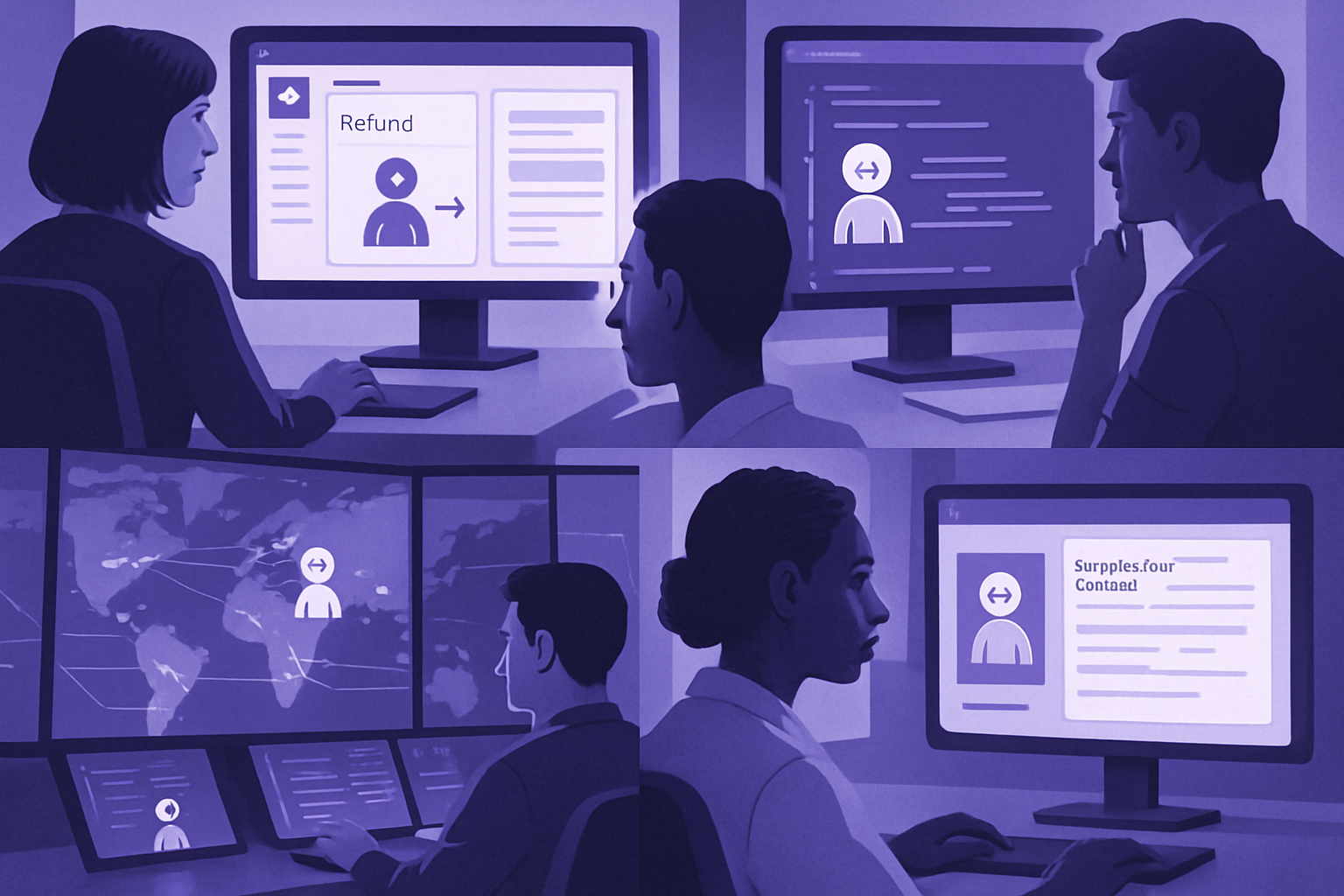
The shift described moves from tools that respond to queries to systems that actually perform the work. In the five relevant areas, agents absorb high-volume execution governed by rules, while humans focus on supervision, exception management, and strategy. This distribution is already operational in companies.
On the ground, the effects are measured by a significant reduction in average processing time in customer support, and by logistical responses reduced from days of coordination to just minutes. In compliance and anti-fraud, the automated drafting of reports on suspicious activities lightens the load for analysts and speeds up submissions.
According to recent industry reports, organizations adopting these agents are witnessing productivity gains and a repositioning of teams towards supervisory tasks. These findings complement direct observations of the described use cases.
Banks: KYC, “block/allow” decisions, and automated SAR reports
Rule-based systems produce numerous false positives in finance, overwhelming compliance teams and obscuring genuinely suspicious signals. Banks are now employing agents capable of conducting contextual investigations on alerts, with faster and more accurate decisions than historical engines.
These agents automate key steps: accelerated KYC risk profile creation from public records, articles, and business databases; immediate “block/allow” arbitration based on customer history, location, and telemetry, with a documented audit trail. In cases of confirmed fraud, they draft suspicious activity reports, easing the compliance workload and speeding up the filing timeline.
For training teams, dedicated courses detail the training of models for anomaly detection and risk scoring in these environments.
Healthcare: ambient documentation, pre-authorizations, and post-discharge follow-up
Clinical burnout, fueled by administrative burdens, is described as a crisis. Studies indicate that doctors spend nearly as much time documenting and managing as they do treating patients. Agents are deployed to securely manage patient data, coordinate schedules, and handle the administrative layer of clinical decision-making.
In consultations, ambient documentation systems listen to exchanges, generate structured notes, and send them to the EHR, reducing post-hour data entry. For insurance pre-authorizations, agents cross-reference treatment plans and payer policies, submitting files in minutes that previously took days in manual processes.
After discharge, agents contact patients via text or voice, escalate anomalies to a nurse, and detect complications earlier than a traditional follow-up schedule. Dedicated frameworks already exist to operate these multi-step clinical flows within a HIPAA-compliant framework.
Logistics: rerouting in minutes and agent-driven inventory management
In the supply chain, multi-agent systems monitor global data flows and reroute shipments as soon as a disruption is detected. What used to require several days of human coordination is now done in just minutes.
When a port becomes congested or a storm occurs, agents seek alternative routes and contact suppliers to adjust delivery slots. They also continuously manage inventory, triggering purchase orders when levels drop below expected thresholds.
On the back-office side, agents match thousands of invoices with purchase orders and shipping receipts, flagging discrepancies for review and reducing the manual effort in accounts payable. Research on multi-agent reinforcement learning describes how these systems negotiate and optimize complex logistics networks.
Support and code: from triage to pull request without human intervention
Support teams face high expectations across all channels. Agents connected to CRMs handle complete journeys: refunds, rescheduling shipments, maintaining context, and being proactive in cases of theft or delays. They draft, consult inventories, trigger returns via API, and update tickets without human action; they escalate with a summary when empathy is required or high-level authorization is needed. The average processing time is significantly reduced, allowing humans to focus on complex relational exchanges.
In engineering, agents take a GitHub ticket, read the repository, code, test, and submit a pull request, often without a developer touching the keyboard. The use of the Model Context Protocol aligns the new code with architecture and conventions, while writing and executing tests, debugging through logs, and iterating happens end-to-end.
Companies also use this to modernize COBOL or Java systems that required specialists for months. Developers, in turn, refocus on design, review, and architectural choices. Open-source projects showcase these capabilities, and guides explain how to connect models and business tools.
Available frameworks and extending use cases beyond these five areas
These systems differ from chatbots: instead of waiting for a prompt, they plan, execute, and adapt multi-step tasks via tools, databases, and APIs, without continuous supervision. The movement is set to be in production by 2026.
The five sectors presented are just a starting point. Wherever high-volume repetitive execution separates humans from important decisions, it is likely that an agent will take over. Training resources and technical frameworks exist to initiate and structure these deployments.
Brief IA — L'actualité IA en français
L'essentiel de l'actualité de l'intelligence artificielle, décrypté et expliqué chaque jour.