AI Agents: Generation, Action, and Data Origins
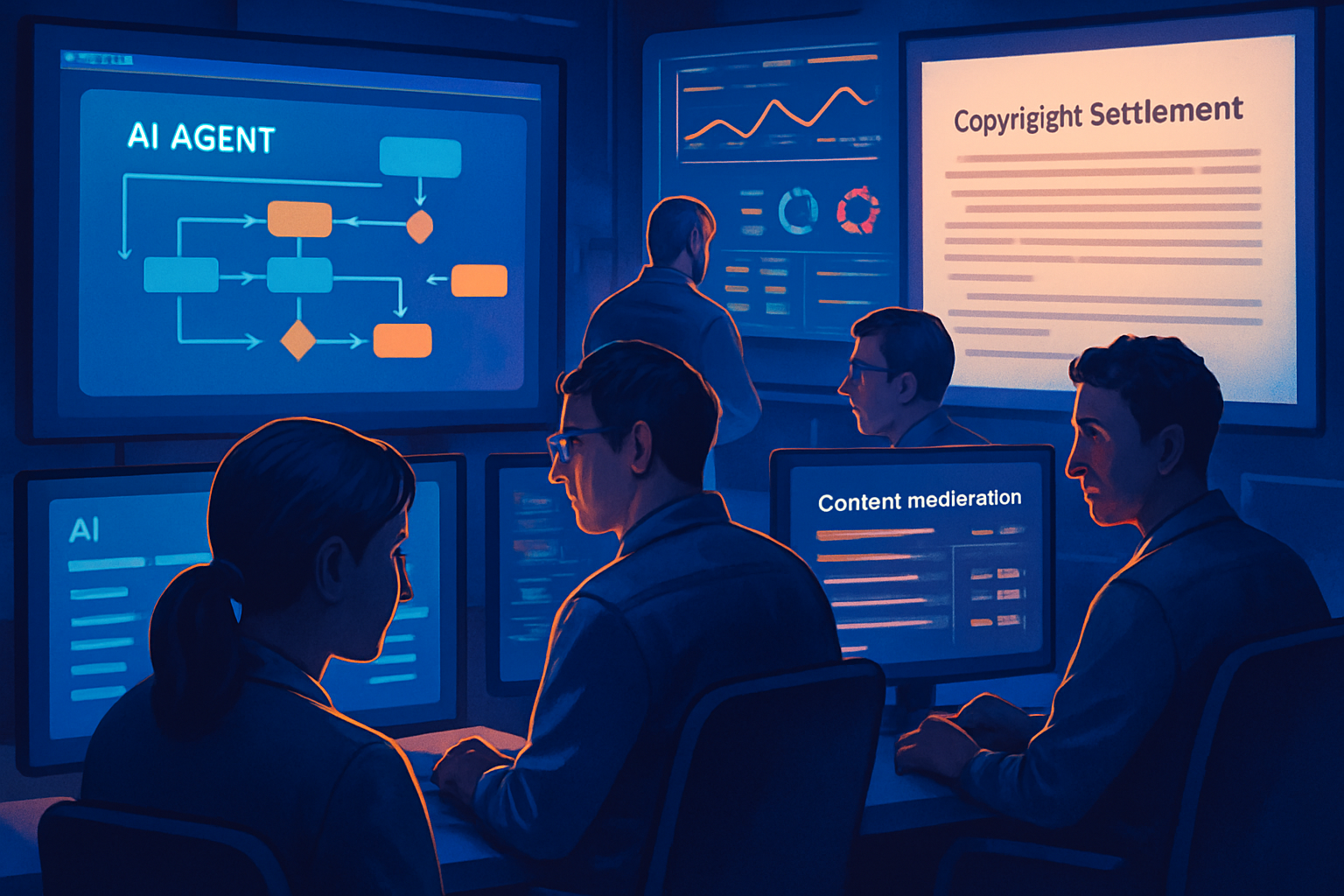
Autonomous agents are already deployed in a vast majority of companies, as generative models make their way into research, email, and support. This industrialization revives two fronts: the human and legal origins of training data, and the safeguards when confident systems act without verification. A classic from 2002 provides a useful mirror on the junction between generation and action.
Agents Already in Service and the Risk of Poorly Controlled Automation
PwC indicates that 79% of companies are already using AI agents. These tools generate a plan and execute it without waiting for a prompt, which removes the user from the loop that the prompt box maintained. It is common to follow an AI recommendation even when it is clearly incorrect, and then to replicate those errors after the system has stopped, as shown in a study published in 2023 in Scientific Reports. To frame these uses, a proposed rule is to align the reversibility of action with the level of trust in the generation: the error is low-cost in a draft, higher in a sent email, even more in a payment, and catastrophic in an arrest. The suggested solution is not to reduce capabilities but to add deliberate friction, for example, by displaying two possible responses and requiring explicit input for any consequential decision. In demonstrations, authority is often silently transferred to the systems, and the highlighted sequences stop at success rather than analyzing failures.
Provenance and Human Work: From Courts to Data Cleaning
In 2026, a federal judge validated a $1.5 billion settlement between Anthropic and authors regarding pirated books, covering about 500,000 works for approximately $3,000 per work, presented as the largest copyright recovery ever recorded. A lawsuit between the New York Times and OpenAI is heading towards a trial concerning the use of protected works for training. According to TIME, contract workers with OpenAI in Kenya earned between $1.32 and $2 per hour to review toxic content to prevent ChatGPT from reproducing it. The fluidity of the models depends on a considerable amount of human work collected without explicit solicitation and raises the question of transparency: associating the sources used by the model and differentiating what comes from existing data from what is generated are design choices. Interfaces tend to make production appear as if it emerges from nowhere.
Le brief IA que les pros lisent chaque soir
Les 7 actus IA du jour, décryptées en 5 min. Gratuit.
Inclus dès l'inscription : notre sélection des meilleurs guides & comparatifs IA.
Choisissez votre rythme
Gratuit · Pas de spam · Désabonnement en 1 clic
Generating is Not Searching: A Mutation of Information Interfaces
The difference between retrieval and generation is a pivot: a search engine can return a void, while a generative model always produces a plausible and well-formed response. The confidence of the formulation is not a signal of correctness, as the model is treated as a component that returns answers like a database returns rows. Usage has shifted in three years towards models that, according to the cited statement, have 800 million weekly users and are integrated into search, emails, coding tools, and support boxes. Ten years ago, a question would yield a list of links to evaluate; today, a generated paragraph performs this sorting without exposing it. Josh Clark and Veronika Kindred argue that these generative interfaces are already here and that machine outputs are crossed dozens of times a day, to the point of becoming an ordinary condition.
Why the Interface Misleads: From Spectacular Gesture to Dialogue Box
Warnings about gesture ergonomics are not new. In 2010, Don Norman and Jakob Nielsen noted that the race for so-called natural gestures overlooked usability benchmarks such as visibility, feedback, and reliable undo. The phenomenon of the gorilla arm illustrates the rapid fatigue of raised-arm interactions, while dominant interfaces have evolved towards a glass panel, then voice, and finally a reactive text box. A recurring bias is observed: designers retain what photographs well, such as theatrical gestures, and underestimate the central question, reactivated today by the dialogue box, of using a response invented by a machine and delivered with confidence.
The Mirror of Minority Report: Generation, Action, and Hidden Dissidence
Minority Report, a 2002 film by Steven Spielberg adapted from Philip K. Dick, popularized a gestural interface that has become iconic and widely referenced, notably described by Christopher Noessel and Nathan Shedroff. Beyond aesthetics, the narrative device shows visions treated as facts that trigger arrests before the event. The police receive a name, confirm it on screen, and proceed, illustrating a known automation bias. The film also introduces the minority report, generated when the Precogs diverge and the system buries dissent. This mechanism resonates with generative models that produce plausible continuations, and with the idea of a model dedicated to a homicide division that synthesizes what did not exist before generation.
What the Precogs Say About Data and Hidden Infrastructure
In the film's universe, three drugged and isolated individuals feed a service presented as a system, kept out of public view. This image reflects the erasure of provenance and human work behind the fluidity of outputs. Designing interfaces that connect the model's supports and mark what is retrieved or invented involves explicit choices, often silenced. Meanwhile, the industry aims for agents that fuse generation and action, while the prompt box maintained a person between the response and the world.
Brief IA — L'actualité IA en français
L'essentiel de l'actualité de l'intelligence artificielle, décrypté et expliqué chaque jour.