AI Agents: Security is Structured by Checkpoints
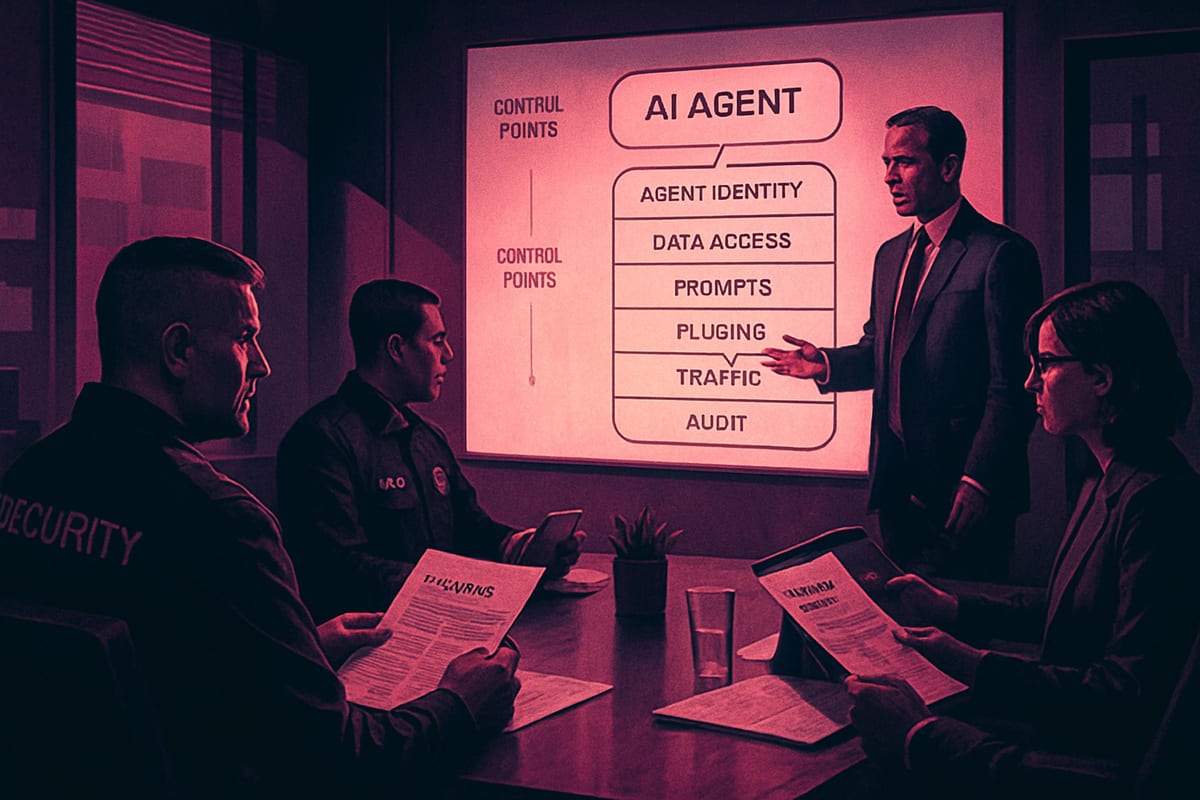
The protection of AI agents does not fall under a single category of "AI security." Recent operations and specialized areas outline a control chain: identity, data, prompts, plug-ins, traffic, and auditability. Established providers and startups are prompted to specify the link they address.
Deals and Funding Marking a Layered Market
Kiteworks has acquired the Israeli startup Bonfy.AI, which specializes in real-time data classification and policy enforcement. Meanwhile, Huskeys, also based in Israel, raised $27 million in a Series A led by Blackstone to develop solutions for understanding and securing increasingly complex internet traffic, including that generated by autonomous systems. These initiatives illustrate the trend towards segmenting the market into distinct security layers, rather than a comprehensive approach to AI security. The main opportunity is emerging around specific control points, rather than a single category.
Anticipated Control Areas and Potential Players
Several control points are emerging as priority targets: the identity of agents, access restrictions to data, governance of prompts, regulation of MCP servers, plug-ins, traffic, and auditability. In this context, identity providers could extend governance to autonomous agents. Data security specialists may be called upon to precisely control the information accessible to agents. Cybersecurity platforms, cloud companies, and enterprise software publishers could integrate agent security capabilities directly into their products.
Le brief IA que les pros lisent chaque soir
Les 7 actus IA du jour, décryptées en 5 min. Gratuit.
Inclus dès l'inscription : notre sélection des meilleurs guides & comparatifs IA.
Choisissez votre rythme
Gratuit · Pas de spam · Désabonnement en 1 clic
Why Agent Identity is Becoming a Standalone Cybersecurity Layer
The shift from experimenting with a few agents to deploying hundreds would make agent identity an additional security layer. These identities are dynamic: agents move between systems, call tools, and make decisions, making their control more complex than that of traditional users or service accounts. In this framework, dedicated permissions, monitoring, and governance are being considered, with the need to trace which agent accesses what information, connects to which systems, and whether their actions were authorized.
Powerful Uses, but an Expanded Surface to Protect for Businesses
AI agents explore the internet, generate code, access files, launch APIs, communicate with internal systems, consult databases, and send emails. These functionalities represent a significant productivity lever while extending the security perimeter to protect beyond users, endpoints, and software, to include software agents operating on behalf of the business. For entrepreneurs, targeting a general category appears too broad: the key question is to precisely identify the control point that the offering masters. In businesses, the anticipated rise of agents reinforces this need for clarity regarding the scope and responsibility of controls.
Brief IA — L'actualité IA en français
L'essentiel de l'actualité de l'intelligence artificielle, décrypté et expliqué chaque jour.