AI Agents: Three Contextual Uses, Study Insights
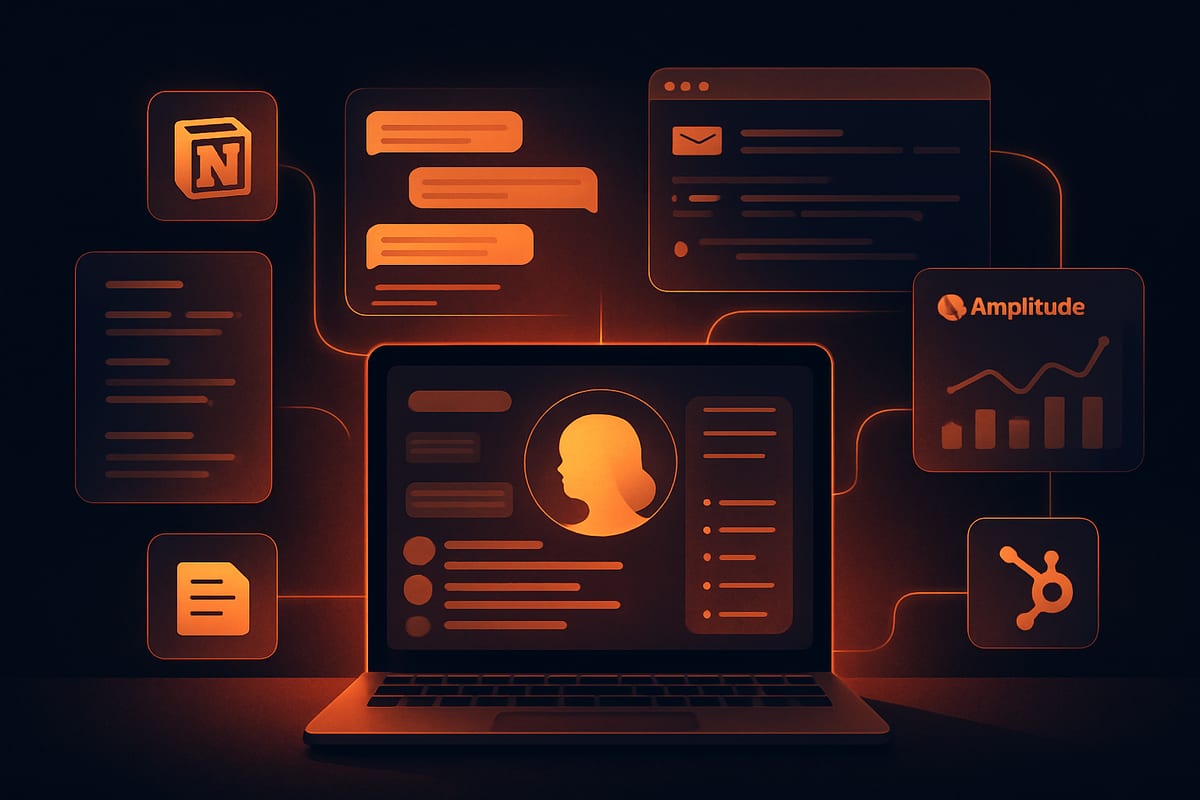
Advanced users of an AI agent distinguish a triptych of contexts — global, local, and ambient — fueled by files, databases, and live connections. Concrete examples range from meeting transcriptions to Shopify data, governance rules, and task lists generated by the agent.
Massive Ambient Streams Without Sorting, Continuously Connected to the Agent
The ambient context describes the broadest and most chaotic aspect of the informational landscape. It consists of unfiltered streams such as emails, meeting transcriptions, and chat messages, deemed valuable because they reflect actual priorities and perceptions of "good" work without the user needing to document them. In observed practice, participants neither defined, cleaned, nor formatted these streams, which primarily came from constantly evolving sources like emails or Reddit posts, routed through MCP connections. Lacking time to sort and classify into global or local, they transmitted the entire stream to the agent in hopes that it would keep up. Most transcribed as many meetings as possible and considered these transcriptions essential to their context library. Slack messages and emails, sent as received, were also deemed key and needed to be available for the agent. Some even requested the feed from about 30 popular subreddits covering AI, marketing, and business. Others linked production tools like Amplitude for continuous access to metrics. In one case, the agent regularly exported Shopify data via a script provided by a participant to update HubSpot customer profiles and track each customer's status. These streams, always active and never organized, continuously influenced users' thinking, which the agent had to take into account.
A Three-Role Typology to Structure Agent Information
The information utilized by agents is divided into three complementary roles. The global context encompasses stable elements that guide the agent's actions over interactions. The local context covers information strictly related to a task or project. The ambient context includes raw, unfiltered streams, within which the agent identifies what is relevant. Together, these roles combine like an architecture: the global serves as a foundation, the local acts as the pillars supporting execution, and the ambient forms the informational environment surrounding the work.
The Same Content Shifts from Ambient to Local Depending on Action
The role of the same information is not fixed. A Slack message may start as ambient stream via an MCP connection, then become local once the user explicitly directs the agent to it for a specific task. Conversely, an article often used as a local resource can be archived and take on the status of a cross-reference, becoming global. Some information may even, depending on circumstances, play multiple roles simultaneously.
Le brief IA que les pros lisent chaque soir
Les 7 actus IA du jour, décryptées en 5 min. Gratuit.
Inclus dès l'inscription : notre sélection des meilleurs guides & comparatifs IA.
Choisissez votre rythme
Gratuit · Pas de spam · Désabonnement en 1 clic
What the Global Covers: Profile, Rules, Corpus, and Practices
The global context is designed to endure, guiding reasoning and high-level priorities, and it evolves little. It may include specific information about the user, recorded during conversations and reused later, including on other topics. It also aggregates best practices in the form of guidelines, examples, or templates describing well-done work; one of the observed configurations included a skill titled "Build Your Own X." Governance rules specify which actions require user approval and which the agent can undertake independently; in one example, any public action and any "radical change" required permission. The global may integrate a prescriptive corpus, such as a canon of books accompanied by explicit instructions in a markdown file to frame the approach to work. Permanent guidelines for clarifying intentions may also be included, to impose questions of precision. In practice, this foundation relieves the user from having to reiterate these elements in each new session.
What the Local Covers: Lists, Histories, and Supporting Artifacts
The local context groups information directly related to ongoing work. It includes task lists by project that the agent can generate and update autonomously, stored in a markdown file or a dedicated tool like Todoist. Codified skills in markdown files are called upon to execute specific tasks. The chat history serves as conversational context, and it can be summarized and then imported into a new discussion to continue when length becomes a hindrance. Change logs automatically record, at the end of a session, the developments of each project. The local can exist in external databases: application folders were maintained in Notion, with the agent reading and updating records, while the participant never edited them directly. Research reports produced, for example, to analyze fields, later served as temporary context for targeted projects. Generally, the local is stored in media that the agent can read and modify, and part of it — lists, change logs, or decision logs — is written by the agent. It is not the final artifact of the user but a supporting device to expose priorities and progress.
Who Decides the Role and How the Agent Accesses Information
In the observed uses, each advanced user had built a context library supplemented beyond the prompt, in various forms. The role assigned to a piece of information can stem from the agent or the user. Files, such as skills accompanied by a short application description, allow the agent to autonomously identify what is relevant for the ongoing interaction and utilize it. Conversely, the user can upload a resource or explicitly direct the agent to a stored item for a specific task. When drafting a research report, best practices structure the global, the task list and research data form the local, and emails with the client as well as a transcription of exchanges constitute the ambient. The produced report is the outcome of the task, not a context, but it can later become a reference for similar projects if its quality justifies it.
Brief IA — L'actualité IA en français
L'essentiel de l'actualité de l'intelligence artificielle, décrypté et expliqué chaque jour.