AI Code Agents: Methods for Reliable Results
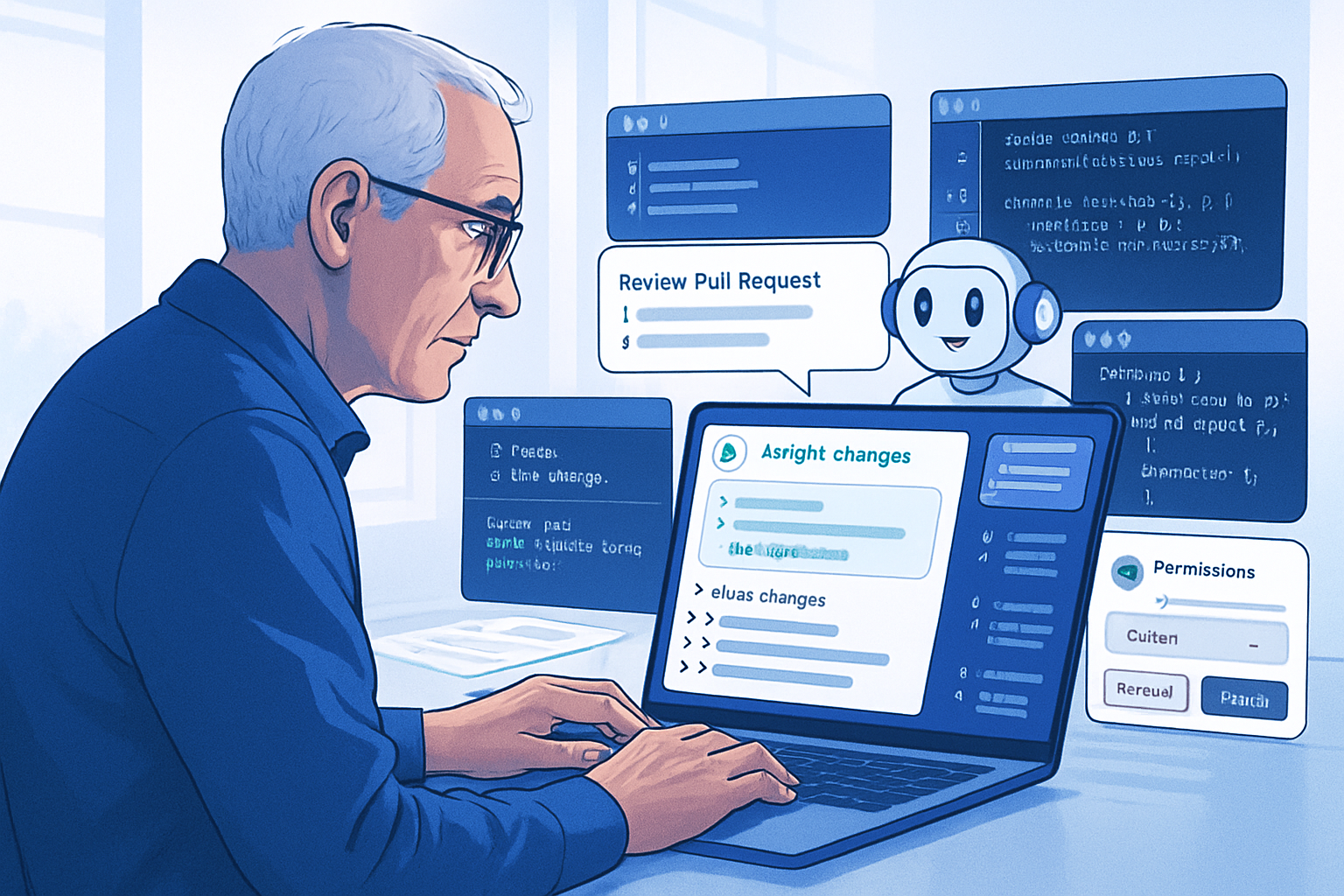
The adoption of development assistants is massive and comes with increased delivery pressure, without replacing engineering judgment, according to HackerRank. For agents to become reliable teammates, several practices stand out: concrete specifications, persistent instructions at the repository, tests as contracts, bounded permissions, and human review. Formats like AGENTS.md, already used by over 60,000 projects, and Copilot instructions structure this framework.
The Developer Retains Control Over Quality and Architecture
Teams using coding agents maintain responsibility for architecture, correctness, and maintainability. The agent can write code, explore options, refactor, and run tests, but the control of design and implementation remains with the developer to uphold quality attributes. The best results come from an explicit framework: a targeted context, an instruction file attached to the repository, examples of existing style, tests that serve as contracts, permission limits, and human review that assumes the outcome. The goal is to make it a faster execution partner within a controlled engineering flow, not to push code directly into production. In practice, better engineering discipline, rather than a model change, conditions the final quality.
Debugging and Practical Scenarios Improve Reliability
The generated code often appears correct when it is not. HackerRank identifies debugging as a core skill: with multi-file practical scenarios, failed tests, and edge cases of integration. A robust method involves first writing tests that fail, verifying their failure, and then implementing the smallest possible fix; the relevant suite is executed before closing the task, and tests are modified only in case of proven errors. This feedback loop drives the agent towards functional code rather than plausible code.
On the operations side, it is necessary to control dependencies and permissions: prohibiting the addition of production dependencies without approval, favoring existing utilities, and requiring justification along with alternatives. Agents interact with development tools and execute commands; when tooling offers hooks or controls, they should be activated. Claude Code's hooks, for example, allow for deterministic checks to be triggered at specific moments in the lifecycle.
Specify, Inspect, and Plan According to the Scope of Changes
Agents excel in execution when the target is clear. A useful specification outlines purpose, scope, constraints, relevant files, acceptance criteria, and test commands. Concrete examples may specify the URL of a page to be added, the reuse of existing components, and limitations on the database schema; acceptance criteria include the absence of console errors, metric matching with a specific endpoint, the addition of transformation tests, and the execution of lint and tests before validation.
Le brief IA que les pros lisent chaque soir
Les 7 actus IA du jour, décryptées en 5 min. Gratuit.
Inclus dès l'inscription : notre sélection des meilleurs guides & comparatifs IA.
Choisis ton rythme
Gratuit · Pas de spam · Désabonnement en 1 clic
Before making any changes to a non-trivial task, the agent must inspect the repository and summarize key points: where authentication is managed, where the bug is likely located, which tests cover the area, and what the smallest safe change is. No writing should begin before this framing to avoid a plausible fix inserted in the wrong place. Planning brings a net benefit for multi-file refactorings, database migrations, performance projects, production fixes, and anything related to security or payments; it is unnecessary for small additions of tests, simple CSS, or localized refactoring.
Institutionalize Instructions with AGENTS.md and Copilot
Rather than repeating rules in every prompt, persistent instructions benefit from living at the repository level. AGENTS.md serves as a README for agents by gathering installation, build, test, and lint commands, coding conventions, and project specifics; over 60,000 open-source projects already use it. Standard instructions can mandate the use of pnpm, TypeScript's strict mode, a preference for functional components, and the prohibition of adding dependencies without validation, along with a requirement for executed tests and a summary of modified files before closure.
On the tooling integration side, Codex reads AGENTS.md and manages overlapping directives from global to directory, while GitHub Copilot offers a .github/copilot-instructions.md file to describe compilation, testing, validation, and conventions. These instructions evolve: an initial AGENTS.md is not final. They should be revised as soon as an error appears, for example, by prohibiting any modification of generated sources to enforce schema updates or refining the testing strategy to avoid unnecessary full executions.
Structured and Concise Instructions Facilitate Use
An instruction file should not become a manual: Anthropic recommends concise, structured, and proven instructions in real situations, reminding that each token consumes useful context. In a sample of 100 popular repositories, recurring issues were identified in these files: lint leakage in 62% of cases and context bloat in 42%, as well as skill leakage and contradictions. Good files cover the essentials of the engineering cycle, naming and security rules, what should not be touched, and how to declare completion; poor ones accumulate generalities, framework explanations, inconsistent rules, and outdated commands.
To guide an agent, targeted examples are better than generic aesthetic judgment: indicating the file whose style should be followed, reusing the same error handling model, or an existing Result<T> type. GitHub's recommendations align with this: breaking down tasks, being specific, providing input-output examples, and staying aligned with best practices, which reduces ambiguity and avoids introducing a style that conflicts with the base.
Massive Adoption Increases Pressure, Not Automated Judgment
According to HackerRank, 97% of developers work with at least one AI assistant, and about a third of the code is generated automatically. This generalization increases delivery pressure but does not replace engineering expertise. The difference between smooth and frustrating usage lies in the workflow: clear objectives, precise project context, validation rules, and a risk-free iteration path. Within this framework, practical rules structure usage to transform the agent into an asset rather than a source of unpredictability.
Brief IA — L'actualité IA en français
L'essentiel de l'actualité de l'intelligence artificielle, décrypté et expliqué chaque jour.