AI Agents in Business: Set the Framework Before Scaling
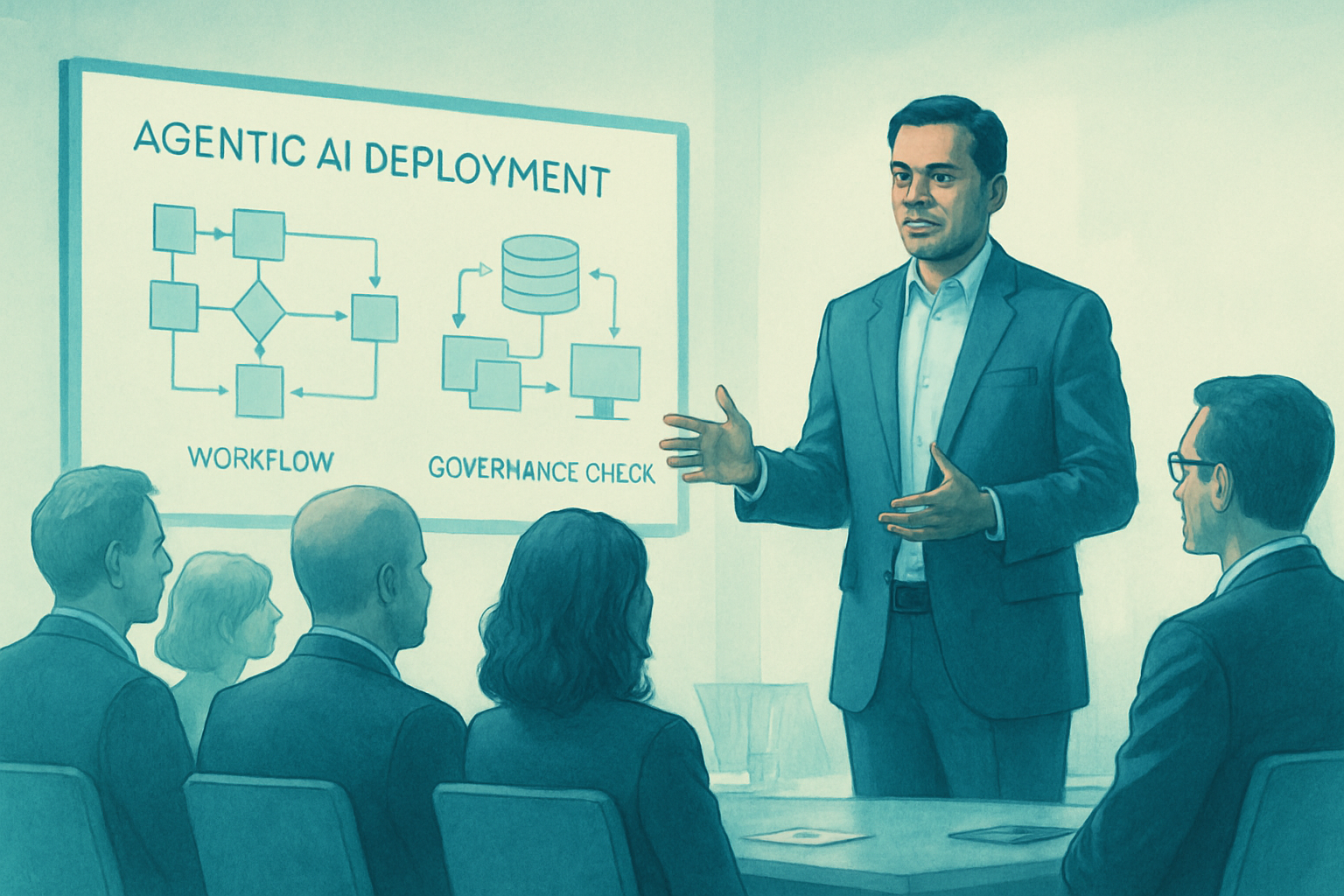
Agentic AI is making its way into businesses, but the generalization remains uneven despite an announced adoption by about 80% of Fortune 500 companies. Arun Chandra, Chief Operating Officer at NiCE, advocates for a structured approach: applying the same standards as for humans, enhancing governance, and linking strategy to value. He warns of the risk of fragmentation associated with isolated agent systems and recommends targeting high-impact and measurable use cases. A connected architecture could eventually enable proactive agents to collaborate to better serve customers.
Avoiding New Silos and Raising Governance Standards
The large-scale deployment of AI agents can lead to new fragmentation if each team develops systems that do not communicate with one another. As agents take on more significant tasks, governance, privacy, security, and change management become major issues. Arun Chandra believes that AI agents should be held to the same standards as human employees and that the workforce should be viewed as a whole composed of humans and AI agents. A connected architecture could allow these agents to act proactively and collaborate to meet customer needs.
A Common Foundation: Unified Data, Context, and Integrations
To achieve scalability, it is essential to approach agentic AI as an integrated whole. Agents require access to the data, knowledge, and context necessary to make relevant decisions, as well as the underlying systems to take action. When information is dispersed, their capabilities are limited. Arun Chandra emphasizes that the effectiveness of agents directly depends on the context, knowledge, and data they can leverage.
Le brief IA que les pros lisent chaque soir
Les 7 actus IA du jour, décryptées en 5 min. Gratuit.
Inclus dès l'inscription : notre sélection des meilleurs guides & comparatifs IA.
Choisissez votre rythme
Gratuit · Pas de spam · Désabonnement en 1 clic
Deployment Method: Rethought Workflows and a Clear Strategy
Arun Chandra highlights the importance of moving beyond experimentation for its own sake, while noting that many companies are still trying to identify concrete applications of agentic AI. He advocates linking scalability to the overall business strategy, whether it involves increasing revenue, reducing costs, or pursuing any other strategic or financial objective. It is necessary to reorganize workflows to integrate agents, rather than simply adding AI to existing processes. He advises against applying AI to outdated or inefficient workflows. To successfully transition from pilots to scale, he recommends building a connected strategy around high-value use cases, adapted workflows, workforce evolution, and measurable outcomes.
A Still Fragmented Deployment Despite Declared Adoption
About 80% of Fortune 500 companies have adopted agentic AI, but the progress toward large-scale deployment remains uneven, with many organizations limiting themselves to isolated pilots. Agentic AI is transitioning from experimentation to production use. The main challenge lies in getting agents to collaborate, linking them to the necessary systems and data, and ensuring their security within business processes.
Brief IA — L'actualité IA en français
L'essentiel de l'actualité de l'intelligence artificielle, décrypté et expliqué chaque jour.