AI Agents: The Dilemma Between Memory and Efficiency
Introduction
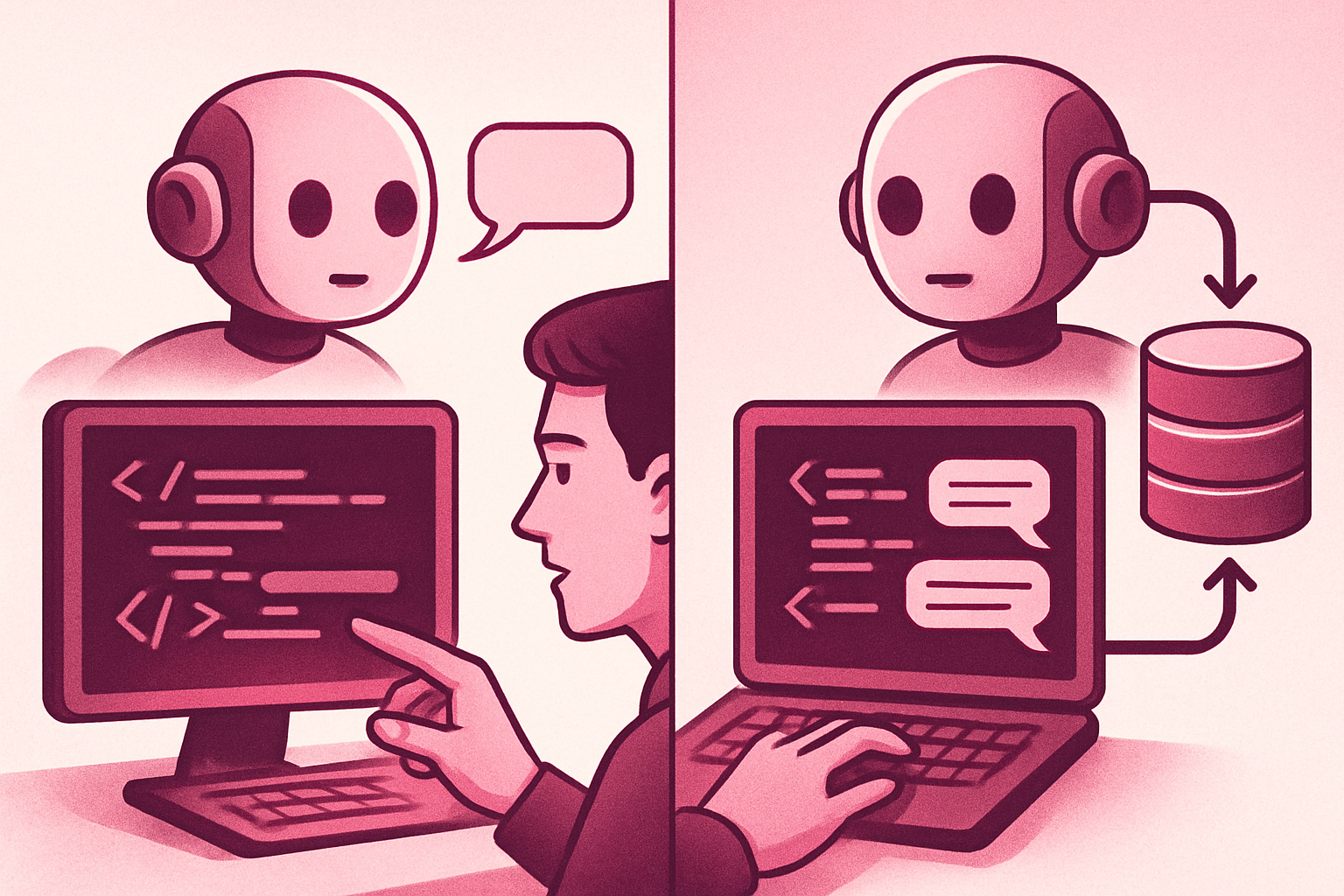
In the field of artificial intelligence, managing an agent's state is crucial for determining its effectiveness and adaptability. Two main approaches stand out: stateless agents and stateful agents. This article explores how these two concepts influence the implementation and deployment architecture of agent-based systems.
We will examine the fundamental differences between these two types of agents and the trade-offs they impose at scale. We will also discuss the implementation methods for each type of agent, focusing on stateless agents that rely on the client for conversation history, and stateful agents that use a database to manage their memory.
Initial Setup
For those discovering Groq language models in a Python environment, the first step is to install the necessary library with the command pip install groq. Once this installation is complete, it is essential to import the library and set the Groq API key in your code.
import os
from groq import Groq

# Get an API key at https://console.groq.com/keys and set it here
os.environ["GROQ_API_KEY"] = "INSERT_YOUR_GROQ_API_KEY_HERE"

# Initialize the client
client = Groq()

# Using an efficient Groq model: Llama 3.1 8B Instant
MODEL_ID = "[llama](/dossier/meta-ia)-3.1-8b-instant"
A crucial choice in this setup is the model used. The llama-3.1-8b-instant model is particularly advantageous due to its low cost and compatibility with Groq's free tier, which allows for up to 14,400 requests per day. This model is ideal for illustrating the paradigms of stateless and stateful agents.
Stateless Agents: Fire and Forget
Stateless agents treat each interaction as a distinct entity, without retaining memory of previous exchanges. When a user submits a request, the agent reads the prompt, uses the language model's inference engine, and then provides a response. Once this process is complete, there is no retention of information.
The Trade-off
One of the main advantages of stateless agents is their ability to scale horizontally efficiently. Since they do not store any user data on the server, requests can be directed to any available instance. However, this approach presents a significant limitation for multi-turn conversations: the client must resend the entire conversation history with each new request, which quickly increases the context window and token usage.
Le brief IA que les pros lisent chaque soir
Les 7 actus IA du jour, décryptées en 5 min. Gratuit.
Inclus dès l'inscription : notre sélection des meilleurs guides & comparatifs IA.
Choisissez votre rythme
Gratuit · Pas de spam · Désabonnement en 1 clic
Illustrative Example
Here is a code example that demonstrates how a stateless agent interacts with a Groq language model. The stateless_agent function shows how the agent relies entirely on the client for conversational context.
def stateless_agent(prompt: str, provided_history: list = None) -> str:
    """
    The agent relies entirely on the client to provide context.
    It does not retain any information from past interactions in local memory.
    """
    # Initialization with a system prompt
    messages = [{"role": "system", "content": "You are a helpful and concise assistant."}]

    # Adding the history provided by the client
    if provided_history:
        messages.extend(provided_history)

    # Adding the new prompt
    messages.append({"role": "user", "content": prompt})

    # The LLM processes the entire chain of messages
    response = client.chat.completions.create(
        model=MODEL_ID,
        messages=messages,
        max_tokens=100
    )
    return response.choices[0].message.content.strip()
To illustrate the limitations of this approach, we simulate a simple conversation between a user and the model.
# --- Stateless Agent Test ---
print("--- Turn 1 ---")
prompt_1 = "Hello, my name is Alice and I am learning about API infrastructure."
response_1 = stateless_agent(prompt_1)
print(f"Agent: {response_1}")

print("\n--- Turn 2 (Without Client Context) ---")
# The agent fails here as it has retained no memory from Turn 1
prompt_2 = "What is my name and what am I learning?"
response_2 = stateless_agent(prompt_2)
print(f"Agent: {response_2}")

print("\n--- Turn 2 (With Client Context) ---")
# The frontend MUST inject the history into the payload for the agent to succeed
frontend_payload = [
    {"role": "user", "content": prompt_1},
    {"role": "assistant", "content": response_1}
]
response_3 = stateless_agent(prompt_2, provided_history=frontend_payload)
print(f"Agent: {response_3}")
Stateful Agents: Context-Driven Continuity
Stateful agents, on the other hand, maintain conversational memory. The client only needs to send the latest user prompt along with a unique identifier linked to the session. The agent then retrieves the session history from a database and adds the new message. After processing by the language model, the agent updates the context in the database.
The Trade-off
This approach offers a smoother user experience and allows for managing more complex and asynchronous workflows. However, it requires heavier infrastructure, including a persistent database. In systems that scale horizontally, solutions like centralized caching with Redis may be necessary to prevent session history from being locked to a single instance.
Brief IA — L'actualité IA en français
L'essentiel de l'actualité de l'intelligence artificielle, décrypté et expliqué chaque jour.