AI Agents: Specialized Tools and Safeguards on Azure
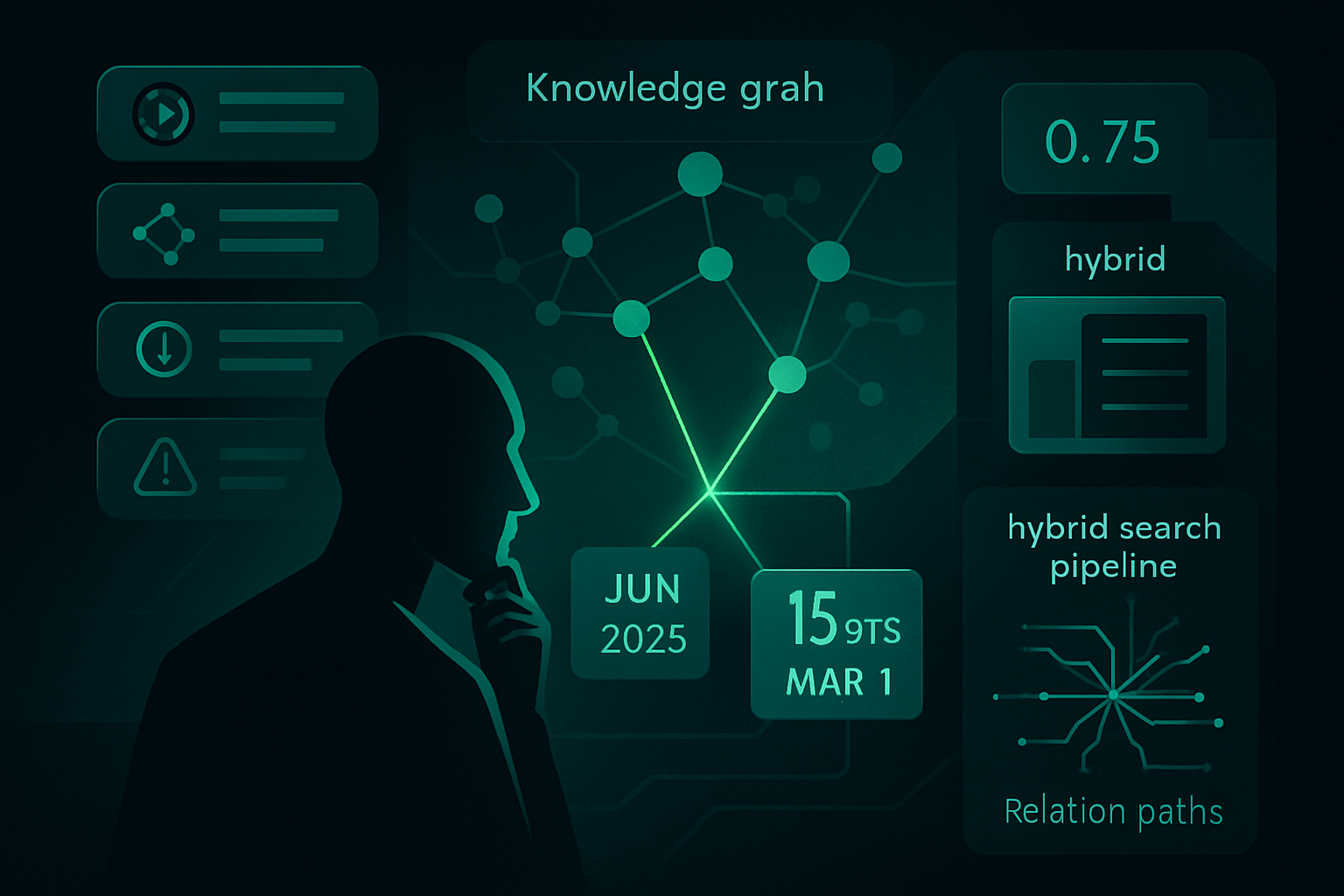
An engineer tests an augmented search agent on Azure, without adding any services, against a fixed pipeline merging typed graph and hybrid search. The published metrics show anchoring gains but unchanged recall, raising a central question: does a model-controlled loop respect the contradiction gate when tools become more expressive than mere similarity?
Unchanged Recall and Limited Corpus, but Enriched Anchoring
For a gold set composed of twenty-one documents, recall remains at 0.75 whether the graph is used or not. Although this limitation persists, each anchored package includes an average of ten temporally valid typed relationship paths, which pure search alone cannot achieve. During the production transition, the number of conceptual fragments decreased from 149 to 120, and the ingestion time detector generated a contradiction about itself during the initial phase. At this stage, merging primarily results in better anchoring, without an increase in recall.
Why Simple Similarity Fails to Validate
An agent limited to repeated similarity search calls reformulates and decomposes but remains confined to the same operation on flat pieces. Iteration mainly allows for reformulated assumptions. With only similarity, the agent cannot confirm the applicability of a rule, determine the validity period of a version, or identify a disagreement between two documents.
What a Vocabulary of Typed Tools Changes
The tested hypothesis is that an agent's reasoning depends on the vocabulary of its tools. By equipping the agent with the language of the knowledge layer—typed relationships with validity periods, entities resolved into canonical identities, interrogable disagreements—iteration approaches navigation. At each step, the agent can resolve an uncertain entity or traverse the specific relationship it needs, instead of multiplying similarity searches.
Design: Same Data, Same Stack, Imposed Limits
The experiments are conducted on the same Azure stack and the same corpus, without adding any services: the agent is merely code and tokens, delivered as an additive commit in the existing repository. The model receives control with strict constraints, while a central question remains: does the contradiction gate persist when the loop is controlled by the model? The results are reported, including when they are not favorable to the approach, with the aim of measuring the loop against a solid single-pass reference and quantifying its cost.
Le brief IA que les pros lisent chaque soir
Les 7 actus IA du jour, décryptées en 5 min. Gratuit.
Inclus dès l'inscription : notre sélection des meilleurs guides & comparatifs IA.
Choisis ton rythme
Gratuit · Pas de spam · Désabonnement en 1 clic
Comparison Base: A Merged Fixed Pipeline
The reference relies on a merged pipeline that removes the router, launching a hybrid search each time associated with a typed traversal over two hops, then passing the combined result to an external reevaluator tasked with presenting the relationship paths as proof. Each relationship incorporates the temporal dimension through a validity window and an ingestion timestamp, while entity resolution relies on two thresholds, with integration blocking and arbitration in the intermediate zone. The system now performs an exploration of its own graph.
Where a Single Pass Is Not Enough: The Counterfactual Sequence
A fixed pipeline implicitly decides, once and before any reasoning, what will be retrieved. It always executes the same steps in the same order and cannot go back to fetch more elements based on an intermediate result, even if it respects time and highlights contradictions. For example, for a roof inspection requirement that changed from a twenty-year threshold starting June 2025 to fifteen years for new H3 business starting March 1, 2026, the question from February 20 is resolved through temporal filtering. In contrast, a counterfactual analysis of claims requires discovering versions and their validity, extracting property attributes, applying the March rule to prior filings, and comparing. No single query, even merged, expresses this sequence. The risk is then a partially anchored response that appears complete. Conversely, human practice intertwines reading, additional retrieval, and verification of the applicable version before responding. For most questions, the fixed pipeline remains fast, cost-effective, auditable, and predictable, but some require discovering what to retrieve after initial reasoning.
A Overused Term, A Sought Test
The term agent is widely used in marketing content, orchestration tutorials, and reflections without verifiable systems, which does not address the engineering question posed: against a single-pass reference, on the same data, what does the loop actually report and at what cost? The described device aims precisely at this goal and frames the design accordingly.
Brief IA — L'actualité IA en français
L'essentiel de l'actualité de l'intelligence artificielle, décrypté et expliqué chaque jour.