AI Agents: Six Models to Choose the Right Architecture
Designing an agentic system does not start with stacking agents, but with framing costs, latency, and human controls. Several proven models cover distinct needs, from a simple single agent to swarms of experts, including improvement loops and routing. Here’s how to select and combine them without overshooting the budget or compromising quality.
Frame Costs and Risks Before Orchestrating Agents
Loops must always be bounded: it is essential to set a maximum number of iterations, as an unbounded loop can lead to increased costs without benefits. Hierarchical architectures involve more agent calls than a flat coordinator; this added complexity, synonymous with increased costs and delays, is only justified if the coordinator is no longer sufficient. Swarm models require an explicit exit condition, such as a number of rounds or a target result, or they risk never stopping. While a swarm can produce high-quality results, it also exposes you to high costs and the risk of unproductive loops due to the lack of a central orchestrator. When the error is costly or irreversible, it is necessary to integrate a checkpoint with a human in the loop, for instance, to validate a payment or a customer refund.
Start Simple: The Single Agent, Then Scale if Necessary
If a task can be solved with a single model call, it is better to avoid agents. Otherwise, it is advisable to start with a single agent, meaning an agent equipped with a model and a set of tools. The addition of extra agents should only be considered after this configuration has failed. The use of multi-agent models is only justified when the single agent fails to accomplish the task.
Frame the Need: Task, Latency, Cost, and Human Approval
Four questions structure the choice of model: does the task follow predefined steps or is it open, and does it require orchestration by model? Does the system require a quick response or can it tolerate a delay? Does the budget allow for multiple model calls per request? Finally, do certain high-stakes or subjective decisions require human validation?
Le brief IA que les pros lisent chaque soir
Les 7 actus IA du jour, décryptées en 5 min. Gratuit.
Inclus dès l'inscription : notre sélection des meilleurs guides & comparatifs IA.
Choisissez votre rythme
Gratuit · Pas de spam · Désabonnement en 1 clic
Organize the Flow: Sequential or Parallel Depending on Dependencies
When the order of tasks is fixed, a sequential chain is necessary: each agent passes its output to the next, with the total time being the sum of the steps, as in extracting, cleaning, and then loading data. Conversely, if there are no dependencies between tasks, parallel execution allows agents to work simultaneously, which is useful for collecting data from many sources at once. The overall time then corresponds to that of the slowest agent, rather than an addition.
Quality Loops: Bounded, Critical, and Refinement
Loop models repeat a task until a condition is satisfied or a ceiling of iterations is reached, which must be set to avoid costs without gain. The generator-critical scheme separates production and verification between two distinct agents. Iterative refinement repeats generation as long as quality verification fails or until the trial limit is reached. These loops are only relevant if quality can be measured objectively, such as code passing a test or text achieving a readability score.
Advanced Orchestration: Routing, Hierarchy, Swarm, Custom Logic
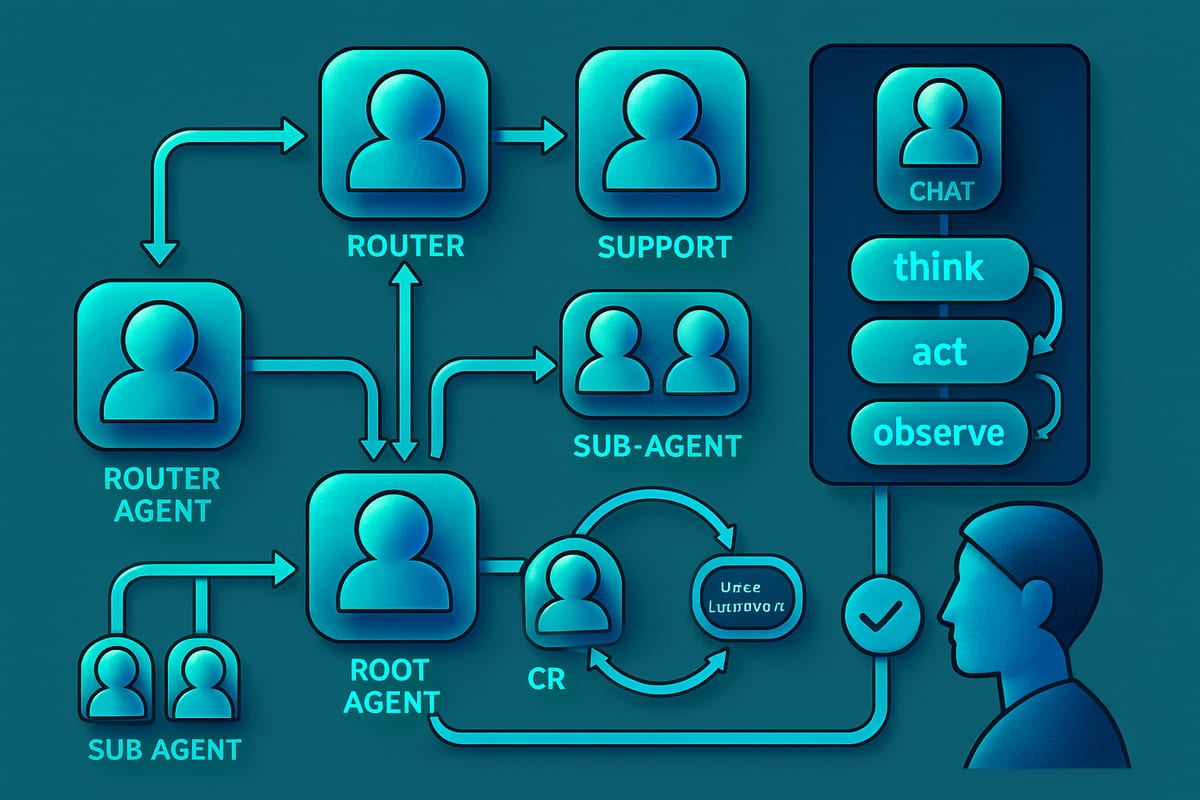
A coordinator reads each request and forwards it to the appropriate specialist agent, such as billing or support. For vague and open objectives, a root agent can break down the mission into subtasks distributed to sub-agents, which can further subdivide. Problems requiring expert debate lend themselves to a swarm: a dispatcher selects the starting agent, then the agents collaborate directly, sharing their findings, reviewing each other, and passing the baton, provided a stopping criterion is set. Product design can thus mobilize market, engineering, and finance agents. When no model fits, custom logic offers total control, such as a refund that checks eligibility in parallel before branching; this control comes with full responsibility for the logic and errors. For step-by-step interactions, the ReAct scheme — think, act, observe — serves as the default model for a standard chat agent.
Brief IA — L'actualité IA en français
L'essentiel de l'actualité de l'intelligence artificielle, décrypté et expliqué chaque jour.