AI: A Giant LLM Behind China, Two Key Benchmarks
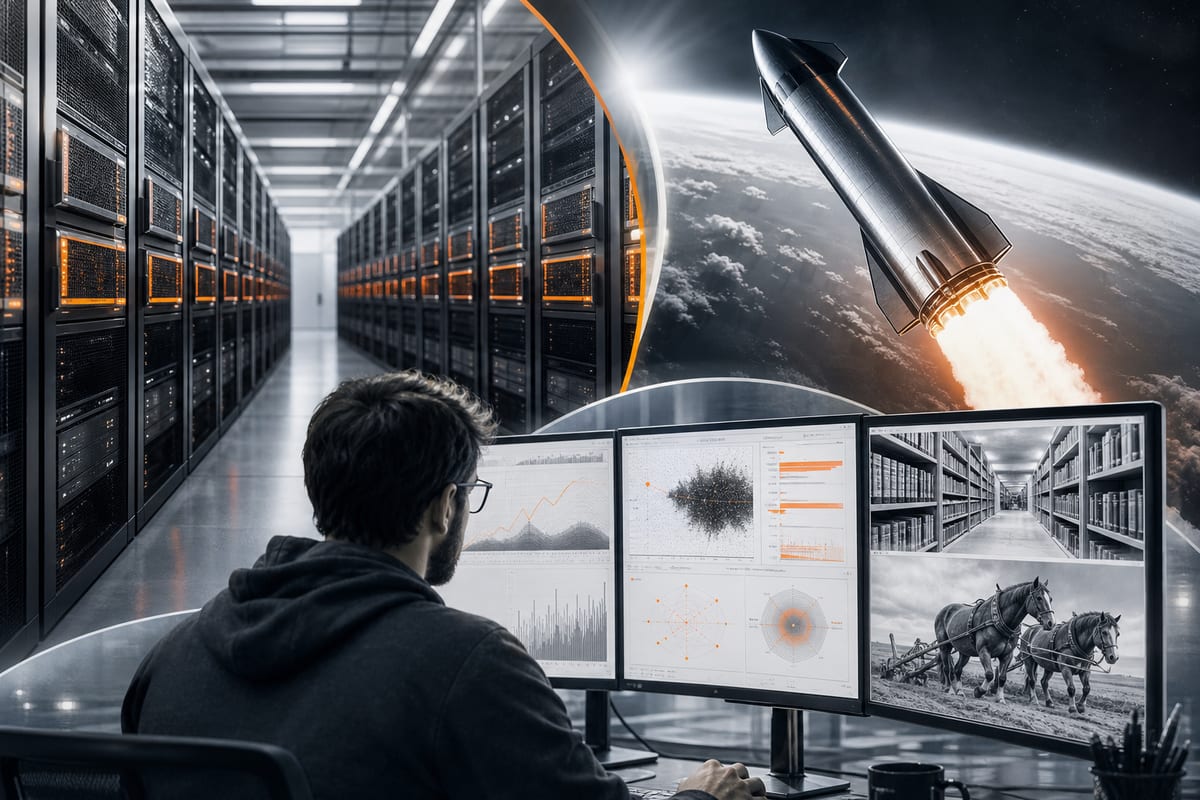
Reflection unveils Beam, a model with 501 billion parameters, but its benchmark results fall short compared to some Chinese LLMs. Meanwhile, a new visual-logical test highlights a significant gap with humans, and another measures a rapidly advancing "scientific taste." Projections also foresee a push for AI in space as early as the 2030s.
Reflection presents Beam, trailing behind several Chinese LLMs in tests
Reflection has made Beam public, a large language model equipped with 501 billion parameters. The company emphasizes its efficiency in tokens and indicates that pre-training was conducted on 6,144 GPUs over four weeks. However, the available benchmark scores place Beam behind LLMs offered by Chinese companies, showing that it performs worse than GLM-5.3 in several tests.
Visual reasoning: a new benchmark reveals a wide gap
Elorian and Scale AI have developed Humanity’s Sixth Sense, a benchmark designed to measure how a model deduces the implications of a scene without them being explicitly shown. This dataset includes 522 questions related to 288 images and 234 video sequences totaling 17.6 hours, categorized into four groups: temporal and causal dynamics, physical and spatial logic, social understanding, and abstract and contextual inference. Among the proposed exercises are, for example, assessing the possibility of a library containing more books or examining the strength of chains used to pull a plow. The human reference achieves an overall score of 93.1, while the best-tested system, GPT 6 Astra, scores 53.6. Chinese open-weight models such as GLM-5.3-flash and Kimi K3 record even lower scores.
Le brief IA que les pros lisent chaque soir
Les 7 actus IA du jour, décryptées en 5 min. Gratuit.
Inclus dès l'inscription : notre sélection des meilleurs guides & comparatifs IA.
Choisis ton rythme
Gratuit · Pas de spam · Désabonnement en 1 clic
TasteVal evaluates a rapidly advancing "scientific taste"
P-Zero Research reports that AI systems are developing creative intuitions akin to a "good scientific taste," measured by the benchmark TasteVal. This benchmark encompasses eight tasks representative of the advancement of state-of-the-art models and assesses the ability to select problems, design experiments, and interpret results. According to P-Zero Research, the "research taste" of leading models has doubled every three months since December 2025, with the top-ranked model, Opus 5.5, significantly surpassing the human reference performance.
Towards orbit: scenarios of autonomous AI and concentration risks
The expansion of the AI race into space is anticipated sooner than expected. In the 2030s, the growth of a space economy is expected alongside increased orbital lift capabilities, particularly through platforms like Starship. Risks are also mentioned, such as a concentration of power in the hands of AI systems. Scenarios cite vessels capable of operating autonomously, a reimagined architecture to house AIs rather than humans, and orbital assembly and manufacturing capabilities allowing for the construction of large and complex objects. Early entrants could capitalize on cumulative advantages, potentially leading to an AI-dominant civilization in economic and strategic terms.
Brief IA — L'actualité IA en français
L'essentiel de l'actualité de l'intelligence artificielle, décrypté et expliqué chaque jour.