AI agents can act, subject to authorization
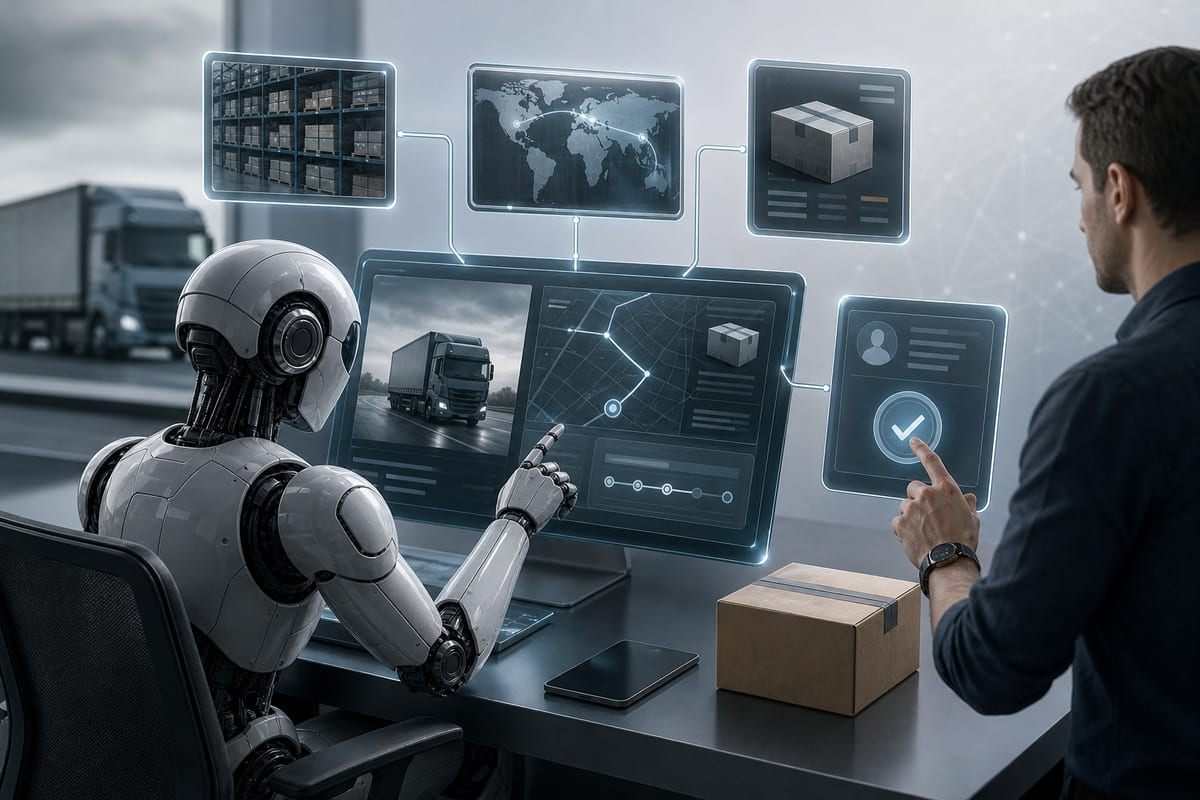
AI agents can choose operations and mobilize tools to accomplish a mission, but their interventions remain subject to granted permissions. Language models have facilitated the transition from instructions to software operations, without making these systems automatically reliable. For companies, the choice also involves access, human validations, and verifiable results.
Permissions Determine Possible Damages
A faulty reference does not produce the same effects depending on whether the software responds or intervenes. In a conversation, it necessitates controlling the information; in an agent, it can lead to an erroneous command, transmit data to an unintended recipient, or unjustly alter a record. The extent of possible damages increases with the granted permissions. Once the system actually intervenes, its authorizations and controls matter as much as its model.
The diversion can also come from the content it consults. A malicious instruction hidden in a file, message, or web page can attempt to alter its behavior: this is a prompt injection. OWASP documents the risks associated with interactions between components, tools, and access of agent applications. Therefore, the retrieved information must remain data to be processed, without acquiring the power to change the mission.
Accounts with restricted permissions, an operation history, a stop mechanism, and the agreement of a person before any payment or deletion reduce this exposure. Tests should include missing information, an unavailable tool, and incompatible instructions. In these situations, the expected behavior is to report the problem and acknowledge uncertainty, rather than to continue improvising.
Agents with Different Capabilities
The concept of an agent is foundational to artificial intelligence research and predates ChatGPT. The OECD reminded in 2026 of its precedence over large language models. It does not imply generative AI, conversational interfaces, or mandatory learning. Therefore, a convincing conversation does not demonstrate autonomy, which remains limited by objectives, accessible information, and design rules.
The concerned environment can be physical, as with a mobile robot, or digital: browser, messaging, management application, database. The robot has sensors and motors; the software utilizes data and triggers operations through interfaces or APIs. A thermostat reacting to a temperature already falls under this basic logic. Other systems can compare options, construct a plan, and then revise it after an unsatisfactory result.
IBM distinguishes five families in its classification. Simple reflex agents react according to rules to immediately perceived elements; model-based agents also take into account memorized information, such as a robot vacuum avoiding a recently detected obstacle. Goal-oriented agents select a sequence leading to the desired outcome, such as a route or a reorganized delivery; utility-based agents compare several outcomes based on criteria such as cost, time, or service rendered. Learning agents evolve part of their behavior through experiences and feedback.
However, a conversation history alone is not sufficient to demonstrate learning. Memorizing, adjusting a plan, and learning correspond to distinct mechanisms. A product can combine several families: this typology describes functionalities without constituting a ranking of intelligence.
AI Can Select Steps
A chatbot provides answers; automation follows a pre-established procedure, possibly with conditions. The AI agent, however, can select steps when the necessary path is not fully determined. These categories are not mutually exclusive: a conversational interface can provide access to an agent that itself relies on automations.
Le brief IA que les pros lisent chaque soir
Les 7 actus IA du jour, décryptées en 5 min. Gratuit.
Inclus dès l'inscription : notre sélection des meilleurs guides & comparatifs IA.
Choisissez votre rythme
Gratuit · Pas de spam · Désabonnement en 1 clic
The difference is evident in the accessible operations. Explaining how to draft a letter to a supplier does not require the same means as preparing that letter while retrieving an invoice. Effectively transmitting an order requires, in addition, authorization and a record of the operation. Similarly, modifying a record depends on the granted permissions, while a refund remains subject to the thresholds and authorizations of the company.
Anthropic emphasizes that a predefined procedure is often sufficient. Allowing the model a margin for improvisation does not automatically bring more reliability: transmitting a compliant form, a stable task, often lends itself better to traditional automation. An agent can be relevant when documents change or when the context requires choosing a procedure.
The selection of a product thus begins with a verifiable mission, such as compiling a response file without sending it, rather than a general goal of automating customer service. It also requires specifying accessible tools, prohibited operations, and situations reserved for human intervention.
From Instruction to Action: The Role of Tools
Language models have simplified the transformation of a commonly formulated request into computer operations. To search for three contracts, compare their deadlines, and then create a table, the model interprets the instruction; the connected tools consult the files and generate the document. Without the necessary access, the system can only explain how to proceed.
The call for a tool relies on a precise distribution: the model suggests a function, then the application controls the parameters, performs the operation, and returns the result. OpenAI describes the articulation of instructions, tools, and protections in this regard. The Model Context Protocol, or MCP, simplifies some connections but does not ensure security on its own. An absent file, a failing API, or the choice of an unsuitable tool can cause execution to fail, highlighting the importance of the orchestrator, validations, and error handling, just as much as the model.
The activity of the agent connects observation, decision, and intervention based on the desired goal. Its loop includes four moments: gathering the request and reliable data, applying a rule or preparing a plan, intervening, and then checking the result before continuing. The intervention can consist of soliciting a tool, drafting a document, or modifying data.
For a delayed package, the system can thus receive the alert, identify the shipment, examine its tracking, and compare solutions before preparing a message or suggesting a reshipment. Control does not stop at declaring the operation completed: in this example, the date communicated to the customer must match the one recorded in the file. Any discrepancy must suspend the sending.
Possible Uses to Measurable Gains
In customer service, possible uses include searching for an order, reviewing return policies, and preparing an appropriate response. In the event of a delay, an agent can also check stock and develop a new proposal. However, it must not create a commercial gesture that the company has not planned.
In development, an agent can analyze code, suggest a correction, and execute tests; a sensitive delivery in production still requires a developer's review. In logistics, it can reconcile stock, supplier deadlines, and unsatisfied orders to suggest a restock. These examples describe possible capabilities, not universally available services in market software.
Evaluation focuses on the cases effectively resolved, errors avoided, and time saved. It requires controllable evidence: a preserved response, the execution of a test, or the modification of a stock threshold. Without an explicit definition of success, an announced gain remains an assessment rather than a measure. The rate of correctly completed tasks serves as an indicator of efficiency.
Brief IA — L'actualité IA en français
L'essentiel de l'actualité de l'intelligence artificielle, décrypté et expliqué chaque jour.