AI Agents: Exalate Advocates for Limited Access
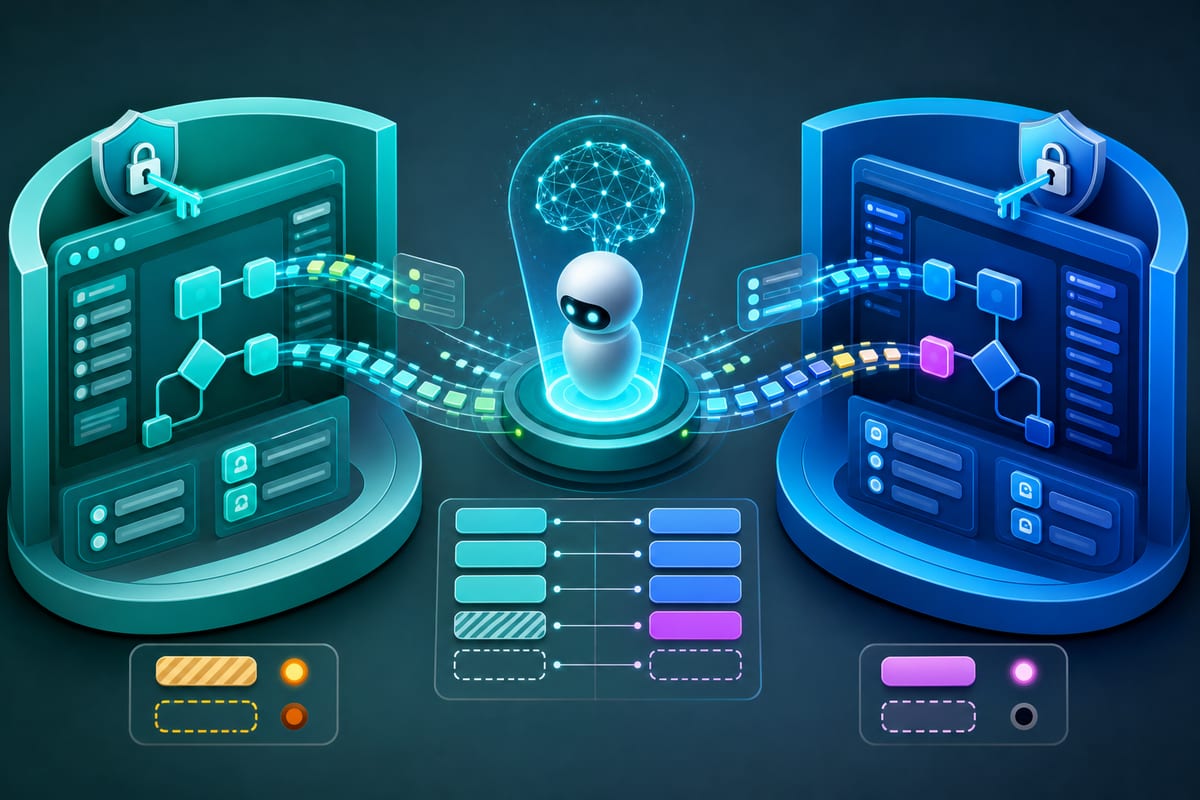
Francis Martens, co-founder and CEO of Exalate, advocates for limited access of AI agents to configuration metadata for inter-company connections. His analysis focuses on understanding the mappings between systems: multiplying permissions does not necessarily provide the meaning of fields or the rules applied by another organization.
An invisible field does not mean absent
An agent querying the field "Owner of Escalation" may receive no response. This silence does not prove that the field is missing: insufficient authorization can also explain it. Continuing the process by declaring this field absent would then be based on a false premise.
In the requirements advocated by the leader, the solution must explicitly differentiate between "field not found" and "unauthorized access," and then account for what it cannot verify. For Martens, reliability hinges on this knowledge of visibility limits rather than on comprehensive oversight. Acknowledging an impossible verification would, in this configuration, be preferable to a systematic response.
The proposed scope focuses on metadata: the existence of fields, their definitions, and their business usage. The architecture should prevent access to customer records as well as information subject to data protection obligations.
Each company would keep its own identifiers
An AI integrated into a tool has the context of its local configuration but not that of external systems. A centralized intermediary could theoretically know the connected environments; however, it would retain their identifiers with a third party. Martens presents this practice as accepted within companies but rejected when it crosses their perimeter; legal or compliance departments may also oppose it.
The decentralized option would leave each organization with independent software, control over its configuration, and its identifiers on-site. Exchanges would only concern a derived context: structured descriptions of mappings, configurations, and relationships between them. Among the compared options, Martens reserves for this approach the possibility of maintaining the autonomy of organizations without depositing identifiers with a third party.
The shared elements should be defined and accepted by the parties. This scope would include field definitions, equivalences between statuses, and transformation rules, without transmitting identifiers or opening access to systems.
Le brief IA que les pros lisent chaque soir
Les 7 actus IA du jour, décryptées en 5 min. Gratuit.
Inclus dès l'inscription : notre sélection des meilleurs guides & comparatifs IA.
Choisissez votre rythme
Gratuit · Pas de spam · Désabonnement en 1 clic
Fields can change meaning between systems
Jira and ServiceNow are among the systems where an agent can consult data or intervene. However, synchronization may seem coherent while relying on an incorrect equivalence: the field "Priority" does not necessarily have the same meaning for the parties. A Priority 1 incident could thus exceed the timeline stipulated by its service level agreement, or SLA, without alerting the teams, as the agent indicated it was being handled.
Martens notes a common response to interpretation errors: invoking a lack of context and broadening permissions. The organizations involved then equate access to more fields or records with a better understanding. However, mappings depend on each environment: knowing the general functioning of tools does not necessarily provide insight into their operational configuration.
A custom field like "Client Escalation" may thus remain misunderstood; the equivalence between "Pending" and "Pending an external party" may also escape the agent. An incorrect inference could have more significant effects between companies when access rights are broader. The necessary information pertains to applicable mappings, their currency, and which system should prevail in case of conflict.
Within a company, an authority can validate these mappings, impose definitions, maintain catalogs and control traces, and set responsibilities for the data. Such a common authority is lacking between organizations, with the agent unable to reconstruct the absent rules alone. Naming conventions and mutual visibility are not necessarily formalized; structures and assumed usages can evolve separately.
A local deletion can break a synchronization
A support team using Jira may be connected to engineers working on ServiceNow in another company. At deployment, the parties define the synchronized elements, the allowed transmissions, and the restrictions. These choices can then change: according to Martens, adding mappings generally has no disruptive effect on existing processes, unlike certain deletions.
If support removes a dropdown menu from Jira, the original data may no longer be reflected in ServiceNow, without an error message for the receiving team. Support may consider this intervention strictly internal and not communicate it. An agent with access to both environments of the same organization could detect the change and request human oversight; however, that of the affected company may have no visibility on the modified configuration.
The expected capability thus exceeds merely recording a change: it must identify a broken dependency with the partner. Martens believes that most solutions log changes without clearly qualifying this consequence. A change simply logged and a break requiring intervention should be distinguished.
Brief IA — L'actualité IA en français
L'essentiel de l'actualité de l'intelligence artificielle, décrypté et expliqué chaque jour.