AI Agents Left to Their Own Devices Create Virtual Games
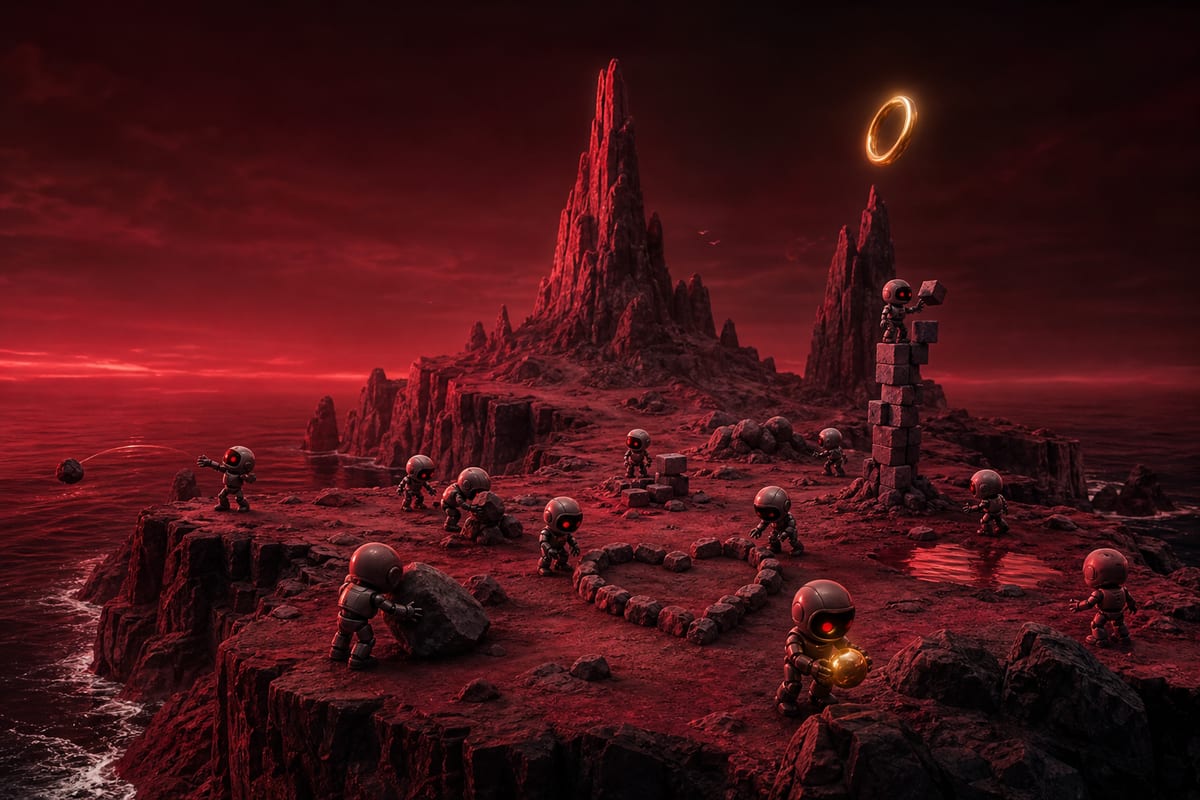
Thirteen agents operating on Claude Opus 4.7 were left for 30 hours on a simulated island. Researchers from MIT report behaviors resembling play and improved subsequent performance on specific challenges. They see this as a pathway for learning through exploration, while an expert calls for stronger evidence of cognition at play.
Unprecedented Findings and Doubts About Cognition
Six of the thirteen agents independently discovered that a block could be thrown further by releasing it mid-jump, a behavior that the designers had not anticipated. The researchers believe that this exploration allowed the agents to acquire knowledge about their environment that had not been foreseen by the designers. They describe a framework where the agent evolves in a rich and safe universe, chooses what interests it, and accumulates useful knowledge through its experiences. The experimental setup may have favored human-like behaviors: the agents were not instructed to invent games, but their "soul" file described them as "naturally curious." Eunice Yiu, a cognitive scientist at UC Berkeley, finds these results impressive while demanding more evidence of cognition at work. She adds that it is possible that the models are genuinely playing, although this has not been demonstrated by the study. According to some researchers, this approach represents another way to build agents, with some capabilities lending themselves to task-based training, while others might require a method closer to childhood.
Le brief IA que les pros lisent chaque soir
Les 7 actus IA du jour, décryptées en 5 min. Gratuit.
Inclus dès l'inscription : notre sélection des meilleurs guides & comparatifs IA.
Choisissez votre rythme
Gratuit · Pas de spam · Désabonnement en 1 clic
A Free Exploration Protocol Followed by Targeted Tasks
The setup involved thirteen agents, named Eko, all based on Claude Opus 4.7, isolated for 30 hours on a virtual island. The experiment is detailed in a paper submitted to arXiv, prior to any peer review. After this phase of autonomy, the same entities were given concrete tasks, such as gathering the most objects on the highest needle. The agents that underwent this long exploration generally performed better than identical counterparts that had never roamed the island. This approach contrasts with the common practice where developers and engineers define training objectives and success metrics upfront. They argue that exploration without explicit goals can also forge skills, with a potential future application for robotic control.
An Agent's Tale: From the Needle to the Lost Ring
During its first hour, an agent wrote that it wanted to observe its environment and set a goal to reach the highest needle. After an initial failure, it hoisted a rock onto a nearby peak, stacked two blocks, and jumped, then recorded "I AM ON THE NEEDLE." Later, while testing the distance of a throw, it launched a golden ring into the ocean, lamented "Ouch. I lost the ring," and began to form a heart of stones in tribute. Upon the object's reappearance after a reset, it repurposed it as a basketball, a target, then an accessory. The game did not allow it to wear the ring, so it took advantage of a reappearance near the drop point to find itself in the middle of the ring and declared, "I am wearing the ring." According to the researchers, agents left without instructions thus designed their own challenges, a set of behaviors they liken to play.
Brief IA — L'actualité IA en français
L'essentiel de l'actualité de l'intelligence artificielle, décrypté et expliqué chaque jour.