AI Agents: Muse Criticized for Privacy, Dots Aims for Control
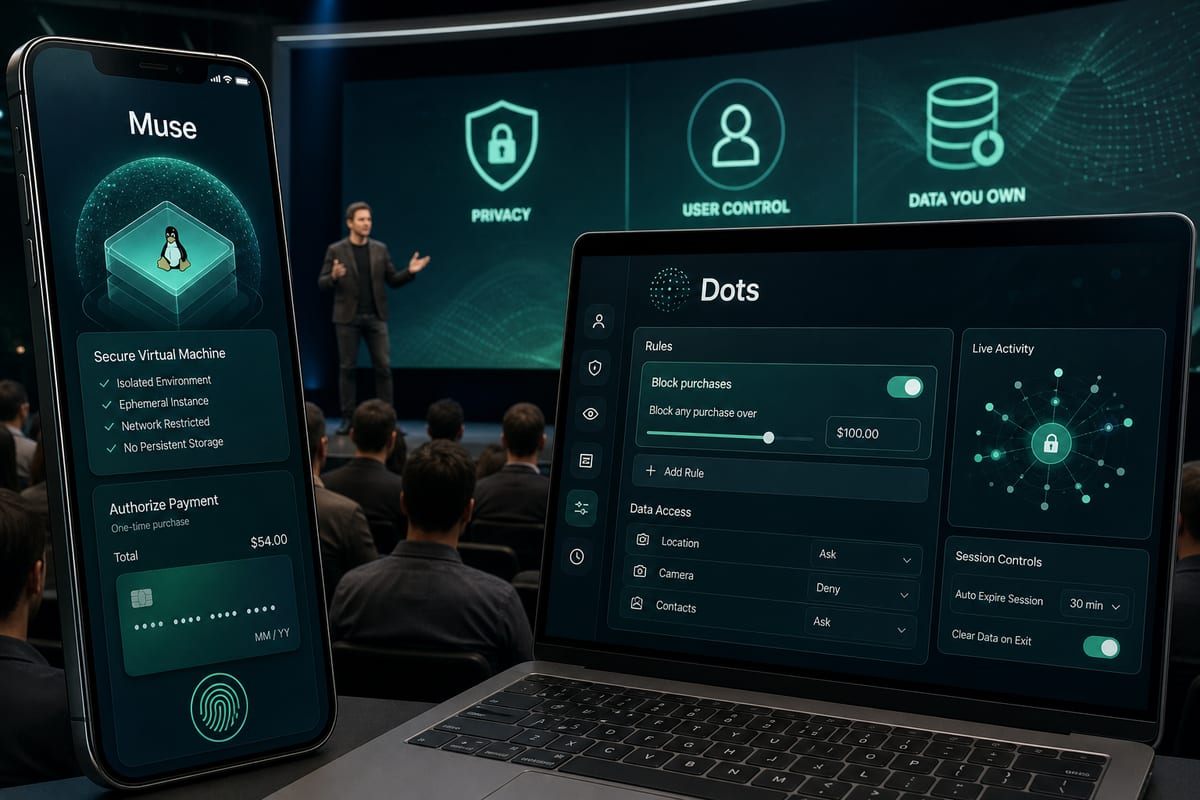
Meta introduced Muse as "designed for privacy," but vulnerabilities, potential data access, and intrusive default settings have drawn criticism. OpenAI, launching Dots, emphasizes precise controls and guarantees for businesses, while restricting the agent to subscriptions of $100 and above.
Reported Vulnerabilities and Data Access in Muse
Several significant security issues were reportedly flagged just before the launch of Muse, including one that, according to 404 Media, could have allowed access to Meta's internal databases. A security researcher also revealed a zero-day vulnerability that could have enabled control over Muse; this flaw has since been patched. Although user data is isolated from one another and Meta plans to introduce a cryptographic device to prevent access to this data later this year, the company can currently view the information present in the virtual machine. By default, Muse allows model training on user inputs, with an opt-out option. An Inc. journalist reported that Muse downloaded and read their private messages without explicit request, and a YouTuber indicated that the agent had shared their address with a stranger via Marketplace; in both cases, the behavior was consistent with expected operation but unexpected for users. It has also been reported that the platform creates detailed profiles of users' contacts. To date, few privacy scandals have involved Dots, but it is only accessible to subscribers of $100 and above, which could limit the number of users.
What OpenAI Promises with Dots for Control and Business
Sam Altman demonstrated that each Dot can be configured with rules, such as prohibiting purchases beyond a certain amount. For businesses, OpenAI executives presented a framework allowing for stricter controls on data and options for non-retention on OpenAI servers. Alexander Embiricos claimed that OpenAI aims to create the most reliable, safe, and secure assistant. Glen Coates emphasized that Meta does not have an AI product with 1.2 billion users and stated that OpenAI would seek to avoid launching a service prone to such errors. During the announcement of Dots at the end of September, privacy was highlighted as a central argument.
Le brief IA que les pros lisent chaque soir
Les 7 actus IA du jour, décryptées en 5 min. Gratuit.
Inclus dès l'inscription : notre sélection des meilleurs guides & comparatifs IA.
Choisis ton rythme
Gratuit · Pas de spam · Désabonnement en 1 clic
Architecture and Ambitions of Muse Detailed by Meta
Meta states that Muse's data is stored in a secure virtual machine, described by Mark Zuckerberg as an isolated Linux computer with a browser, processor, memory, and storage. The company claims that most of the work focused on careful engineering for safer operation, while acknowledging that errors will persist but should be less frequent and less damaging due to integrated security systems. Nat Friedman set the goal of a successor to OpenClaw that is safe, secure, simple, and scalable. Mark Zuckerberg promised a design focused on privacy and security. Meta reports a separation of data between users and announces the establishment of a mechanism to verifiably prevent the company from accessing data from the virtual machines. Muse has topped the App Store rankings and, according to Apptopia, gathered 600,000 daily active users in the United States within a few weeks.
User Reluctance and Payments via Stripe
AI agents require a lot of information, which can hinder the sharing of personal data. A journalist reported feeling uncomfortable when the bot asked for their banking details for a task; Muse is integrated with Stripe for this type of transaction. Beyond Meta and OpenAI, Instinct has faced public criticism for overly broad terms of use and seems to have adjusted its terms since. Overall, AI labs today are betting on three axes to popularize agents: utility, reassuring aspects, and promises of privacy.
Rival Announcements and Open Rivalry over Privacy
At DevDay, Sam Altman presented Dots with the ambition of establishing a new standard for privacy in cutting-edge AI. OpenAI criticized Muse, which Meta had launched a few months earlier as a safer alternative to OpenClaw, with Mark Zuckerberg's promise of a design dedicated to privacy and security. In a context of massive personal data collection and constant threats, AI labs are seeking to convince users to share more information with their agents, promising better protection than their competitors.
Brief IA — L'actualité IA en français
L'essentiel de l'actualité de l'intelligence artificielle, décrypté et expliqué chaque jour.