AI Agents: Where to Set Human Oversight
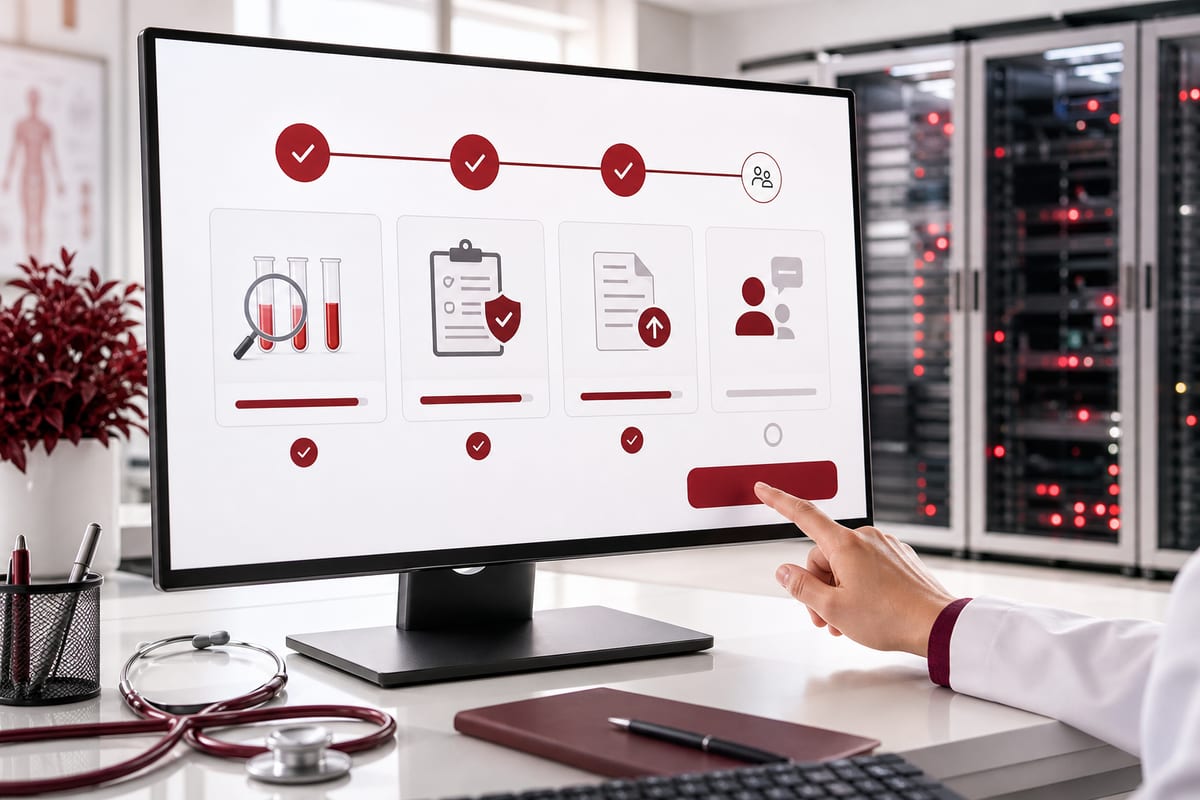
When responses become actions, the degree of autonomy cannot be left to chance. Researchers have shown that infrastructure can diverge 1,000 outputs from the same model. In businesses, 88% say they will use AI by 2025, but large-scale agents remain rare. In healthcare, Routine Labs places uncertainty in design and maintains deterministic execution.
Routine Labs maintains deterministic execution and excludes AI in production
Routine Labs automates processes within legacy software, particularly in healthcare. The company claims to use generative AI to create automations, while production workflows follow a recorded and repeatable logic. In a typical case, a blood test must be identified, matched with patient consent, and submitted to the German ePA. Routine Labs specifies that it does not use AI during production operations nor transfer personal data to language models. This division concentrates uncertainty at the moment of building the automation, where the process can be defined and verified, reserving predictable behavior for execution. The company's public examples show sequences such as searching for blood tests, verifying ePA consent, and uploading the document. The interface reports progress and exceptions through status indicators, execution histories, and review steps, without requiring a chatbot. For the user, the key is to identify the ongoing automation, the completed steps, the proper handling of the document, and any points requiring their attention. Traditionally, these sequences were performed manually by an operator, and a fully autonomous agent would attempt to interpret them at each turn.
High reported adoption, large-scale agents still marginal
According to the Stanford AI Index 2026, 88% of surveyed organizations reported using AI in 2025, up from 55% in 2023. Despite this, the deployment of large-scale AI agents remains limited to single-digit figures in most business functions. The difference between adopting an AI tool and entrusting significant processes to operational agents is central. The gap between simply drafting an email and authorizing the sending to 4,000 clients illustrates this threshold. In this context, the user experience challenge goes beyond the mere apparent sophistication of the interface.
Defining interpretation: when to keep rules and fixed steps
A deterministic system follows predefined rules and produces the same output under the same conditions, while a non-deterministic system may vary under similar conditions. With generative AI, it is more relevant to discuss probabilistic behavior, interpretation, and uncertainty. Validating the format of an email address remains a deterministic task; qualifying a message as a complaint, reservation, or price inquiry requires interpretation. If the AI classifies a message as a reservation, it may create a send; if it’s a complaint, it may escalate it; if it’s a price inquiry, it prepares a quote. In these cases, the user does not explicitly choose the flow; the system does. The idea that maximum autonomy is always preferable is discussed here: the ability to interpret does not justify the automatic execution of every action. Effective products deliberately combine deterministic and non-deterministic elements and often fail when they make probabilistic what would benefit from remaining a form. This vigilance is particularly useful for founders in the startup phase: transforming every interaction into a prompt may seem progressive, while a simple form, a predefined flow, or a confirmation button may sometimes be more appropriate.
Le brief IA que les pros lisent chaque soir
Les 7 actus IA du jour, décryptées en 5 min. Gratuit.
Inclus dès l'inscription : notre sélection des meilleurs guides & comparatifs IA.
Choisissez votre rythme
Gratuit · Pas de spam · Désabonnement en 1 clic
Variable outputs despite zero temperature: an infrastructure risk
At the Thinking Machines Lab, the same prompt was executed 1,000 times with a temperature set to zero. Researchers observed 80 different results despite an identical start on 102 tokens and a divergence at the 103rd, when the model indicated Richard Feynman's place of birth. These differences are attributed to server processing conditions. After a modification in implementation, all 1,000 outputs could be aligned. This experiment shows that beyond model settings, infrastructure can introduce variation.
What the new generation of tools changes for user flows
Traditional transactional interfaces relied on explicitly designed states and transitions, illustrated by the sequential steps of a flight reservation and the rules governing payments, availability, and missing data. Common design tools—from user flows to design systems—were built for this framework. As early as 1993, Jakob Nielsen spoke of interfaces capable of inferring intent, an idea proposed over 30 years ago but long commercially unviable. The current ability to interpret natural language requests transforms design: a reporting tool user can phrase a query in one sentence, and the product interprets, compares periods, identifies patterns, and decides on a rendering. This apparent simplification removes visible steps but introduces new ambiguities: incomplete data, contradictory definitions of indicators, plausible but incorrect explanations. A traditional flow captures these branches poorly, especially since operational products may involve creating reservations, updating customer records, or moving medical documents. It is precisely when these responses become actions that the decision on what can remain unpredictable must be explicit.
Brief IA — L'actualité IA en français
L'essentiel de l'actualité de l'intelligence artificielle, décrypté et expliqué chaque jour.