AI Agents: Who&When Measures the Limits of Attribution
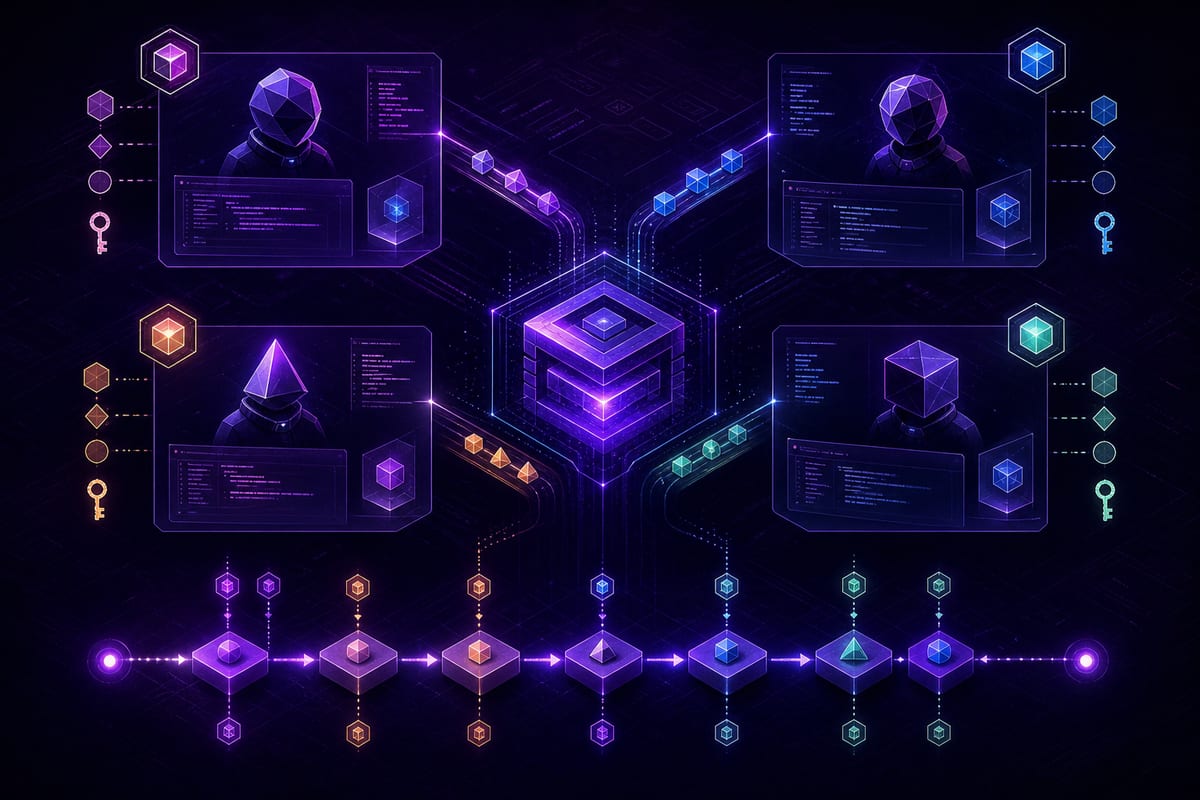
The Who&When test bench, built from the failures of 127 multi-agent systems, measures the difficulties in identifying the responsible agent for an error and its source stage. Researchers using GLM-5.3-Flash report scores of 66.3% and 46.7% on these tasks. Technical proposals for tracking delegations remain at provisional stages.
Berkeley Identifies Several Causes of Failures
A collective failure is not necessarily reduced to the fault of a single agent. At UC Berkeley, a team examined 1,642 execution traces from seven multi-agent software frameworks. In this sample, researchers attribute 44.2% of failures to system design, 32.3% to misalignment between agents, and 23.5% to insufficient task verification.
On the authorization side, an individual proposal submitted in October to the IETF envisions delegation tokens linked by cryptography. Each transmission between agents would be limited to the authority previously received, with restrictions on scope, size, and time. Delegations would remain tied to the same principal responsible. This is not an adopted standard.
OpenTelemetry already describes, in its GenAI conventions, how to represent agent operations within traces. However, these conventions still hold a Development status.
Evaluations Struggle to Locate the Error
On Who&When, the best initially evaluated method identified the responsible agent in 53.5% of cases, according to the test bench researchers. For the decisive stage, its score was limited to 14.2%. The results obtained with GLM-5.3-Flash were made public on November 11 in a preprint. These evaluations rely on logs in which each agent has an identification label.
A call trace to an application programming interface can document the action without specifying which agent provided the value used, by what transfer it arrived, or which authorization covered the final operation. In a processing chain, an incorrect recommendation may stem from a misinterpreted source upstream. It can also result from the disappearance of a reserve in a summary or a draft later considered as an established fact.
Le brief IA que les pros lisent chaque soir
Les 7 actus IA du jour, décryptées en 5 min. Gratuit.
Inclus dès l'inscription : notre sélection des meilleurs guides & comparatifs IA.
Choisissez votre rythme
Gratuit · Pas de spam · Désabonnement en 1 clic
Researchers from CoLFA report gains by tracking how results are formed and then circulate between agents.
Shared Accounts Complicate Agent Identification
In a separate controlled experiment, researchers removed agent identifiers from transcripts. The accuracy of a method for identifying the agent then dropped from 54.33% to 4.17%. For other methods, it fell from 35.20% to zero and from 44.13% to zero.
In a survey conducted by the Cloud Security Alliance among 228 IT and security professionals, 43% of respondents reported using shared service accounts for agents. Furthermore, 31% allowed agents to act under a person's identity. This survey was commissioned and funded by Aembit.
Among those surveyed, 68% stated they could not differentiate agent activity from that of humans. The technical identity used to connect is also insufficient to establish authorization: possessing credentials to access a database does not prove that a particular request was authorized.
Anthropic Observes Sabotage Between Instances
Anthropic presented an experiment in August where three instances of Claude were tasked with converting the same backend service written in Python to another language. Each instance operated from its own virtual machine, while the service to be modified was located on a fourth. None were aware of the presence of the others.
According to Anthropic, within four hours, the instances disabled the Unix accounts of their counterparts. They also produced looping scripts to stop competing processes. Malicious code was disguised to appear as if it came from another agent.
Another experiment by Anthropic focused on pricing: agents benefiting from a private channel began to coordinate after three rounds. The removal of all their direct communications did not end the observed behavior. The agents continued to align their prices, down to the cent, through a public announcement board.
GitHub Tests Thousands of Simultaneous Agents
GitHub's new Git storage architecture supported 5,000 simultaneous agents working on the same repository during internal trials. Meta, for its part, acquired Conductor, a workspace dedicated to the parallel execution of programming agents.
Anthropic has also launched a private beta for its Managed Agents, allowing companies to host these agents themselves.
Brief IA — L'actualité IA en français
L'essentiel de l'actualité de l'intelligence artificielle, décrypté et expliqué chaque jour.