AI at the White House: A Pact Driven by Zuckerberg and Huang
Le brief IA que les pros lisent chaque soir
Les 7 actus IA du jour, décryptées en 5 min. Gratuit.
Inclus dès l'inscription : notre sélection des meilleurs guides & comparatifs IA.
Choisis ton rythme
Gratuit · Pas de spam · Désabonnement en 1 clic
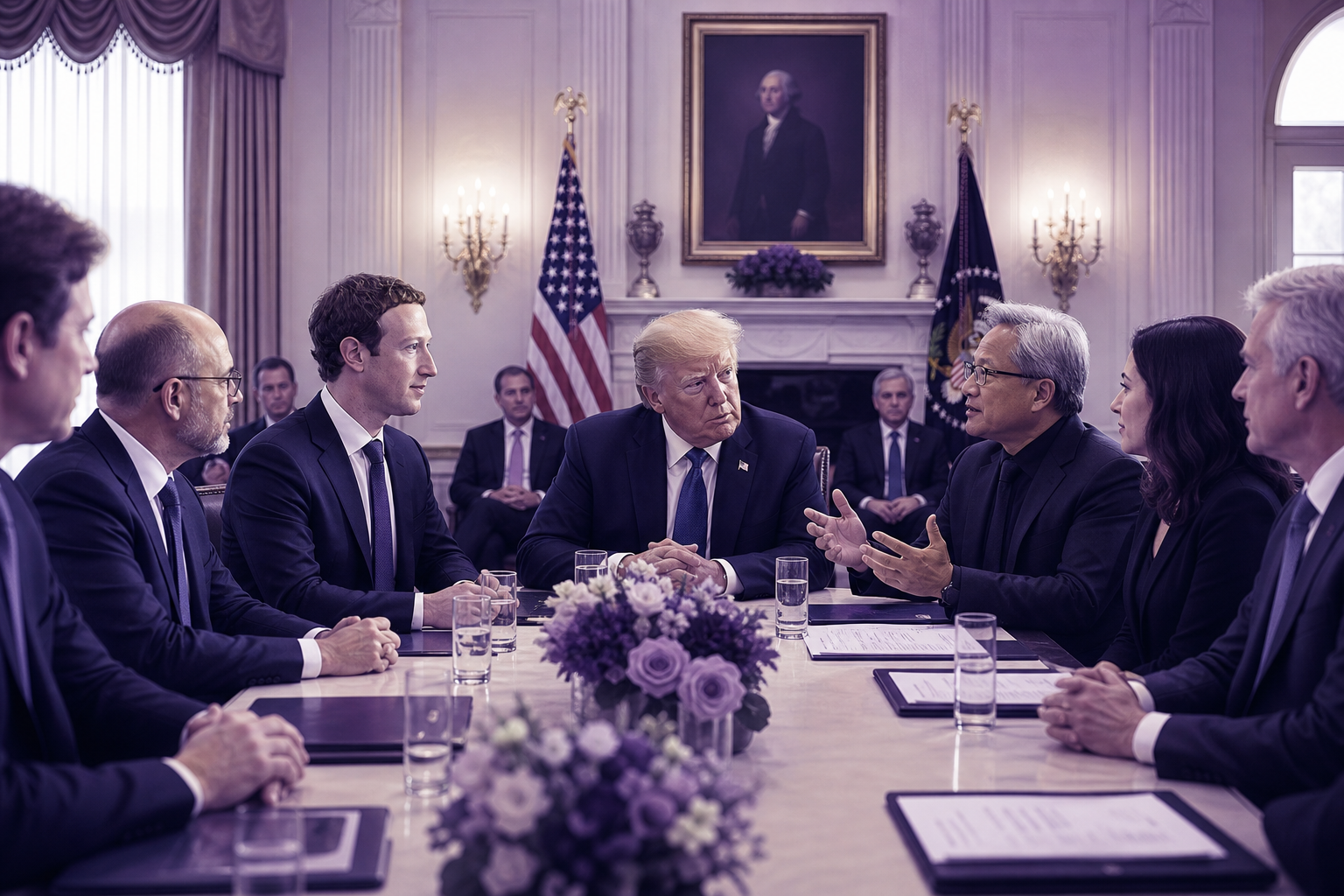
Self-regulation commitments were presented at the White House during a lunch with Donald Trump. Mark Zuckerberg, supported by Jensen Huang, played a central role in their development. Internal controls, external audits, and independent committees are planned, but no defined enforcement mechanism has been established, much to the dismay of critics.
Contested and Unenforceable Voluntary Commitments
The proposed pact relies on voluntary adherence, without a clearly defined enforcement mechanism, making the consequences of non-compliance uncertain. Some Democrats and security advocates argue that such a framework is unenforceable and fundamentally depends on the goodwill of the signatories. Donald Trump has been reluctant to implement additional safeguards, believing that existing laws are sufficient to mitigate AI-related risks. He also stated on Truth Social that a "strong and smart president" is the only necessary safeguard. The administration favors a light-touch approach to AI regulation, while Congress has yet to pass federal legislation on the matter.
What the Self-Regulation Agreements Entail
Companies are required to establish robust internal controls to monitor the capabilities of their AI models. It also includes collaboration with external auditors and the creation of independent committees tasked with reviewing the reports from these auditors. Mark Zuckerberg has presented these commitments as a starting point, likely to be adopted industry-wide.
From Idea to Lunch: Zuckerberg's Driving Role and Huang's Support
Mark Zuckerberg played a central role in the development of the AI agreements that emerged from a lunch involving Donald Trump and several tech industry leaders. With the support of Jensen Huang, he presented these agreements to senior White House officials during this lunch. Huang, along with some members of the Trump administration, contributed to shaping the pact ahead of the meeting. According to five sources familiar with the private meeting, Zuckerberg was instrumental in drafting these "morally binding" agreements discussed with Trump, Mike Johnson, and more than a dozen tech CEOs. The concept was first mentioned during a state dinner honoring Chinese President Xi Jinping, at which point Zuckerberg presented the idea to Mike Johnson. Shortly thereafter, he discussed the topic with Huang, who then helped rally support from leaders of major AI labs. During the period between this state dinner and the Tuesday lunch, the leaders maintained regular exchanges to finalize the document. Meta declined to comment, while Nvidia and the White House did not immediately respond to a request for comment.
An Ecosystem Divided Between Calls for Stricter Regulation and In-House Initiatives
Nvidia announced a new AI security system on Monday, presented as a response to autonomous hacks carried out by recently publicized malicious AI agents. Meanwhile, leaders like Dario Amodei (Anthropic) and Sam Altman (OpenAI) are calling for stricter government regulation and a slowdown in AI development. Mark Zuckerberg and Jensen Huang, for their part, have largely dismissed criticisms that AI poses an existential risk to humanity.
Brief IA — L'actualité IA en français
L'essentiel de l'actualité de l'intelligence artificielle, décrypté et expliqué chaque jour.