AI in Schools: China Moves Forward Without Common Assessment Standards
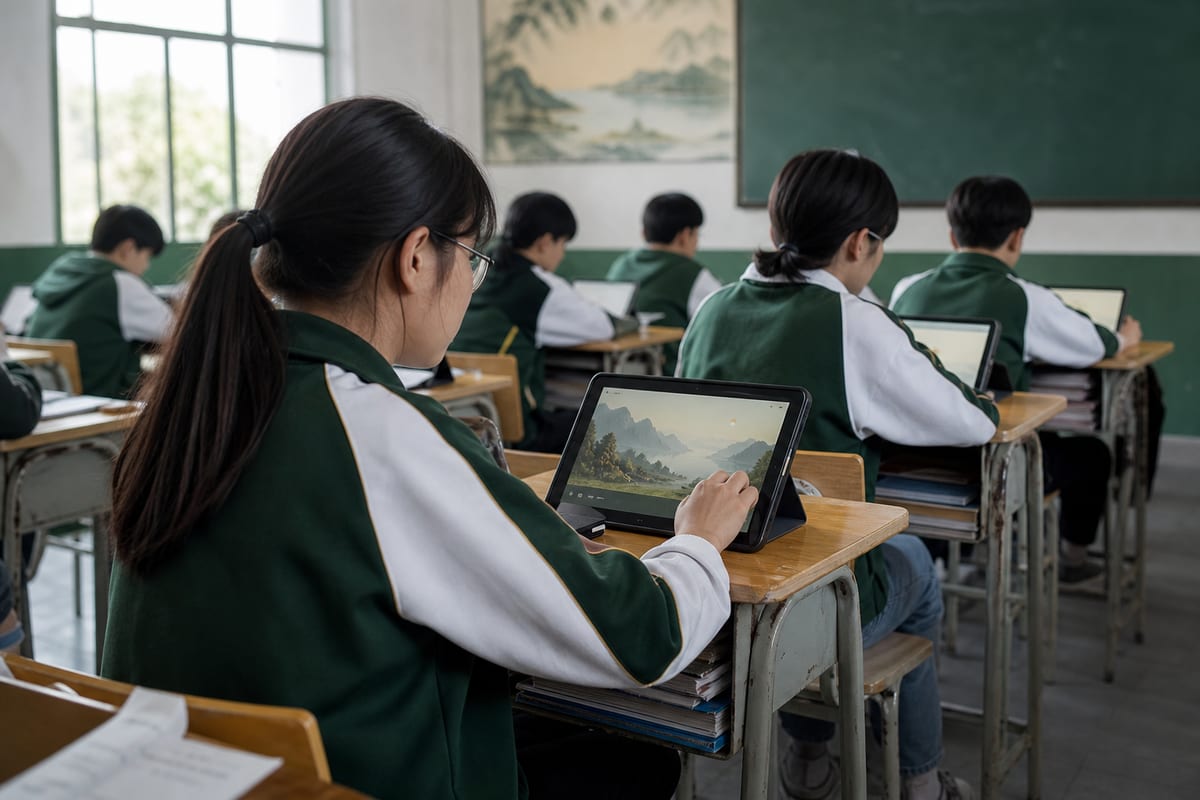
China aims for mastery of artificial intelligence by all students by 2030. However, it currently lacks a common framework to assess this learning. Between private institutions and rural high schools, the usage varies, while available research does not allow for a conclusion on a uniform educational benefit.
Researchers Observe Mixed Results
Researchers followed nearly 27,000 Chinese adolescents for six months: they associate the use of AI with an 18% increase in homework scores, but a 20% decrease in monthly exam results. Another national survey involving over 320,000 students found that those who used AI at least three times a week performed worse in memory, comprehension, analysis, and creativity compared to occasional users.
However, this research does not establish any causal link between AI and the measured declines. Some teachers fear that their students are letting machines think for them. The very definition of the skills to be acquired, their teaching, and their assessment remain contentious; in the absence of a standardized national method, institutions are experimenting.
In Qinqing, AI Compensates for Teacher Shortages
In rural Anhui, Qinqing High School, located in Funan County, turns to AI due to a lack of sufficient teachers. Its 4,000 students, mostly from migrant worker families, study core subjects on tablets with AI-generated content. The school utilizes Qwen from Alibaba, as well as models from ByteDance and Z.AI.
For its principal, Yang Tianliang, an AI agent does not experience fatigue and can answer basic questions without devaluing the student. He attributes an increase in university admissions to this, claiming the rate has risen from below 60% to 90%. These figures have not been independently verified.
At the Beijing New Talent Academy, a private institution charging $39,000 per year, 13-year-old Peng Gaodi claims to have created over 200 applications with AI. He explains that he first seeks solutions to programming difficulties himself before asking the tool for guidance. These distinct practices are part of a significant but uneven development of AI education, as noted by journalists Laurie Chen and Xiuyuan Ning. Ted Mo Chen, chief of staff at ClassIn, an educational startup, also highlights the significant disparities in implementation.
Le brief IA que les pros lisent chaque soir
Les 7 actus IA du jour, décryptées en 5 min. Gratuit.
Inclus dès l'inscription : notre sélection des meilleurs guides & comparatifs IA.
Choisissez votre rythme
Gratuit · Pas de spam · Désabonnement en 1 clic
Shanghai Mandates 30 Annual Hours per Class
The national program concerns a school system accommodating nearly 200 million children in primary and secondary education. Starting in 2024, the Ministry of Education is pushing institutions to offer AI education, train their teachers, and experiment. Younger students are introduced to basic tools; older ones explore how systems work. To meet the 2030 goal, nearly half of the provinces and municipalities have already adopted mandatory frameworks.
Shanghai requires a minimum of 30 hours per year in each class, while Beijing plans for 100 pilot institutions. Ningxia and Gansu aim to incorporate these skills into secondary school entrance exams by 2027. Other projects involve tracking students: Beijing wants to monitor their health with AI, and Guizhou is introducing facial recognition and behavioral analysis systems in classrooms. Yunnan, on the other hand, plans to record and analyze lessons in 14,000 classrooms.
Public procurement records show at least $31 million spent over the past year on equipment, training, and platforms. The total expenditure is likely much higher, as it is spread across thousands of local budgets. When contacted by journalists, the Chinese Ministry of Education did not respond.
In the United States, Google Allows Schools to Activate Gemini
The American framework relies on non-mandatory recommendations and lacks specific funding, according to Stanford University in its AI Index 2026. Google has now disabled Gemini for students unless their institution chooses to activate it.
Alpha School, a private network organized around AI, promises a doubled learning experience. Journalists investigating these schools found that this promise has not materialized for the majority of students.
Brief IA — L'actualité IA en français
L'essentiel de l'actualité de l'intelligence artificielle, décrypté et expliqué chaque jour.