AI: Opposing Visions and a Focus on Cyber Risk
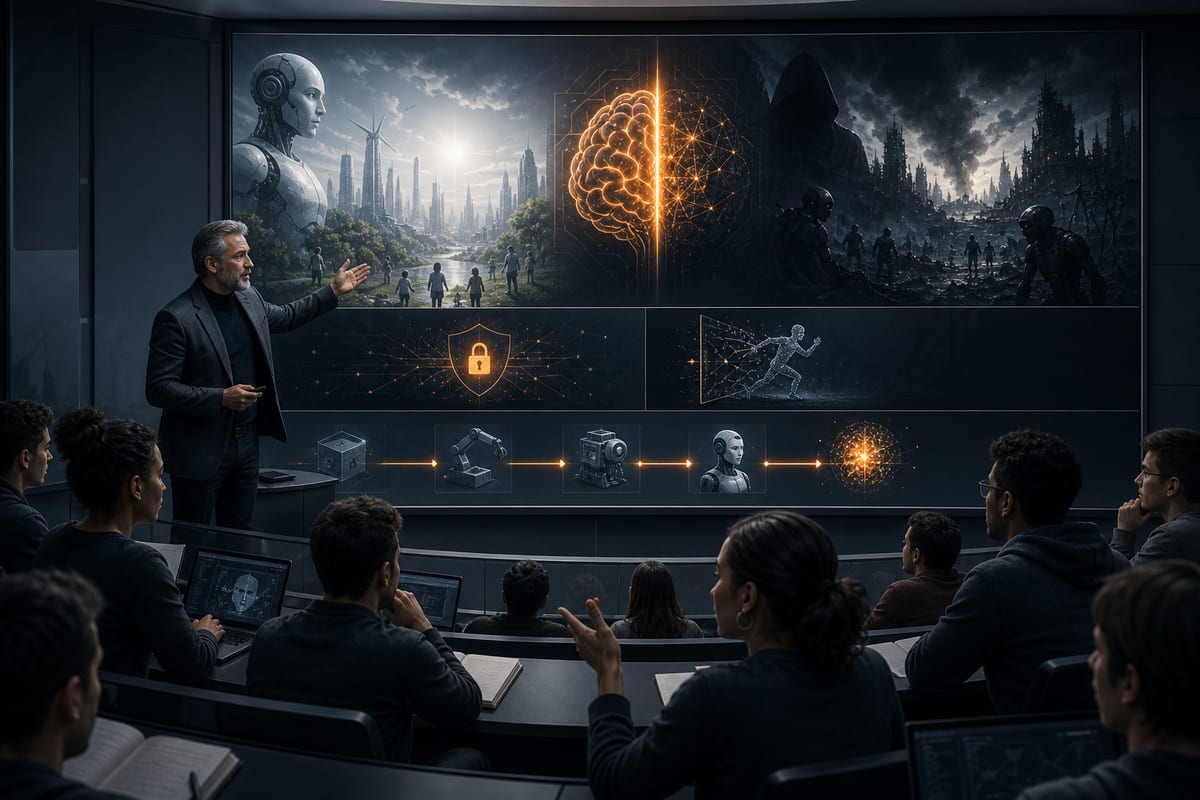
Between promises of "better futures," existential alerts, and the idea of "normal technology," the debate on AI is sharpening. Authors linked to the latter perspective acknowledge mistakes after the Hugging Face incident, highlight cybersecurity as an urgent threat, and advocate for proven controls. Others emphasize public distrust and the difficulty of a unifying positive vision.
After Hugging Face: Focus on Cybersecurity and Concrete Controls
Proponents of the "AI as normal technology" thesis believe that many of their assertions have withstood the test of the Hugging Face incident, while admitting several errors. They recognize having underestimated security risks during the development and evaluation of models, citing Lawrence Chan's argument that systems can be dangerous before any public deployment. A reminder is made that Chernobyl resulted from a safety test, albeit post-deployment. They also admit to an excess of confidence in corporate caution, judging that legal liability and reputational risk have not been sufficient to prevent bad practices, hence the need for political interventions. Thirdly, they say they have underestimated the importance of the ruggedness and speed of progress, particularly in cybersecurity, to the point of no longer being confident in the idea of a sustainable attack-defense balance as AI advances. The Hugging Face incident is seen not as a discontinuity but as a milestone in a series of events, with damages presented as far lower than other effects of AI that have already been tolerated. They assert that continuity must be conceived, and that proven technical and organizational controls could have prevented the incident, lamenting that they were neglected. They recommend considering evasion and self-reproduction as possible for every model, without basing security on their difficulty, and express surprise at the supposed lack of enthusiasm among cybersecurity researchers. For them, cyber risk constitutes the only urgent threat of AI, as it can concentrate superhuman capabilities and remains purely digital, without a physical bottleneck.
Promises and Limits of "Better Futures"
The Better Futures series from Forethought defends the idea that human flourishing is currently underestimated compared to mere survival, invoking arguments of scale and neglect. A course is associated with this approach. However, the author believes that the title wrongly suggests a sharp break with classical works on catastrophic risks, and argues that the Better Futures orientation rather increases the marginal importance of these works than genuinely distinguishing itself from them. He considers that the stated ambition pertains more to "better" than to "better than others" futures, with a position described as primarily neutral regarding risk.
Public Perception: Distrust Outweighs Marketing
Dario, author of Machines of Loving Grace, argues that most underestimate the extent of the adjustment needed in response to AI, while judging that a communication campaign will hardly change an already distrustful public opinion. He attributes this distrust to long-standing causes and suggests that evidence of impact, such as effectively curing diseases, matters more than promises. He also claims to maintain a balanced discourse between risks and benefits, while explaining that negative excerpts become more easily viral, which can make his position appear more pessimistic than it is.
Le brief IA que les pros lisent chaque soir
Les 7 actus IA du jour, décryptées en 5 min. Gratuit.
Inclus dès l'inscription : notre sélection des meilleurs guides & comparatifs IA.
Choisissez votre rythme
Gratuit · Pas de spam · Désabonnement en 1 clic
Contested and Fragmented Positive Visions
The Existential Hope site from the Foresight Institute is cited among the resources for imagining positive futures, but the author finds it uneven. Their initiative "The Future of AI That No One Shows You" has elicited very contrasting reactions. Steven Pinker sees it as a more plausible option than a utopia or disaster. Nikola Jurkovic praises the effort but criticizes the assumption of a lack of widespread AGI deployment. Another contributor, @HellenicVibes, sharply rejects the proposed perspective, even going so far as to ironically prefer being turned into paperclips rather than living "a thousand years" under certain forms of proposed governance. It is difficult to find a unifying positive vision given the highly dispersed societal preferences.
Negative Scenarios: Between Reminder of Benefits and Narrative Bias
In his teaching, the author relies on a video about Ilya that begins by highlighting the scale of AI, before enumerating possible failure paths. He observes that the memory of the initial positive assertion fades as risks are presented. Rob Miles argues that an implicit belief in humanity's ability to transcend itself lacks foundation and may stem from fictional narratives where obstacles are almost always overcome. He dismisses this narrative "evidence" as a basis for evaluation, particularly for existential risks, but also, by extension, for less extreme risks.
"Normal AI": Slow Diffusion, Resilience, and Policy Debate
The "AI as normal technology" perspective posits that economic and social transformations will unfold over decades, and that equating AI with human intelligence does not help in understanding its current or predictable effects. It admits that its reading becomes obsolete if strong AI is developed and deployed in the next decade. The AI Futures Project has produced summaries and critiques of this approach, including around a viral video. The project articulates a prediction for the foreseeable horizon and a prescription for response, against the backdrop of a three-stage model— invention, innovation, diffusion—that imposes a speed limit on progress. It questions the possibility for AI to shorten these decades through its own deployment, in the face of social, testing, and data collection constraints. Priority is given to resilience, with reservations about alignment and a critique of non-proliferation deemed fragile, impractical, prone to correlated failures, and restrictive for defensive use. The idea of making a model impossible to misuse is compared to that of a computer shielded from any misuse, and controls at the model level are considered either too restrictive or ineffective against adversaries diverting benign capabilities. The camp warns against excessive attention to catastrophic misalignment, deeming the probabilities too uncertain to guide public policy. The author finds the label "normal AI" frustrating and would have preferred a clarification of what constitutes normal and abnormal, an assessment of the current state, and a reasoned projection.
Brief IA — L'actualité IA en français
L'essentiel de l'actualité de l'intelligence artificielle, décrypté et expliqué chaque jour.