AI: Washington Bets on the AP1000, China Accelerates
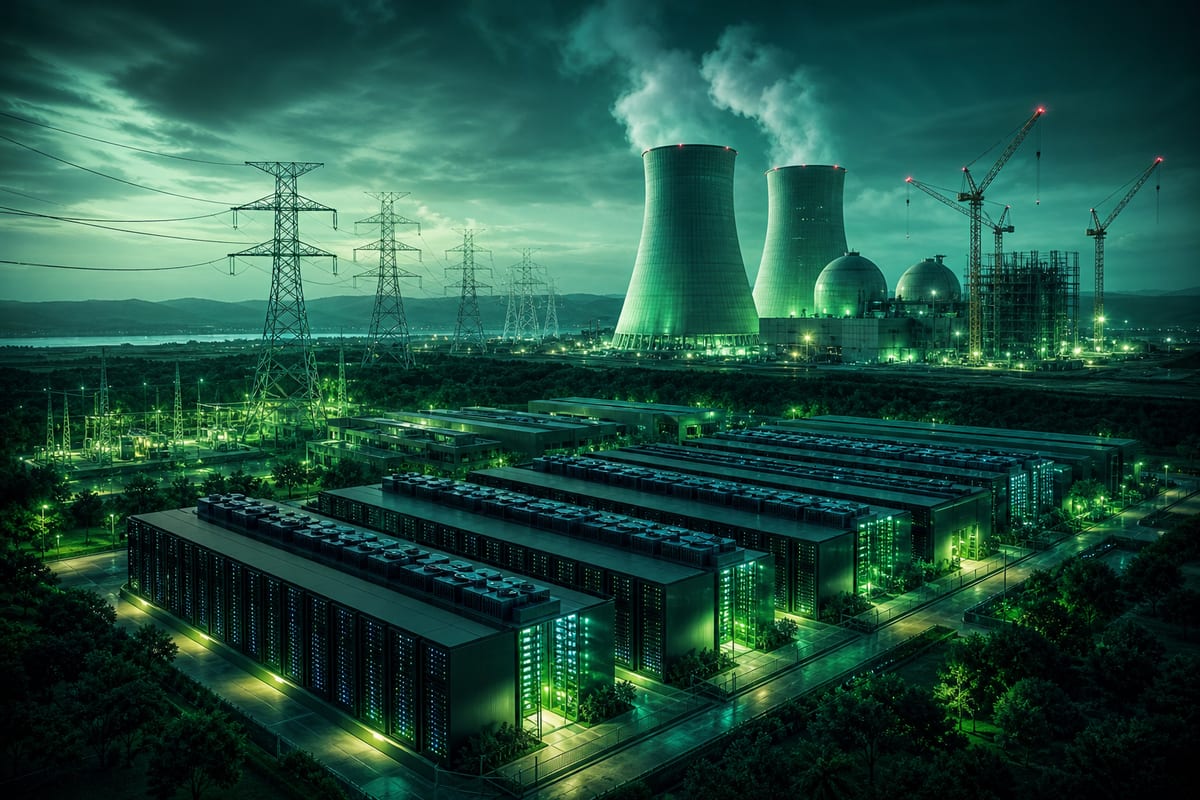
The rise of data centers is prompting states to secure abundant and stable electricity. In the United States, the executive branch is relying on fleets of AP1000 reactors, targeted loans, and financing frameworks, while Beijing is ramping up construction and keeping pace. Decisions on who pays and the rapidly evolving public opinion on nuclear energy will shape the future.
Who Pays What: Private Commitments, FERC Rule, and Blocked Legislation
The cost of new electricity needed for data centers is at the heart of the equation. In March 2026, seven tech giants including Amazon, Google, Meta, and Microsoft signed a consumer protection commitment, which was expanded in July to include utilities, developers, and states. The White House now counts over 280 signatories and 23 states. The signatory companies commit to establishing or acquiring a specific energy source, covering all costs related to transmission infrastructure, paying the set rates whether they use the energy or not, and working with network operators on resilience issues. According to the executive branch, this commitment pertains to about 80% of the energy supplied to households and businesses, but it remains voluntary and non-binding at the federal level, a scope that some analysts consider essentially symbolic.
On June 18, the Federal Energy Regulatory Commission required the six regional network operators under its jurisdiction to review or justify the connection terms for large loads such as data centers, with studies limited to a period of 60 to 90 days, as well as obligations regarding cost transfer and co-location with production. Meanwhile, the Consumer Protection Act passed the House with a vote of 417 to 3 before failing in the Senate over the voluntary or mandatory nature of the obligations. A consensus remains on the principle that data centers should cover their costs, with the mechanism still to be determined. The EPRI notes that between 2015 and 2024, the growth of data centers modestly reduced average residential rates nationally by better distributing fixed costs, while in the PJM, it accounted for about half of the recent capacity price increases. Properly designed, new nuclear and generation capacities can shift the investment burden to industrial users rather than households.
American Industrial Capability: AP1000, Loans, and Korean Framework
The two AP1000 reactors commissioned at Vogtle serve as the technical and regulatory benchmark in the United States: they are the only large advanced commercial reactors to have been fully designed and authorized for operation in the country. In May 2025, Executive Order 14302 set the goal of starting construction on 10 large reactors with finalized designs before 2030. In October 2025, the Department of Commerce formed a partnership with the owners of Westinghouse, Cameco, and Brookfield around at least $80 billion worth of AP1000 projects, with the state aggregating financing and permitting support and expecting to receive 20% of Westinghouse's cash distributions beyond $17.5 billion once construction commitments are made.
On June 23, 2026, the Department of Energy conditionally approved up to $17.5 billion in loans for the acquisition of long-lead equipment—such as heavy forgings, pressure vessels, turbines, and generators—for 10 AP1000 units spread across a maximum of five sites, each containing two reactors. For each project, ownership must be shared between Westinghouse and an electricity supplier, with each party investing $500 million in equity, and Westinghouse has signed letters of intent with seven potential partners that already have sites. The early purchase of critical components is expected to shave up to three years off the construction schedule.
Two additional milestones were established in October: a framework with South Korea to build six AP1000 and two APR1400 reactors in the United States, valued at $120 billion with a $10 billion down payment due before the end of the year, and the inclusion of these eight units in the national goal of 10 reactors. The locations have not yet been made public, with Cameco indicating deployment on federal lands starting with two AP1000 reactors. Additionally, the Nuclear Regulatory Commission extended the design certification of the AP1000 until 2066, incorporating about 200 amendments based on the experience from Vogtle. The current reference reflects how Vogtle 3 and 4 were built and operated, allowing future project developers to rely on it without needing to seek approval for these already vetted changes. Ho Nieh, president of the NRC, describes the ambition as a shift from isolated units to large-scale deployment. However, this certification does not grant any site authorization, with each project remaining subject to its own permits.
Le brief IA que les pros lisent chaque soir
Les 7 actus IA du jour, décryptées en 5 min. Gratuit.
Inclus dès l'inscription : notre sélection des meilleurs guides & comparatifs IA.
Choisissez votre rythme
Gratuit · Pas de spam · Désabonnement en 1 clic
Speed and Volume: China Multiplies Construction Sites
China's trajectory is marked by its pace and scale. Between 2016 and 2024, the installed nuclear power capacity in the country increased by 76%, representing about 24 gigawatts added over eight years. As of May 2026, China operates 60 reactors representing nearly 59 gigawatts and has 36 more under construction, which accounts for about half of the nuclear projects currently underway worldwide. According to the International Energy Agency, nine of the ten nuclear construction starts planned for 2025 are located in China. This progress is supported by standardized batches and predominantly domestic components, with an average construction time estimated by the EIA at about six years between 2012 and 2021, compared to about nine years globally. In contrast, it is noted that the last two reactors in the United States took about fifteen years to complete.
On July 31, 2026, the State Council approved eight additional reactors across four projects located in Zhejiang, Guangdong, Liaoning, and Shandong, with an estimated cost exceeding 160 billion yuan (about $24 billion). Six are based on the Hualong One design and two on the Guohe One. This momentum aligns with a target of approximately 110 gigawatts installed by 2030, and a projection of 150 gigawatts by 2035 from the China Nuclear Energy Association. China is on track to surpass the United States and the European Union in installed capacity by 2030, according to some estimates. The comparison remains unfavorable for the United States in terms of speed: China has approved eight reactors in a single meeting, while Washington has yet to announce sites or commence work on its new program.
American Starting Point: A Large but Aging Fleet
The United States remains the leading nuclear nation by the size of its fleet, with 94 reactors in operation for about 97 gigawatts. This fleet was primarily built between the 1960s and the late 1980s, before a near halt in construction. Unit 1 of Watts Bar, initiated in 1973 and commissioned in 1996, marked the end of this period. Since then, only three reactors have joined the grid: Watts Bar Unit 2 in 2016 and Vogtle Units 3 and 4 in 2023 and 2024. Vogtle illustrates the pitfalls encountered: approximately $35 billion in total cost, against an initial budget of about $14 billion, and nearly seven years of delays in delivery.
AI Demand Drives Towards Dispatchable and Low-Carbon Production
The rise of AI is inseparable from a massive increase in electricity needs. An academic estimate puts the capacity of American data centers expected by 2032 at 188 gigawatts, a load that, at full capacity, would equate to the annual consumption of the current American residential sector. In this context, nuclear energy presents several sought-after characteristics: it generates no carbon emissions, operates continuously without depending on weather conditions, and its density allows for the installation of capacities close to gigawatt-level loads without requiring a redesign of the regional grid. Small modular reactors offer an alternative when the standard size of 1.1 gigawatts is not suitable; an agreement signed in January 2026 between Meta and TerraPower could enable the commissioning of up to eight reactors of this type.
Opinion and Incentives: From Taboo to Tax Credit
The restart of programs cannot be explained without a recent shift in perceptions about nuclear energy. For a long time, nuclear power was kept at bay from the notion of clean energy, associated in the collective imagination with Three Mile Island, Chernobyl, or Fukushima rather than with zero emissions, and opposed by part of the environmental movement in favor of solar and wind energy. In recent years, activists and climate scientists have reevaluated its role in decarbonization. On the economic signal front, the Inflation Reduction Act of 2022 established a production tax credit for existing facilities, enhancing the viability of assets already in service.
Brief IA — L'actualité IA en français
L'essentiel de l'actualité de l'intelligence artificielle, décrypté et expliqué chaque jour.