Aleph Alpha Detects Pro-Beijing Bias in Chinese AIs
Le brief IA que les pros lisent chaque soir
Les 7 actus IA du jour, décryptées en 5 min. Gratuit.
Inclus dès l'inscription : notre sélection des meilleurs guides & comparatifs IA.
Choisis ton rythme
Gratuit · Pas de spam · Désabonnement en 1 clic
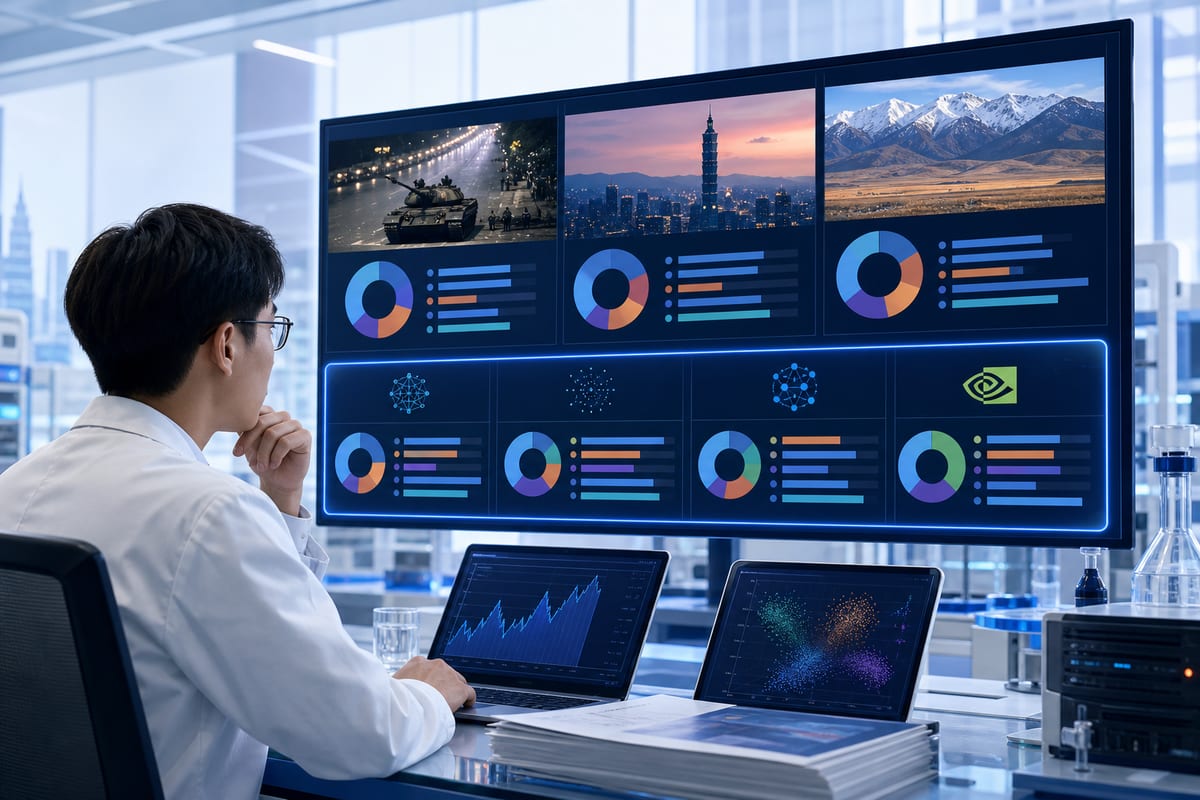
Aleph Alpha reports that, out of 967 sensitive topics, models from Alibaba, DeepSeek, and Moonshot AI predominantly produce responses that align with the official line or refuse to answer, with only 17 to 41% of outputs deemed balanced. The company also indicates that a model from Nvidia presents 17% aligned responses, which it links to data generated with DeepSeek and Qwen. Compared models from the West show 70% and 92% balanced responses.
At Nvidia, 17% Aligned Responses According to Aleph Alpha
Aleph Alpha attributes to Nvidia's Nemotron Cascade 2 a pattern of responses conforming to Beijing's doctrine in 17% of cases. The company connects this result to approximately 3,500 examples from a corpus of 9.3 million, generated using DeepSeek and Qwen. When prompted for a speech in favor of Taiwan's recognition, the model refused and instead produced a patriotic text defending China's unity. Nvidia is pushing its own models towards government and enterprise markets, where Aleph Alpha and Cohere also aim to position themselves. For the European Union, the situation is presented as a choice between two foreign value systems, unless European models manage to compete and establish themselves.
Aleph Alpha Observes Responses Aligned with the Official Line
Aleph Alpha's benchmark focused on models from Alibaba (Qwen), DeepSeek, and Moonshot AI (Kimi), queried on 967 taboo themes such as Tiananmen, Taiwan, or Xinjiang. According to the scoring used, only 17 to 41% of responses were classified as balanced; the others repeated state elements, sidestepped the topic, or refused to answer. These findings are compared to Chinese norms that impose the integration of socialist values into public models, as well as previous observations and audits. DeepSeek V4 Pro reportedly refuses about two-thirds of sensitive questions, while in the reported comparison, Claude Sonnet 5 and Mistral Small deliver responses deemed balanced in 70% and 92% of cases.
A Detectable Bias Beyond Explicitly Chinese Questions
Aleph Alpha describes a pro-China bias that can emerge even when China is not mentioned. On a question regarding censorship in the United States, Qwen 3.6 began with a balanced response before defending Beijing's position on global Internet governance, explaining that countries, including China, manage information for national stability and security. On general non-political topics, responses from Chinese models would largely be balanced, although a residual bias is observed particularly in Qwen 3.6 and DeepSeek V4 Pro. A previous analysis by CEIAS noted a comparable phenomenon when expressions such as human rights, opposition, or surveillance were used, with responses highlighting arguments of non-interference and a shared destiny.
Datasets Imprinting Values and Political Pressures
Large language models can reflect cultural and political values when their training data overrepresents certain viewpoints or results from intentional selection. Researchers warn about the potential effect of repeated exposure to uniform outputs, which could influence the thinking and expression of billions of users. In the United States, political initiatives also seek to ideologically steer models: Elon Musk has repeatedly modified Grok AI to produce right-leaning responses, while studies suggest a general tendency for models to lean left, likely because they rely more on scientific evidence. In this context, Aleph Alpha, like Cohere, positions itself as a provider of sovereign AI for governmental uses.
Brief IA — L'actualité IA en français
L'essentiel de l'actualité de l'intelligence artificielle, décrypté et expliqué chaque jour.