Alibaba: Two Medical AIs, Promises and Challenges
Le brief IA que les pros lisent chaque soir
Les 7 actus IA du jour, décryptées en 5 min. Gratuit.
Inclus dès l'inscription : notre sélection des meilleurs guides & comparatifs IA.
Choisis ton rythme
Gratuit · Pas de spam · Désabonnement en 1 clic
Alibaba, through its DAMO Academy, presents EAGLE and RADAR, two AI systems trained on large cohorts to read existing scans. The published results report high sensitivities, broad anatomical coverage for the abdomen, and a measured gain for radiologists. The EAGLE code is not public, RADAR remains confined to research, and larger-scale trials are required before any authorization.
Publications, Code Access, and Permissions Still Needed
The performance of these systems has been published in Nature Medicine and Science. The source code of EAGLE is not accessible, as it is protected by patents, which limits the possibility of independent verification by other researchers. For RADAR, resources are available on GitHub, but the model remains strictly reserved for research. Before clinical use, larger-scale trials are necessary to obtain authorization from health authorities. It remains to be demonstrated that the results hold up with different imaging equipment and across varied populations.
EAGLE Reads Chest Scans and Achieves 90% Sensitivity
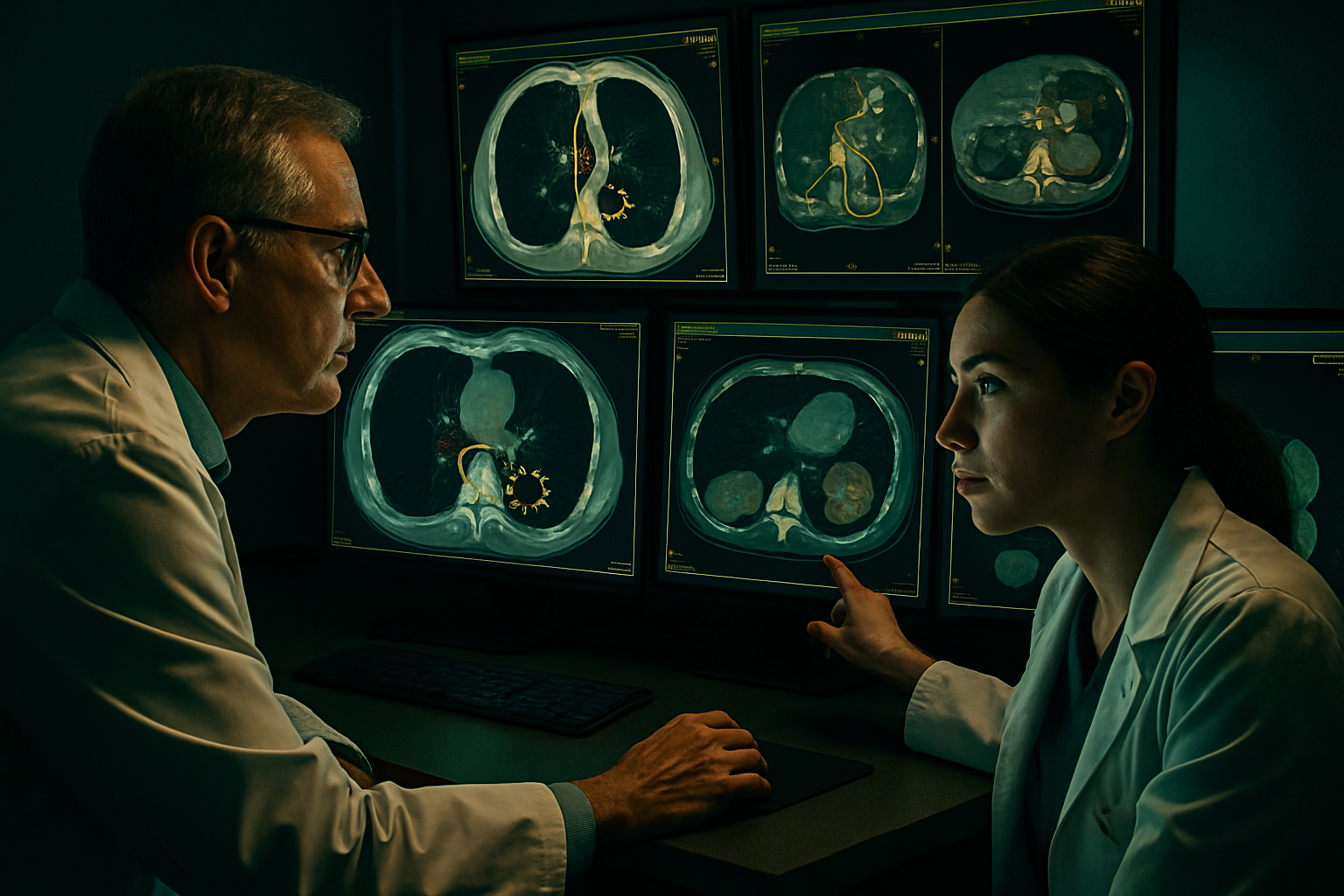
Designed by the DAMO Academy, EAGLE leverages chest scans already performed during routine check-ups or lung screening programs, eliminating the need for new examinations. The algorithm was trained on 6,813 patients and tested on over 80,000 records, particularly in China, the Czech Republic, and Russia. It achieves 90% sensitivity for confirmed cancers and 52.5% for precancerous lesions, with a specificity of 98.5%. Out of 100 healthy individuals, nearly 99 are correctly identified as disease-free. In a test involving 17 radiologists, EAGLE's assistance raised their overall detection rate from 71.9% to 85.7%.
RADAR Covers 18 Structures and 146 Anomalies in the Abdomen
RADAR is a vision-language model designed for versatile use at the abdominal cavity level. This system was trained on over 400,000 injected scans and 15 million medical images linked to their textual reports, from which it learned vocabulary and descriptions without requiring manual annotations for each image. During its evaluation, it is capable of examining 18 anatomical structures and identifying 146 anomalies or diseases. In a comparative trial involving 26 radiologists, RADAR's support increased their diagnostic sensitivity by about 10%, particularly due to the automatic pre-identification of suspicious areas.
Support for Clinicians to Prioritize Further Examinations
According to the DAMO Academy, these tools are not intended to replace human expertise but to assist in the rapid triage of cases, guiding earlier referrals for further examinations. They produce diagnostic elements from already available imaging, without imposing new medical procedures. Alibaba presents EAGLE for esophageal cancer screening, a challenging clinical context due to the organ's movements, and RADAR for the abdomen, positioned as an aid to radiologists. The DAMO Academy, Alibaba's technological and scientific research subsidiary, is driving these developments.
Brief IA — L'actualité IA en français
L'essentiel de l'actualité de l'intelligence artificielle, décrypté et expliqué chaque jour.