Alibaba Launches Qwen3.8-Max, a 2.4 Trillion Parameter AI
Le brief IA que les pros lisent chaque soir
Les 7 actus IA du jour, décryptées en 5 min. Gratuit.
Inclus dès l'inscription : notre sélection des meilleurs guides & comparatifs IA.
Choisis ton rythme
Gratuit · Pas de spam · Désabonnement en 1 clic
Alibaba Launches Qwen3.8-Max, AI with 2.4 Trillion Parameters
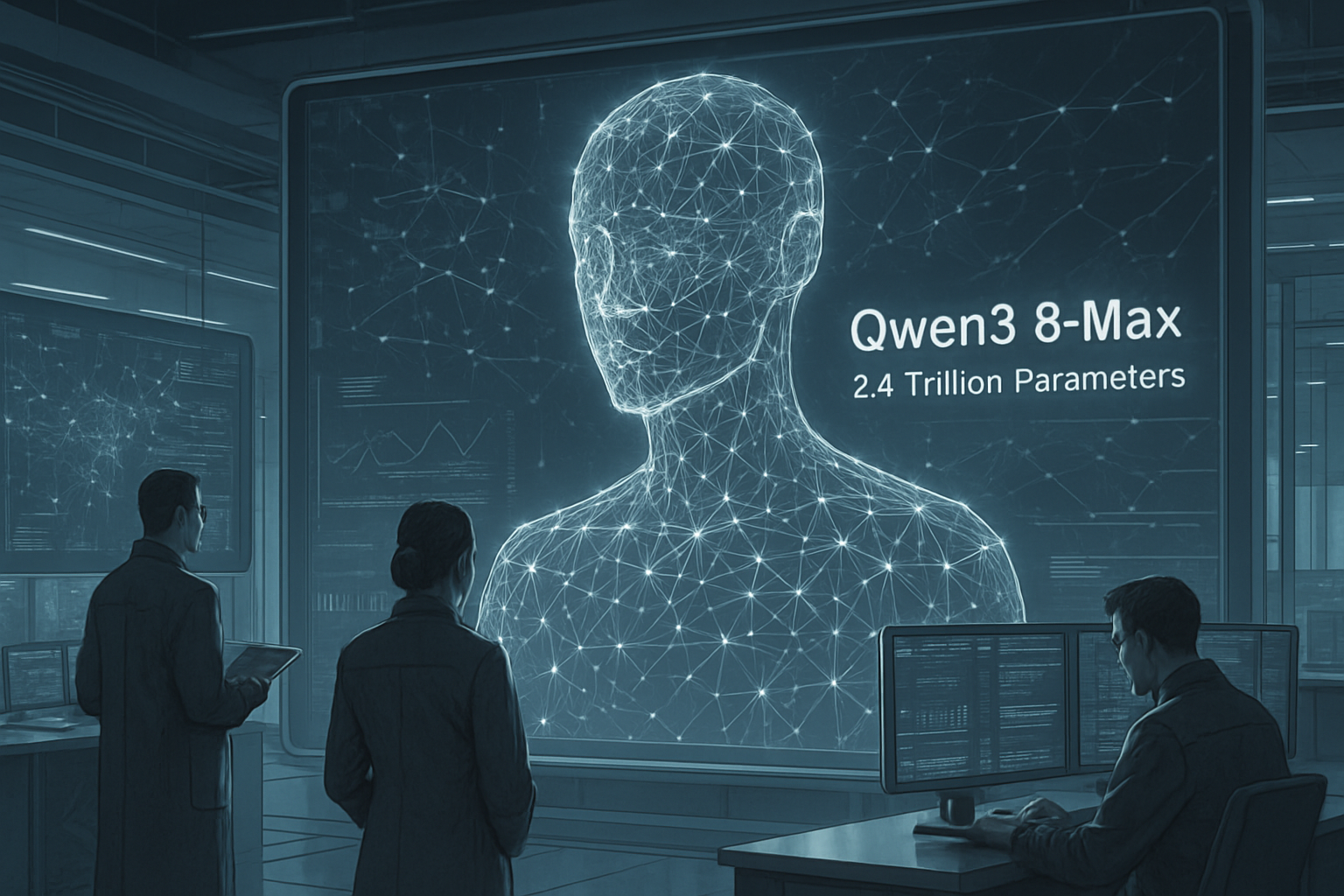
Alibaba has unveiled Qwen3.8-Max, a language model with 2.4 trillion parameters designed to autonomously perform complex tasks over several days.
In tests, the model autonomously built software, reproduced and improved upon the results of a research paper, and successfully managed a simulated e-commerce business. Internal benchmarks place its performance on par with the best Western models. Qwen3.8-Max is available now, with weights set to be released next week.
Alibaba's new flagship model, Qwen3.8-Max, is designed to handle complex tasks autonomously over extended periods, ranging from reproducing research articles to chip design. The team plans to publish the weights next week.
The Alibaba Qwen team presented Qwen3.8-Max, its most powerful language model to date. The model spans 2.4 trillion parameters in total, with 95 billion active per query. Qwen3.8-Max builds on the Qwen3.5 architecture, and the team indicates that the focus is on accomplishing complex tasks independently over prolonged periods, rather than merely responding to one-off queries.
Alibaba initially announced the model in mid-July as a preliminary version available through Alibaba's Token plan, Qoder, and QoderWork at ten percent of the standard price. At that time, the team had already cited 2.4 trillion parameters and ranked the model just behind Fable 5, but had not shared benchmarks. Qwen3.8-Max is the first model in the Qwen-Max class whose weights will be made public.
Three Autonomous Coding Executions Put the Model to the Test
To demonstrate the coding capabilities of Qwen3.8-Max, the team presented three case studies in which the model worked without any human assistance.
-
In the first case, Qwen3.8-Max spent 16 days building the command-line tool oh-my-cli. The model took user requests, transformed them into GitHub issues, self-assigned these tasks, wrote the code, conducted tests, and iteratively improved the results. By July 30, 2026, it had accumulated 265 commits, 127 pull requests, and 151 issues, all without human intervention.
-
In the second case, the model received the research paper "Unified Data Selection for LLM Reasoning" without any starting code. Its task was to reproduce the results of the paper and improve upon them. Over a period of about five days and approximately 125 hours of compute time, Qwen3.8-Max wrote 7,600 lines of code and executed 33 GPU training jobs, according to the team. It first reproduced the six main results of the paper. Then, it tested 18 of its own ideas over four cycles and surpassed the paper's method on the AIME24 mathematical benchmark by 2.7 points.
-
The third case involved the multimodal dialogue intent recognition challenge WWW2025 on Alibaba's Tianchi platform, where 526 human teams competed. In 24 hours, the model refined several Chinese language models as well as Qwen2.5-VL-7B for product screenshots and combined them into a voting system. Out of 45 submissions, accuracy improved from 0.60 to 0.853. This placed Qwen3.8-Max ahead of 458 out of 526 human teams.
Chip Design and Simulated Fiscal Testing for Long-Term Planning
Two other case studies target tasks that span hundreds of interaction cycles. In the first, Qwen3.8-Max was tasked with designing a cryptographic building block for encryption schemes. The main efficiency metric for such a circuit is the number of logic gates required, the basic elements of a chip. The fewer gates there are, the smaller and more efficient the chip. The model started with a functional but cluttered design using 8,298 gates and reduced it to 678 gates after about 500 iterations.
After an automated layout pass using the open-source tool OpenROAD, the physical area of the chip decreased from 106x106 to 46x46 micrometers, representing an 81% reduction. The Qwen team claims that the model continued to make deep structural changes even after hundreds of iterations, rather than settling for superficial modifications.
The second case study is E-Commerce-Bench, a simulation of a full fiscal year in online commerce based on anonymized data from Taobao and Tmall. The model starts with 100,000 yuan in capital and must manage multiple online stores simultaneously over a full year. This involves purchasing products, negotiating with suppliers in natural language, adjusting prices, managing returns, and dealing with crises like typhoons or supply chain disruptions.
Hidden within the supplier pool are 152 scammers that the model must identify. Qwen3.8-Max finished with a balance of 416,252 yuan, quadrupling its initial capital. This is 38% more than the second-place model, GLM 5.2, and over 2.5 times what its predecessor Qwen3.7-Max achieved. The model aggressively invested early in the year and realized a net profit of over 100,000 yuan during the holiday season.
Multimodal Skills and Application Reconstruction Without Source Code
For multimodal tasks, Qwen3.8-Max can process documents of over 200 pages and videos exceeding 100 hours, according to the team. They also introduce RecreationBench, a new benchmark that requires the model to reconstruct functional applications without access to the source code.
The model can only observe the target application through interaction, meaning clicks and keyboard inputs. Tests cover Ubuntu, macOS, Windows, Android, and the web. Simultaneously, the team is releasing Qwen-MM-Plugins, a library of extensions that adds image and video processing, visual tool usage, and multimodal memory to existing agent systems.
Benchmark Results and Competition in China
Alibaba's benchmark results for Qwen3.8-Max in coding, agent work, reasoning, and multimodal tasks compare it to other leading models. In the benchmark tables published by the Qwen team, the model ranks near or above Claude Opus 4.8, Claude Fable 5, and GPT-5.6 Sol in many categories. On PaperBench, Qwen3.8-Max achieves 93, the highest score in the comparison. On TerminalBench 2.1, it scores 86.6, behind GPT-5.6 Sol's 88.8. As is typical with self-reported figures from model manufacturers, these results come from internal executions. Independent verification is still pending.
The Qwen team attributes the model's ability to support such long-duration tasks to a major expansion of training environments during reinforcement learning. Training has shifted from focusing solely on single tasks to covering multi-day workflows, nested directory structures instead of individual files, and a variety of agent harnesses.
The team's internal score index across more than ten benchmarks has risen from 0.474 to 0.725. The model achieved the best results with around 4,000 environments, after which scores slightly declined.
As the number of RL training environments and compute time increases, Qwen3.8-Max's scores consistently rise across dozens of internal and public benchmarks, according to the Qwen team.
The Race for Open Models in China Intensifies
Qwen3.8-Max's most direct rival also comes from China. Moonshot AI released Kimi K3 with open weights on Hugging Face on July 27, a multimodal model mixing experts with 2.8 trillion parameters and a context window of one million tokens. In addition to the weights, Moonshot also released parts of its own infrastructure, including attention kernels, a MoE communication library, and tools for running agents at scale. However, independent testing has tempered the company's claims. K3 has fallen well short of the best Western models in both cyber capabilities and complex mathematics.
Qwen3.8-Max is available now via QwenCloud. The weights will be uploaded to Hugging Face and ModelScope next week. The model supports both OpenAI's chat completion format and Anthropic's API protocol, allowing it to connect directly to Claude Code, Codex, Qoder CLI, Qwen Code, and OpenClaw. A parameter called reasoning_effort allows users to choose between three levels that trade speed for comprehensiveness.
Qwen indicates that the model operates similarly across different agent harnesses and is not specifically tuned for its own environment.
Qwen3.8-Max is not the only new addition Alibaba has recently made. A few weeks ago, the team introduced Qwen-Image-3.0, an image generator for information-dense layouts that handles inputs of up to 4,500 tokens and renders text readable as small as ten pixels. At the other end of the spectrum, Alibaba continues to promote small open models like Qwen3.6-35B-A3B, which has 35 billion parameters in total but activates only three billion at a time.
Brief IA — L'actualité IA en français
L'essentiel de l'actualité de l'intelligence artificielle, décrypté et expliqué chaque jour.