Alibaba Aims for 500,000 Connected Chips and 20 GW by 2032
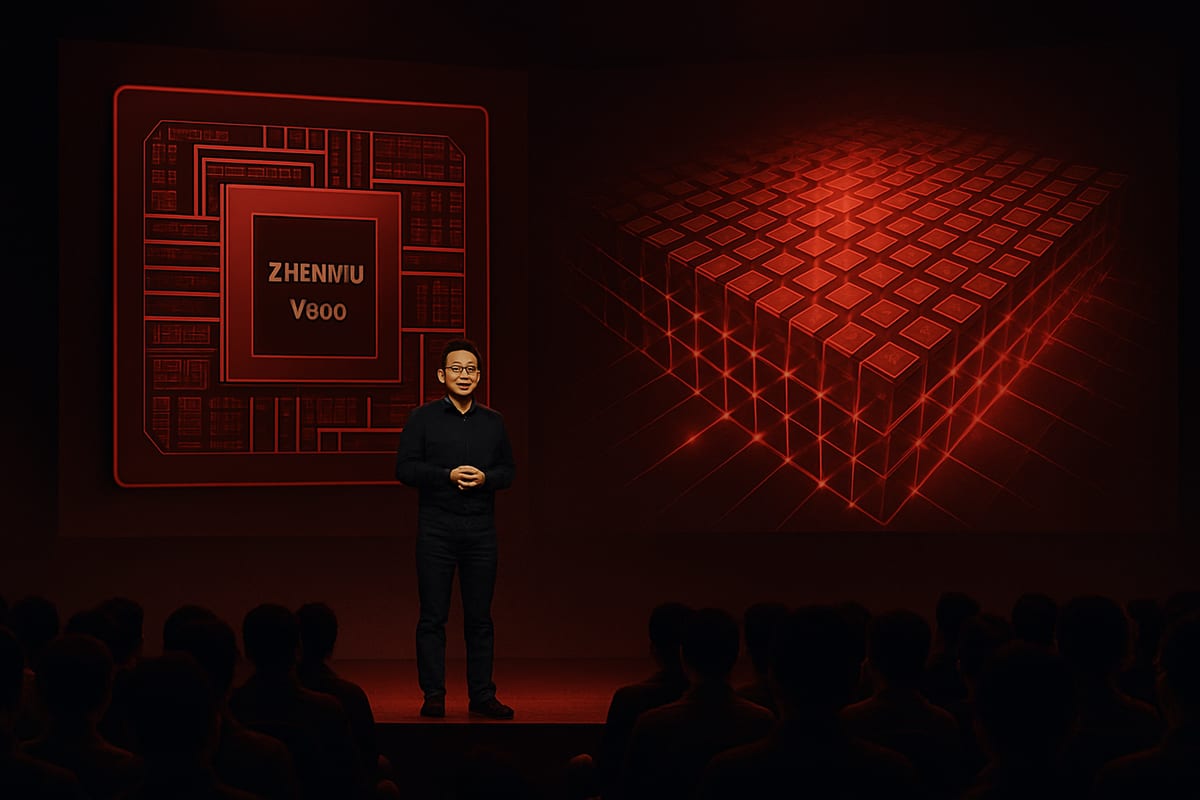
The Chinese group unveils the Zhenwu V900, its AI chip touted to be three times more powerful than the M890 and intended for mass production in the first quarter of 2027. Meanwhile, Alibaba is pushing for very large cluster architectures, planning 20 GW of data center power by 2032, and accelerating the Qwen model family.
Clusters of up to 500,000 processors and 20 GW targeted
The Zhenwu V900 has been designed to be connected in very large sets, with up to 500,000 interconnected processors. Alibaba is also setting an infrastructure target: 20 gigawatts of cumulative capacity for its data centers by 2032. These choices align with international ambitions in the cloud, competing with AWS, Microsoft Azure, and Google Cloud.
The Zhenwu V900, technical specifications and production timeline
Eddie Wu, CEO of Alibaba, presented the Zhenwu V900 in Hangzhou during the Apsara conference. The company describes it as the most powerful Chinese AI chip to date and announces a tripled power compared to the M890 model. Large-scale commercialization is expected in the first quarter of 2027.
Le brief IA que les pros lisent chaque soir
Les 7 actus IA du jour, décryptées en 5 min. Gratuit.
Inclus dès l'inscription : notre sélection des meilleurs guides & comparatifs IA.
Choisissez votre rythme
Gratuit · Pas de spam · Désabonnement en 1 clic
Alibaba connects numerous processors to bypass U.S. restrictions
Due to restrictions imposed by the United States, which limit access to advanced technologies, Alibaba opts for the combination of multiple processors instead of relying solely on the increased performance of a single chip, contrary to the strategy typically associated with NVIDIA. Huawei is taking a similar approach, and its Ascend AI chips are gradually gaining ground in the Chinese market.
Qwen roadmap and imminent diplomatic context
On the software side, Alibaba is already training the Qwen 4 generation and preparing the Qwen 4.5 and Qwen 5 series. The upcoming iterations aim for a scale between 5 and 10 trillion parameters, while Qwen 3.8 Max claims 2.4 trillion. This sequence comes on the eve of a scheduled meeting between Donald Trump and Xi Jinping, where NVIDIA's leader, Jensen Huang, is also expected to attend.
Brief IA — L'actualité IA en français
L'essentiel de l'actualité de l'intelligence artificielle, décrypté et expliqué chaque jour.