Alpha Centauri: An AI Maps the Trajectory of a Planned 2029 Mission
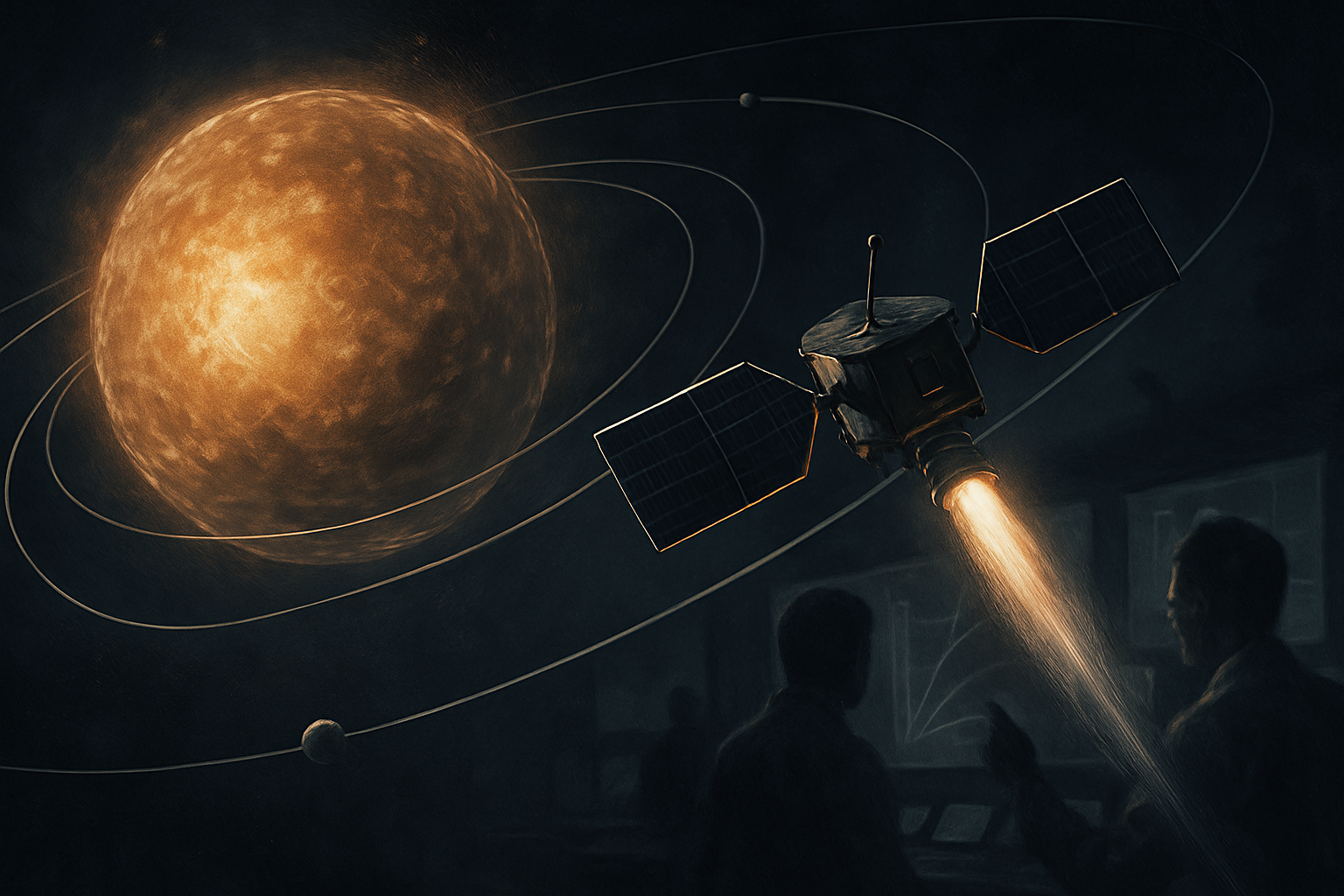
A nonprofit organization plans to send a spacecraft to Alpha Centauri by the end of 2029, with a budget of $15 million and a payload of at least one kilogram. The trajectory, proposed by an AI system developed by a new lab funded with $58 million, involves a travel time of up to 80,000 years and is part of the reflection on the Fermi Paradox.
Assumed flight durations of 70,000 to 80,000 years
The Fermi Explorer Mission project anticipates a journey that could last up to 80,000 years to reach Alpha Centauri, which is 4.4 light-years away and about 25 trillion miles from Earth. For comparison, Voyager 1, one of the fastest objects ever launched, has been traveling since 1977 and has covered less than 1% of that distance; at its current speed, it would take more than 70,000 years to reach Alpha Centauri. Philip Johnston, co-founder of the mission, believes that even if the Fermi probe is launched, it is unlikely to be the first to arrive: if, in a thousand years, an engine just 20% faster were developed, a spacecraft launched then would surpass the Fermi probe by over 10,000 years on the way to Alpha Centauri.
AI proposes a novel solar trajectory
After twelve months of unsuccessful attempts, the Fermi team entrusted the trajectory problem to Get Physics Done, an open-source tool designed by Physical Superintelligence (PSI) that segments physics problems into subtasks, selects simulations to run, and relies on AI models such as Claude or GPT. Seven days later, according to a report that has yet to be peer-reviewed, the system devised a new route, combining known orbital maneuvers in a previously unused configuration. The proposed scenario aims to bring the spacecraft's orbit closer to the Sun than Mercury's; at each closest approach, the engine would be activated so that the solar panels benefit from quadrupled light intensity, with the rapid thrust also generating more energy than elsewhere. This method would allow for smaller solar panels and a lightweight device. According to Matt Pines, co-founder and CEO of PSI, the system conducted most of the research almost autonomously over a three-day period, using a billion tokens, while an astrophysicist intervened to define constraints, request cost estimates, and verify results. Pines highlights the uniqueness of the proposed profile, while noting that the model lacks the discernment of a human scientist and may pursue dead ends or overlook other options.
Le brief IA que les pros lisent chaque soir
Les 7 actus IA du jour, décryptées en 5 min. Gratuit.
Inclus dès l'inscription : notre sélection des meilleurs guides & comparatifs IA.
Choisissez votre rythme
Gratuit · Pas de spam · Désabonnement en 1 clic
A frugal mission and a symbolic payload
The Fermi Explorer Mission, a nonprofit organization co-founded by Philip Johnston, plans to launch by the end of 2029. The project is currently funded by individual private donors, with an estimated cost of $15 million. To adhere to this budget, the team is not aiming to complete the journey within a human lifetime. The spacecraft must carry at least one kilogram of payload, including artistic and scientific elements, messages, and a copy of the Golden Record, a gold-plated disc attached to the Voyager probes in 1977 containing sounds and images of Earth.
The new PSI lab and its financial resources
The chosen trajectory was discovered by an AI system designed by Physical Superintelligence (PSI), a research lab in applied physics to AI launched with $58 million in funding, led by Breakthrough Energy, a climate-focused investment fund founded by Bill Gates, co-founder of Microsoft. Alex Wissner-Gross, a physicist and co-founder of PSI, proposed submitting the trajectory problem to the system during his podcast.
After Starshot, another path to Alpha Centauri
In 2016, Yuri Milner announced Breakthrough Starshot, a mission aimed at sending tiny probes to Alpha Centauri using powerful lasers, to reach one-fifth the speed of light and hope to arrive at the system in 20 years. One hundred million dollars had been promised for a prototype, but ten years later, no launch has occurred. Philip Johnston, president of the Fermi Explorer Mission, states that he does not want to replicate this model and desires a project that is genuinely feasible. Before the contribution of AI, his team spent a year unsuccessfully searching for a solution for a small solar spacecraft limited to $15 million, facing the dilemma of providing enough energy without weighing down the craft.
A project also conceived as a response to the Fermi Paradox
This program is in line with the question posed by Enrico Fermi in 1950: the Milky Way contains hundreds of billions of stars, most of which are older than the Sun, and even a very slow civilization could have spread there in a few million years. Despite this, no evidence of extraterrestrial intelligence has been detected. Philip Johnston believes that if a probe to another star is indeed launched, the hypothesis of an insurmountable technical barrier or lack of interest would no longer suffice to explain this silence. He then mentions other possibilities: an extreme rarity of life similar to ours, or common but ephemeral intelligent civilizations. According to him, it is possible that achieving superintelligence could be self-destructive and that a "great filter" could occur within the next 50 years.
Brief IA — L'actualité IA en français
L'essentiel de l'actualité de l'intelligence artificielle, décrypté et expliqué chaque jour.