AMD Challenges Nvidia with Helios AI: A Turning Point in the AI Race
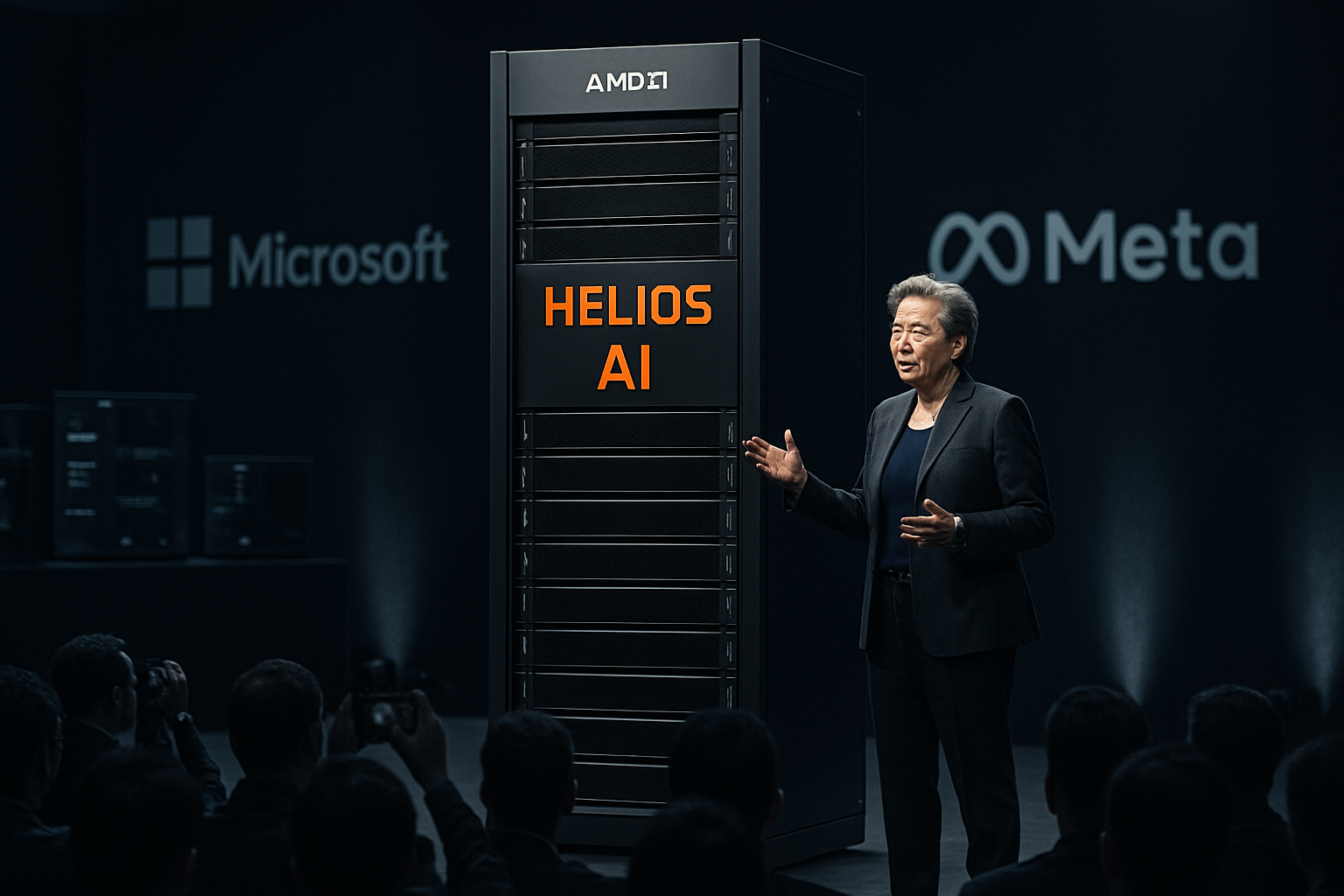
AMD Launches Helios AI to Compete with Nvidia
AMD, the semiconductor giant, has decided to take on Nvidia head-on with the announcement of its latest hardware system, Helios AI. This rack-scale system is designed to meet the growing needs of the world's most advanced artificial intelligence laboratories. During the Advancing AI conference, which took place in a sold-out San Francisco venue on Thursday, AMD's President and CEO, Dr. Lisa Su, unveiled this new rack system, named Helios. She also mentioned an impressive list of clients, including Microsoft, highlighting that the company plans to begin deliveries later this year. Meanwhile, AMD showcased its new chips, designed to address the increasing demand for computing power in the AI industry.
Rack systems, which integrate numerous processors into a single high-performance unit, are essential for data centers. These systems are used to train and execute AI models as well as other tasks requiring intensive computing power.
Helios: A Cutting-Edge System for AI
Lisa Su described Helios as the "most powerful AI rack in the tech industry," asserting that it has been designed to handle the world's most advanced and demanding models at a massive scale. AMD anticipates that this system will be deployed by leading AI companies at a gigawatt scale.
Historically, Nvidia has dominated this market with its own rack-scale systems, such as Vera Rubin and Grace Blackwell. However, AMD appears ready to enter the competition with Helios, which, according to The Register, outperforms Vera Rubin on several performance metrics.
Le brief IA que les pros lisent chaque soir
Les 7 actus IA du jour, décryptées en 5 min. Gratuit.
Inclus dès l'inscription : notre sélection des meilleurs guides & comparatifs IA.
Choisissez votre rythme
Gratuit · Pas de spam · Désabonnement en 1 clic
Strategic Partnerships and Prestigious Clients
Helios, although unveiled in 2025, was highlighted at CES 2026. It has already attracted several renowned clients, including OpenAI, Meta, Oracle, Anthropic, and Microsoft, all of whom plan to deploy this system. Satya Nadella, CEO of Microsoft, stated on Monday that the company would expand its Azure infrastructure with Helios. Additionally, a strategic partnership between Anthropic and AMD was announced on Wednesday, aiming to deploy up to two gigawatts of GPUs through this new rack system.
AMD also took the opportunity to present its Venice-X CPU, specially designed for data centers and capable of handling extremely compute-intensive workloads. This processor is expected to launch in 2027.
The Future of AI Chips According to AMD
During her speech, Lisa Su shared her vision for the evolution of the chip industry. She predicted that by 2030, chips dedicated to AI will represent a significant share of the overall computing market. This shift is primarily due to the rise of agentic AI, which requires considerable computing power to execute complex tasks involving multiple steps, such as reasoning, data access, and tool usage. Su emphasized that when you ask an agent to do something, it involves dozens of steps, necessitating many GPUs to accomplish these tasks.
Su also estimated that the AI accelerator market could reach around $1.4 trillion by 2030, which would mean this segment could approach the current size of the semiconductor market as a whole. She highlighted that GPUs should make up the majority of this market, as algorithms continue to evolve, thereby fostering programmability within the silicon ecosystem.
Brief IA — L'actualité IA en français
L'essentiel de l'actualité de l'intelligence artificielle, décrypté et expliqué chaque jour.