AMD Challenges Nvidia with Open Source in AI Chips
Le brief IA que les pros lisent chaque soir
Les 7 actus IA du jour, décryptées en 5 min. Gratuit.
Inclus dès l'inscription : notre sélection des meilleurs guides & comparatifs IA.
Choisis ton rythme
Gratuit · Pas de spam · Désabonnement en 1 clic
AMD Leverages Open-Source to Challenge Nvidia
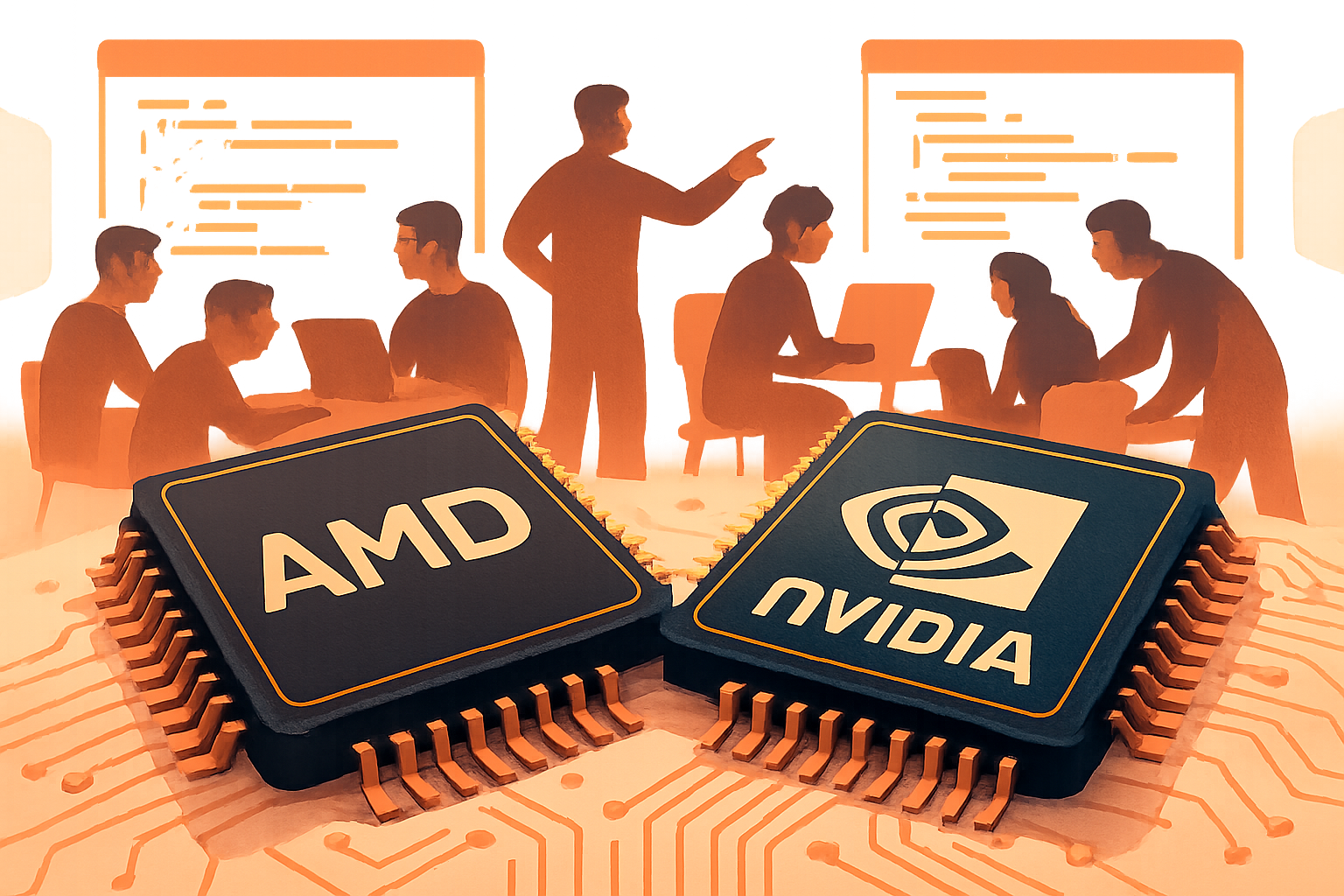
AMD has chosen to fully embrace open-source to position itself against Nvidia in the dedicated artificial intelligence chip market. By establishing strategic partnerships with major players like OpenAI and Anthropic, AMD aims to maximize the impact of ROCm, its open-source software designed for programming AI chips. This strategy seeks to leverage the flexibility and collaborative innovation that open-source allows.
Stock Decline Despite Promising Strategy
Despite a notable 9% drop in its stock price following the announcement of its financial results, AMD remains confident in its strategy. The company highlights its openness as a key competitive advantage in the race for AI chips, particularly against Nvidia. The ROCm software, which is freely accessible and modifiable by anyone, is at the heart of this approach. During the earnings presentation, Lisa Su, AMD's CEO, emphasized that ROCm is at a "turning point," with a tenfold increase in open-source contributions over the past year.
Open-Source as a Development Lever
In July, prior to the earnings announcement, two AMD executives shared their vision with the media. They explained how the open-sourcing of certain software and hardware products gives AMD an edge over competitors like Nvidia and Qualcomm. This strategy allows AMD to benefit from the skills of a vast community of engineers, thereby accelerating the development of its software in a highly competitive AI landscape.
The Strength of the Open-Source Community
Kirk Saban, Corporate Vice President of Products, Software, and Solutions at AMD, expressed his belief in the potential of open-source. According to him, the open-source community offers unprecedented power, allowing AMD to benefit from the development work of numerous developers who enrich the company's codebase. This collaborative approach is seen as a way to harness the brightest talents in the industry.
Chips Optimized Through Open-Source
Salil Raje, Senior Vice President of AMD's Adaptive and Embedded Computing Group, stated that AMD's latest chips are particularly well-suited for AI agents. This is largely due to developers' ability to enhance the software through open-source contributions. Raje described open-source as a "central pillar" of AMD's strategy, emphasizing the importance of collaboration with the ecosystem to improve the efficiency of AI solutions on their platform.
Market Volatility and Future Prospects
The chip market has recently experienced fluctuations, affecting companies like AMD. A massive sell-off occurred at the end of July, but despite this, AMD recorded a 9% decline in its stock after announcing its financial results. Nevertheless, AMD's revenue reached $11.5 billion, surpassing analysts' forecasts. Capital expenditures also nearly tripled, reaching $808 million compared to the previous year.
AMD, a Growing Alternative to Nvidia
In a context where companies are seeking to increase their computing power to support their AI systems, AMD is increasingly positioning itself as a viable alternative to Nvidia. AMD's stock has seen an impressive rise of about 193% over the past year, while Nvidia's stock has increased by about 20%. This dynamic underscores AMD's growing appeal in the AI chip market. A key element of this strategy is to compete with CUDA, Nvidia's software, which is widely regarded as a stronghold in the industry.
Brief IA — L'actualité IA en français
L'essentiel de l'actualité de l'intelligence artificielle, décrypté et expliqué chaque jour.