AMD Acquires Taalas to Strengthen Helios Strategy Against Nvidia
Le brief IA que les pros lisent chaque soir
Les 7 actus IA du jour, décryptées en 5 min. Gratuit.
Inclus dès l'inscription : notre sélection des meilleurs guides & comparatifs IA.
Choisis ton rythme
Gratuit · Pas de spam · Désabonnement en 1 clic
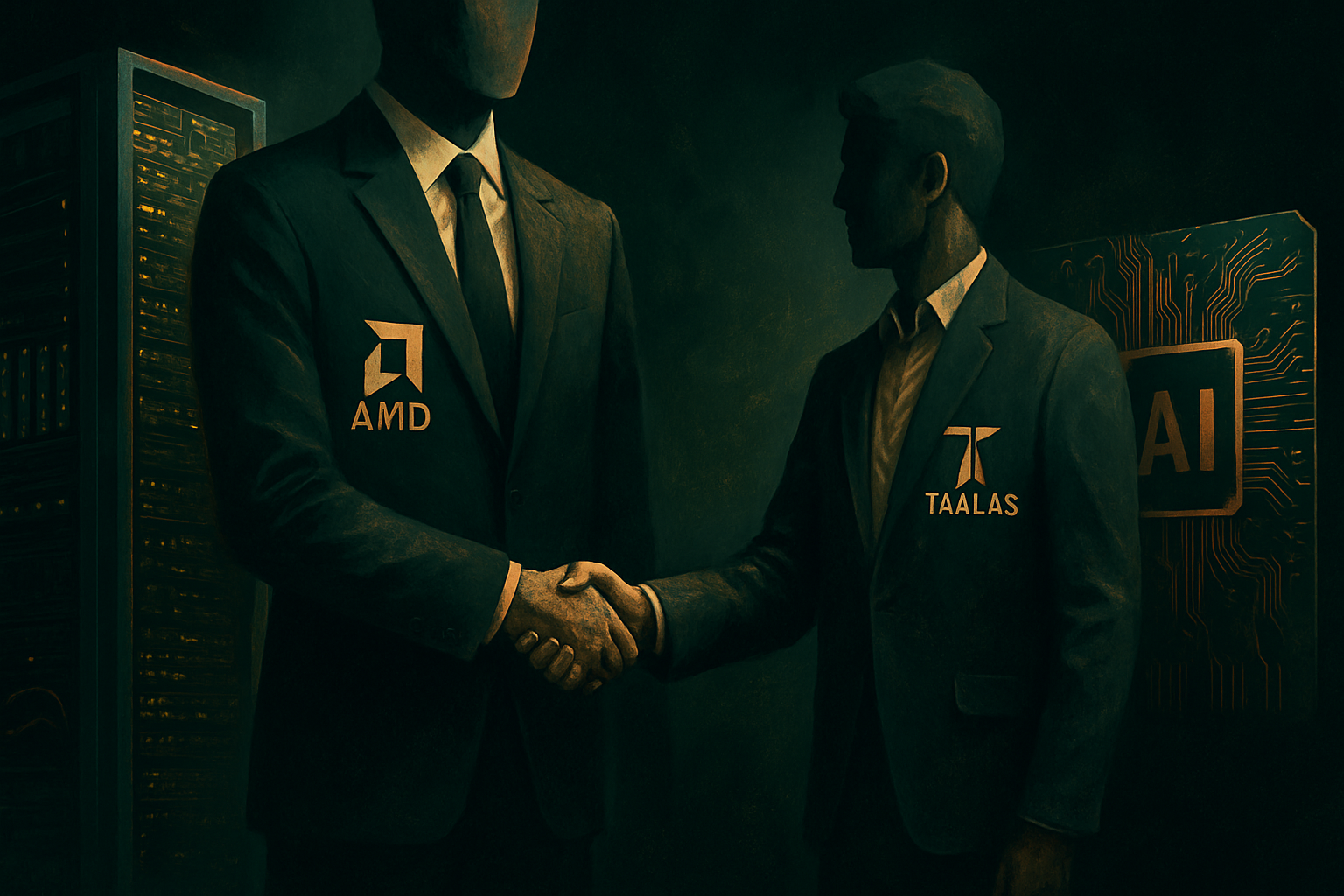
AMD recently announced the acquisition of Taalas, an innovative startup specializing in inference accelerators, a key technology for data processing in the field of artificial intelligence. Although the amount of this acquisition has not been disclosed, it marks a significant turning point in AMD's strategy, which seeks to position itself more firmly in the AI data center market. This move comes at a time when competition with Nvidia, the undisputed leader in this sector, is becoming increasingly fierce.
Technical Details or Key Figures
Taalas is recognized for its inference acceleration solutions that optimize the performance of AI models by reducing latency and increasing energy efficiency. These technologies are essential for companies that process massive volumes of data and require real-time responses. With this acquisition, AMD hopes to integrate these advanced capabilities into its Helios rack, a platform designed to meet the growing computational power needs of data centers.
The AI data center market is rapidly expanding, with forecasts indicating that the demand for acceleration solutions could reach several billion dollars in the coming years. By integrating Taalas's technologies, AMD could not only enhance its offerings but also attract new customers seeking high-performance and cost-effective solutions.
Impact / Consequences for the Sector
AMD's acquisition of Taalas could have significant repercussions on the competitive landscape of data centers. Nvidia, which has dominated this market with its high-performance GPUs, could see its position challenged if AMD manages to offer more efficient and cost-effective AI solutions. This dynamic could prompt Nvidia to intensify its innovation efforts and adjust its pricing strategies to maintain its market share.
Furthermore, this acquisition highlights a broader trend in the tech industry: the necessity for companies to diversify their portfolios and integrate emerging technologies to remain competitive. Companies that do not adapt quickly risk falling behind in an ever-evolving sector.
Reactions or Perspectives
Industry analysts welcome this acquisition with a mix of optimism and caution. On one hand, they emphasize that integrating Taalas's technologies could enable AMD to effectively compete with Nvidia. On the other hand, some experts warn of the challenges of integrating and scaling new technologies in an already saturated market.
Potential customers, for their part, are paying close attention to this development. Companies investing in AI are looking for solutions that not only deliver high performance but are also economically viable. If AMD can demonstrate that its Helios rack, enhanced with Taalas's technologies, can meet these requirements, it could be a game-changer for many players in the sector.
In conclusion, AMD's acquisition of Taalas represents a major stake in the future of the AI data center sector. As competition with Nvidia intensifies, this strategy could allow AMD to position itself as a key player. The coming months will be crucial to observe how this integration unfolds and what the repercussions will be on the market. Companies and investors should closely monitor this evolution, as it could redefine the standards of performance and efficiency in the field of artificial intelligence.
Brief IA — L'actualité IA en français
L'essentiel de l'actualité de l'intelligence artificielle, décrypté et expliqué chaque jour.