Anima Announces 75% Reduction in Wait Times at Clinics
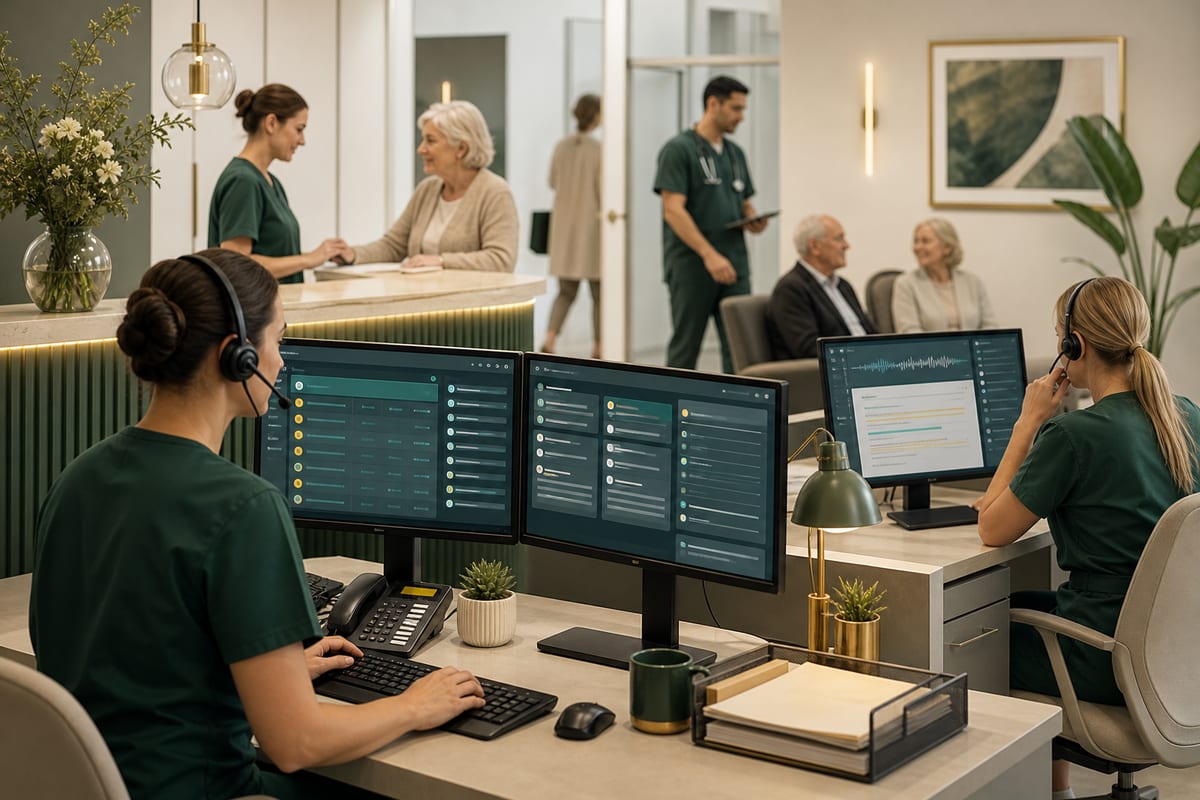
The British publisher Anima is combining OpenAI models with its tools for calls, document management, and medical writing. The company reports median resolution times of 3.5 hours, phone queues reduced to 10 minutes, and backlogs of 100,000 documents cleared in just a few days at certain clinics.
Significant Decrease in Case and Call Resolution Times
Anima reports a median resolution time of about 3.5 hours for cases and claims that most files are closed within 24 hours. Regarding phone standards, the company reports wait times reduced from 40 to 50 minutes to just 10 minutes in clinics using its receptionist Andi, which it presents as a reduction of at least 75%.
Accelerated Document Processing and Backlogs Resolved
According to Anima, practices that previously managed about 15 clinical documents per hour now typically handle 30 to 45, with the most efficient managing 45 to 60. The company also claims to have seen clinics eliminate backlogs of over 100,000 documents in just a few days. These results are based on the Documents product, which extracts metadata using GPT-6, then associates each document with the patient, identifies clinical codes, and proposes an action for validation.
Three Products Linked to Patient Files and Teams
Anima consolidates patient requests, documents, and follow-ups within a single platform, featuring assistants that collect histories, process documents, and draft notes. Andi, the voice standard, guides the conversation via a proprietary policy engine and relies on GPT-5.4 mini for questionnaire selection, before creating a structured case in the dashboard for review. Scribe, based on GPT 5.6 Luna, transforms transcriptions into structured notes and reuses this context to generate referral letters and follow-up messages, which the company claims can be produced in seconds instead of several minutes, including for letters that often took 5 to 15 minutes.
Le brief IA que les pros lisent chaque soir
Les 7 actus IA du jour, décryptées en 5 min. Gratuit.
Inclus dès l'inscription : notre sélection des meilleurs guides & comparatifs IA.
Choisissez votre rythme
Gratuit · Pas de spam · Désabonnement en 1 clic
Choice of OpenAI and Adaptation Through Contextual Learning
Anima indicates that it selected GPT-6 for document processing and GPT-Live for call management after comparing internal and open-source models. Its leader, Shun Pang, cites criteria such as the impression of intelligence, the performance-to-cost ratio, and the ability to follow instructions reliably through contextual learning. Clinical coding is presented as a challenge, with about 800,000 SNOMED codes and variable usage across practices. To adapt without specific client tuning, Anima employs contextual learning, and Michael Skupien emphasizes the ability of OpenAI models to follow instructions reliably.
Adoption in the UK, Expansion, and User Feedback
Originating from the UK, Anima claims to support over 14 million patients across more than 1,000 clinics and manage over 800,000 files each month. The company continues its expansion in the United States, Australia, and other regions. According to its surveys, 86% of patients would reuse Andi, with individuals aged 80 and 90 among the most satisfied, as Shun Pang describes a voice agent perceived as patient and polite. He also states that doctors are now finishing on time rather than working until 8 or 9 PM. The founder, who has clinical training, links the creation of Anima to a case where abnormal results would have remained pending for six months. The company claims a vision of personalized care for all.
Brief IA — L'actualité IA en français
L'essentiel de l'actualité de l'intelligence artificielle, décrypté et expliqué chaque jour.