Anthropic: 950 Claude Agents Discover an Enzymatic System
Le brief IA que les pros lisent chaque soir
Les 7 actus IA du jour, décryptées en 5 min. Gratuit.
Inclus dès l'inscription : notre sélection des meilleurs guides & comparatifs IA.
Choisis ton rythme
Gratuit · Pas de spam · Désabonnement en 1 clic
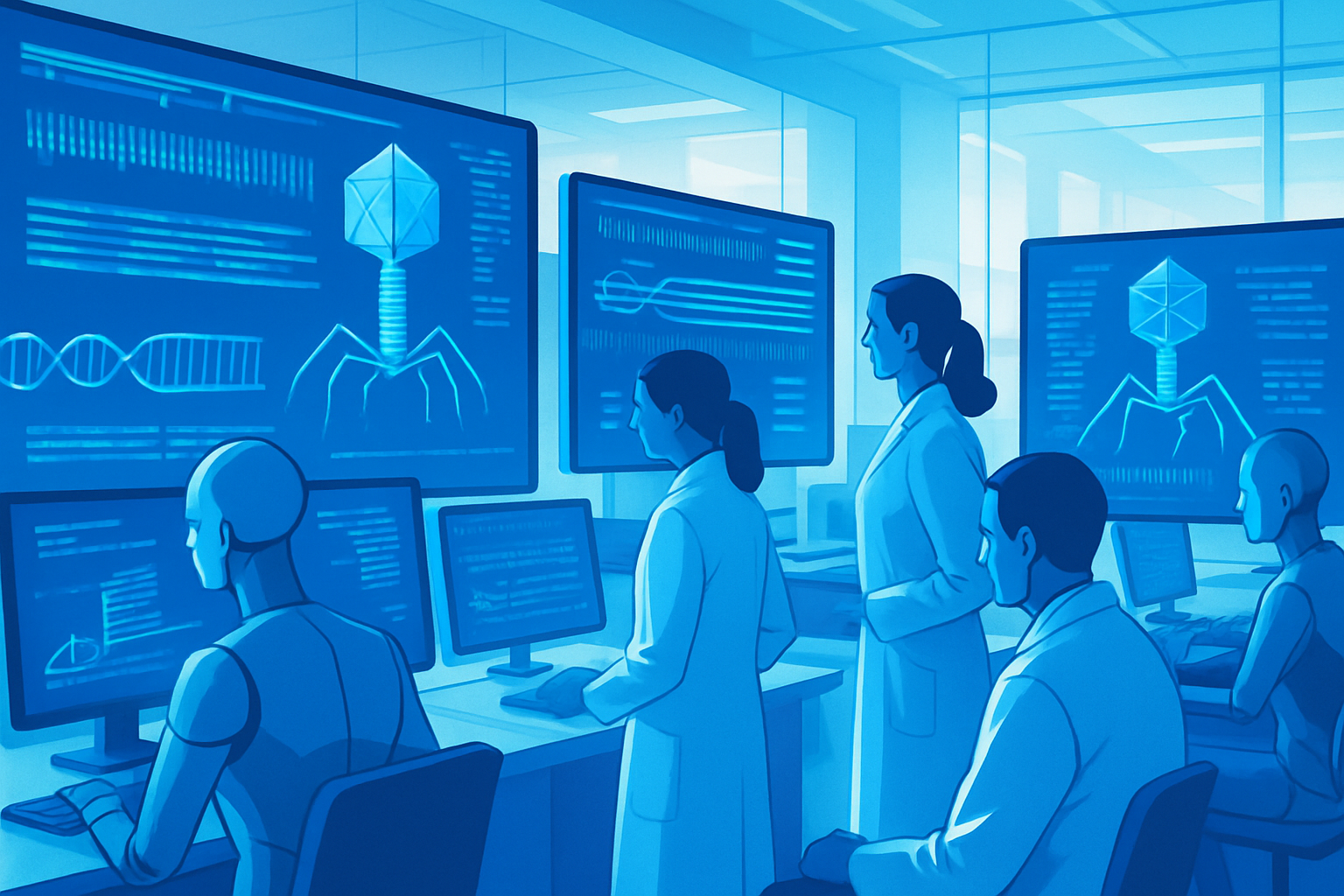
Anthropic reports that it has identified a novel enzymatic complex, ART, in the DNA of bacteriophages thanks to Claude. The operation involved 950 agents over 21 hours and nearly 210 million tokens, achieving a result that would have taken weeks or months for a human. The company likens the properties of ART to the CRISPR mechanism.
950 AI agents, 21 hours, and nearly 210 million tokens
Anthropic states that it mobilized 950 AI agents to analyze a large-scale database. After 21 hours and nearly 210 million tokens processed, one of the agents identified the signal that will be named ART. According to Anthropic, a human researcher would have needed weeks, if not months, to achieve a similar result.
The ART complex identified in bacteriophages and likened to CRISPR
The discovered enzymatic complex has been named ART, which stands for array-associated reverse transcriptases. Anthropic indicates that this mechanism was identified in the genetic material of bacteriophages, viruses that specifically target bacteria. According to the company, the characteristics of ART are similar to those of the CRISPR system, a genetic modification process that allows for precise cutting and alteration of DNA. The Nobel Prize in Chemistry was awarded in 2020 to Emmanuelle Charpentier and Jennifer Doudna for CRISPR.
Nature of ART and Anthropic's research framework
The acronym ART refers to reverse transcriptases associated with networks, a family of enzymes that transcribe RNA into DNA and are found in retroviruses like HIV. Anthropic has opened a dedicated laboratory in San Francisco and announces the discovery of a previously unknown enzymatic system. This advancement comes at a time when AI also raises concerns regarding its potential use in the development of biological weapons.
Brief IA — L'actualité IA en français
L'essentiel de l'actualité de l'intelligence artificielle, décrypté et expliqué chaque jour.