Anthropic Brings Claude to AMD GPUs in Three Days
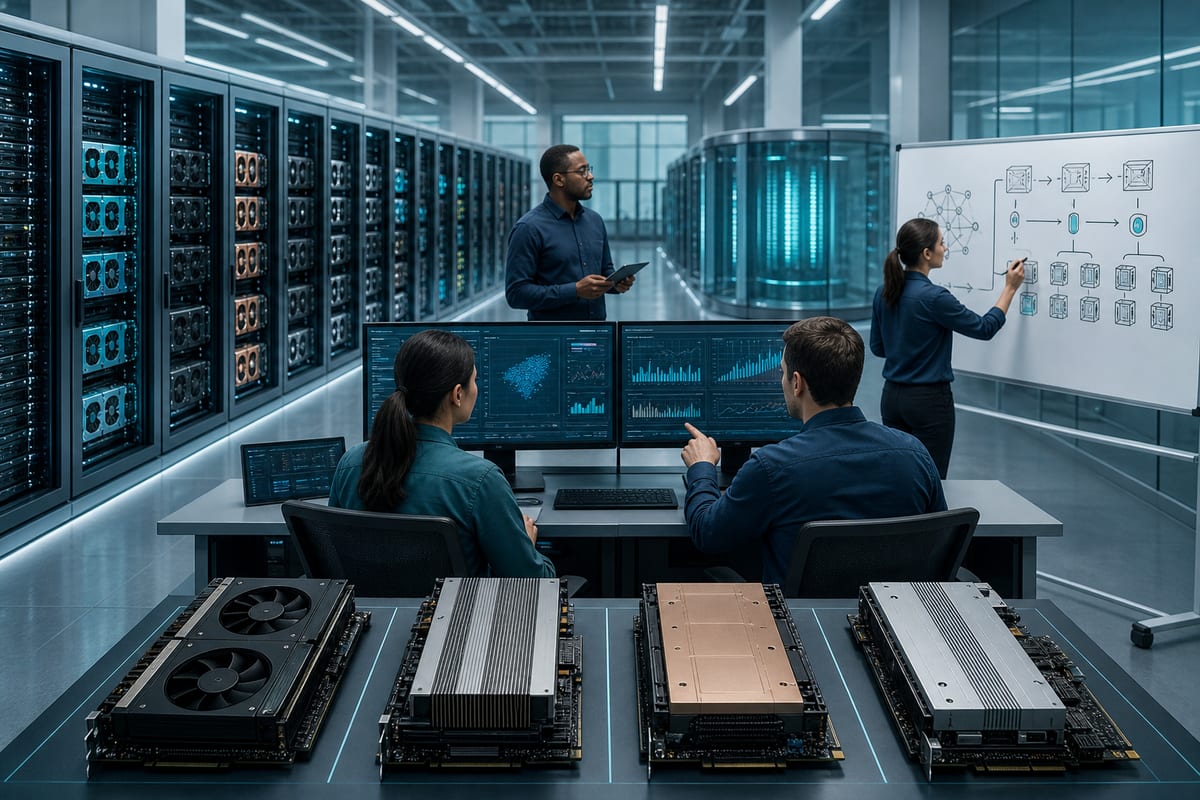
Anthropic claims to have reduced the porting of its models to AMD GPUs to three days thanks to its Mythos model, well below the usual timelines. This multi-chip strategy, presented as a way to lessen dependence on CUDA, comes as both Nvidia and AMD are financially committed to Anthropic, with amounts and deployments planned through 2027.
Nvidia and AMD Fund Anthropic, with Deployments Announced Through 2027
Nvidia has made financial commitments to Anthropic. In November 2025, as part of a $45 billion agreement with Microsoft, the company pledged to invest up to $10 billion in the lab. According to the S-1/A filing submitted on November 10, 2026, Nvidia is also participating in a conditional private placement totaling $26 billion, involving seven tech companies at the offering price. AMD, for its part, announced in July 2026 a strategic investment of up to $5 billion. In return, Anthropic plans to deploy up to two gigawatts of AMD Instinct MI455X GPUs in rack-scale Helios systems, with an initial phase of one gigawatt expected in the first half of 2027.
Anthropic Aims to End CUDA Lock-In Through Automated Porting
Nvidia's advantage largely relies on CUDA, a software ecosystem that keeps developers tied to its chips and makes porting to other architectures costly, to the point that many companies abandon the effort. Anthropic claims to have engaged AI to automate this work, aiming to reduce the software overhead that has benefited Nvidia. If the reported performance is confirmed, this would make it easier to switch to other suppliers as well as to use cheaper or more accessible alternatives, given that Nvidia's margin on AI chips exceeds 70%. According to at least one major lab, CUDA's supremacy no longer seems impossible to challenge, and the models could help mitigate hardware dependencies. However, this data comes from a presentation intended for investors and has not been independently verified.
Le brief IA que les pros lisent chaque soir
Les 7 actus IA du jour, décryptées en 5 min. Gratuit.
Inclus dès l'inscription : notre sélection des meilleurs guides & comparatifs IA.
Choisissez votre rythme
Gratuit · Pas de spam · Désabonnement en 1 clic
Three Days Announced to Activate AMD: Mythos Ported Almost All Kernels
Anthropic describes a concrete case on AMD GPUs, which have traditionally been activated at the cost of months of work and dozens of engineers. This year, the lab entrusted the operation to its cutting-edge model, Mythos. It claims that the model wrote or ported nearly 100% of the kernels, with very little human intervention, and that Claude was operational on AMD in about three days, compared to six to twelve months with traditional engineering approaches. The metrics mentioned pertain to query processing on AMD MI355X GPUs.
A Multi-Chip Strategy Posed as an Initial Bet and Sustained Over Time
Anthropic asserts that it built a multi-chip strategy from the outset, which was deemed irrelevant by the majority of industry players at the time. Tom Brown indicates that the company trains and runs Claude on four families of chips grouped in an interchangeable compute pool. Each architecture requires its own software and a dedicated inference stack, making the effort costly and time-consuming. According to him, Anthropic has nonetheless invested for years and has achieved a high level of execution on this front.
Compute Pools and Multipliers: Allocation, Research, and Dedicated Capacity
The lab states that it combines AWS Trainium, Google TPUs, Nvidia GPUs, and AMD GPUs within the same pool, used for research, model creation, client needs, and internal operations of Claude. It claims to derive more value for every dollar invested in computing than any other leading lab. In a context of limited resources, this method seeks the best balance between cost and performance, considering that some chips are more efficient for training and others for inference. Beyond the multi-chip approach, Anthropic is betting on compute multipliers, described as breakthroughs that add up to extract more performance at constant physical capacity, with the prospect that Claude may one day discover them himself. This recursive improvement remains debated and unproven. Meanwhile, with Anthropic Direct, the company is building its own capacity by renting chips for dedicated data centers, with the stated goal of reducing total cost of ownership. Anthropic claims that this has broken its dependence on Nvidia.
Brief IA — L'actualité IA en français
L'essentiel de l'actualité de l'intelligence artificielle, décrypté et expliqué chaque jour.