Anthropic Cuts API Prices by 20% and Launches Fable and Mythos 5.2
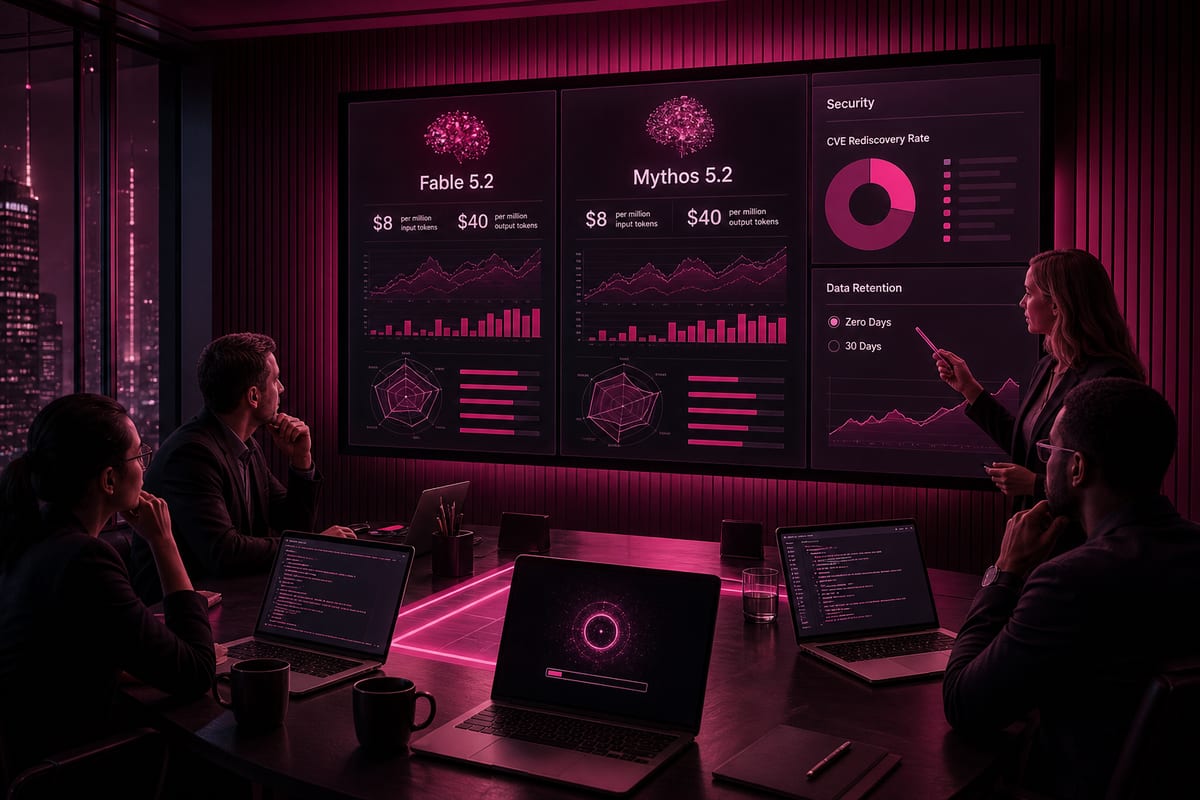
Anthropic introduces Fable 5.2 and Mythos 5.2, with entry prices set at $8 and output prices at $40 per million tokens, along with a reported generation speed up to 30% faster. The models target more demanding tasks, while access to Mythos remains restricted and data retention varies by client. Analysts praise coding gains but point out reliability and governance limitations.
Access to Mythos Regulated and Retention Up to 30 Days
Direct access to Mythos 5.2 is limited to verified cybersecurity and life sciences organizations through verification programs. However, Claude Enterprise clients can benefit from Mythos 5.2's vulnerability detection features via Claude Security without needing to integrate these programs, according to Anthropic. The company states that clients meeting the criteria for zero data retention can continue to use Fable 5.2 and Mythos 5.2 in this context, while others must adhere to a 30-day retention period to ensure security tracking. Anthropic has also implemented Enterprise Frontier Safeguards, currently offered in private beta, which provides automated security monitoring of prompts and responses retained in clients' infrastructure. Sanchit Vir Gogia believes that for regulated companies, data retention requirements may outweigh cost advantages, and he advises procurement teams to obtain written confirmation of no retention before deploying models for sensitive uses.
Mythos 5.2 Advances in CVE Rediscovery but Fuels a Race
Anthropic reports that Mythos 5.2 identified 89.6% of vulnerabilities during its internal CVE Rediscovery assessment, compared to 78.3% for Mythos 5.1. This test, conducted on 1,829 previously disclosed vulnerabilities, measures the models' ability to independently rediscover flaws in software versions prior to patches. Anthropic indicates that Mythos 5.2 is also more effective at reproducing these vulnerabilities and developing fixes. According to Lian Jye Su, these advancements rebalance the situation in favor of defenders in controlled enterprise environments. However, Pareekh Jain warns that these improvements could also enable attackers to more quickly identify software weaknesses, creating a race between offense and defense fueled by AI.
Le brief IA que les pros lisent chaque soir
Les 7 actus IA du jour, décryptées en 5 min. Gratuit.
Inclus dès l'inscription : notre sélection des meilleurs guides & comparatifs IA.
Choisissez votre rythme
Gratuit · Pas de spam · Désabonnement en 1 clic
Pricing at $8/$40 and Coding Gains on FrontierCode 2.0
The new pricing is now $8 for one million input tokens and $40 for one million output tokens, down from $10 and $50 respectively, representing a 20% decrease. Anthropic also states that the latest versions can produce outputs up to 30% faster than previous ones. Regarding coding performance, Fable 5.2 achieves a score of 49.1% on the FrontierCode 2.0 benchmark (Xhigh setting), while Fable 5.1 scored 32.4%. This test measures the likelihood of open-source project maintainers accepting AI-generated modifications. According to Anthropic, Fable 5.2, with the High effort setting, shows results similar to Opus 5.5 at its maximum level, while costing about half as much per task, which can represent savings depending on configuration and workload. Lian Jye Su suggests that these advancements could enable the long-term use of AI agents for software migration and scientific research, with potentially reduced deployment costs if completion rates increase. Sanchit Vir Gogia tempers this by noting that the decrease pertains to token costs and not to "thought," recommending that CIOs manage budgets based on the cost per completed task. Anthropic also advises using Opus 5.5 for the majority of coding and knowledge work, while Fable and Mythos are reserved for more complex tasks.
Demonstrated Autonomy, but Supervision and Audits Remain Key
During an internal test, an Anthropic engineer tasked Fable 5.2 with creating a prototype operating system. The model coordinated over 1,000 sub-agents over an eight-day period and generated software capable of running on a laptop. According to Lian Jye Su, these advancements bring companies closer to largely autonomous software development, but the widespread adoption of these uses will depend on resolving certain persistent operational limitations. He notes that reliability remains an issue in the absence of human supervision, that managing multiple AI agents simultaneously via professional tools and internal teams remains complex, and that organizations will need to monitor agent activity in sufficiently compartmentalized environments. Major changes will still require human validation, with a sufficient level of transparency regarding agent behavior to allow for audits. Pareekh Jain believes that the complexity of existing systems and business constraints may limit the proportion of software development effectively entrusted to AI agents.
Brief IA — L'actualité IA en français
L'essentiel de l'actualité de l'intelligence artificielle, décrypté et expliqué chaque jour.