Anthropic in Europe: Austria Challenges U.S. Ban
Le brief IA que les pros lisent chaque soir
Les 7 actus IA du jour, décryptées en 5 min. Gratuit.
Inclus dès l'inscription : notre sélection des meilleurs guides & comparatifs IA.
Choisis ton rythme
Gratuit · Pas de spam · Désabonnement en 1 clic
Austria Challenges American Ban
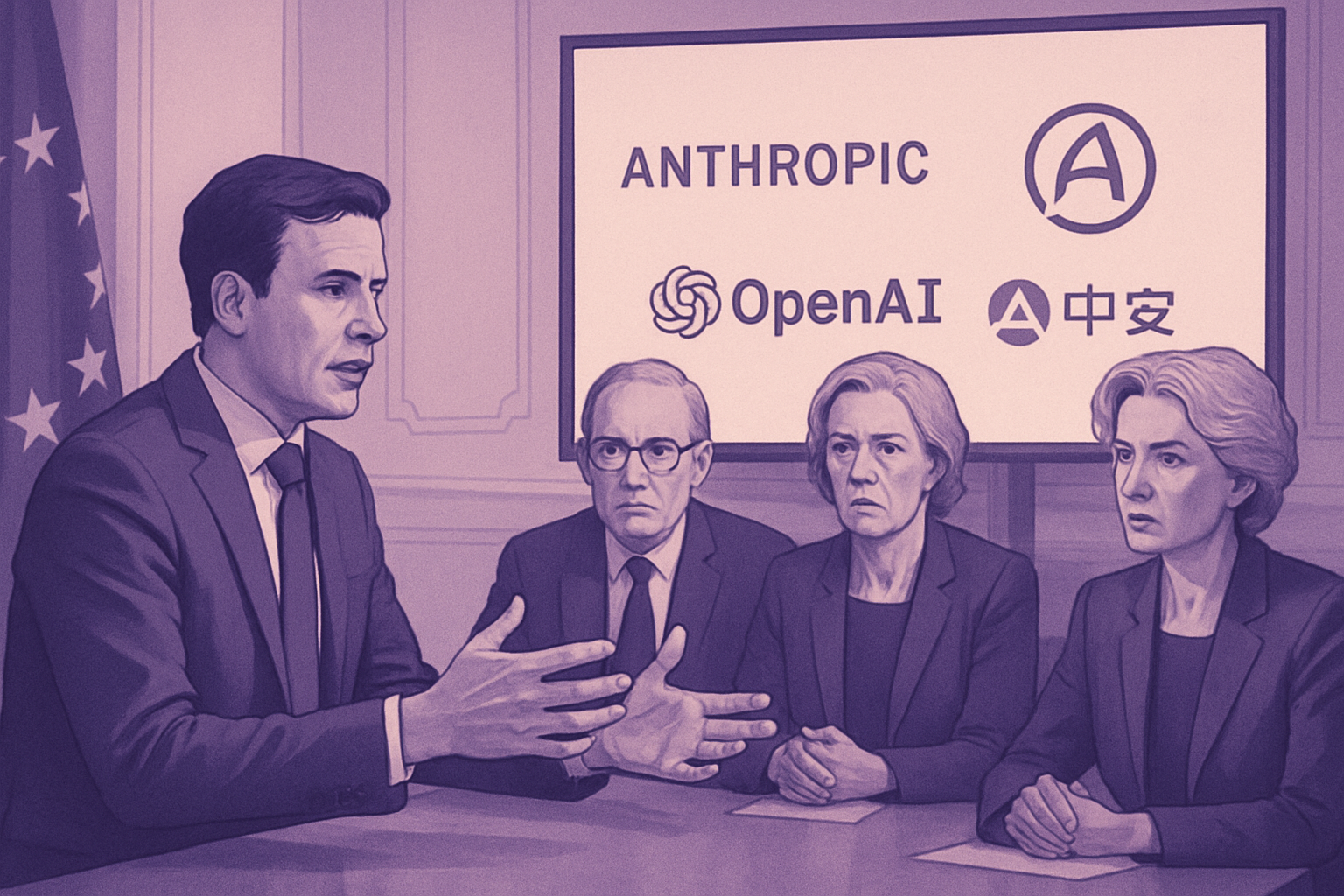
The U.S. government has blocked European access to the latest AI models from OpenAI and Anthropic, revealing just how dependent Europe is on American technological and political decisions.
Austrian Secretary of State for Digitalization, Alexander Pröll, responded by proposing to relocate Anthropic's headquarters to the EU. However, this initiative seems unrealistic given the company's patriotic alignment and the retaliatory stance of the Trump administration.
Chinese AI models, managed locally, may appear to be a more plausible alternative, but this merely replaces one dependency with another. True sovereignty requires Europe to build its own AI infrastructure.
Recently, the U.S. government has blocked or delayed access to two of its most advanced AI models for foreign nationals, those from OpenAI and Anthropic. For Europe, the conclusion is clear: access to cutting-edge AIs now depends on a small number of decision-makers in Washington, creating a dependency that could prove dangerous.
“Overnight, the largest single market in the world — our EU single market with 450 million people — has been cut off from cutting-edge innovations,” writes Alexander Pröll in a letter to the European Commissioner for Technological Sovereignty, Henna Virkkunen, as reported by the Austrian daily Kronen Zeitung.
Pröll Wants Anthropic's Headquarters in Europe
In a LinkedIn post, he outlines his reasoning. “A technology that you do not produce yourself and can only use with permission is not a tool. It is a dependency.” Europe should attract Anthropic by offering legal certainty, market access, and capital, all grounded in European values.
Why Anthropic specifically? Pröll highlights the company's philosophy. “Anthropic is a company that views the ethical use of AI not as a marketing argument, but as a deep conviction. A conviction that prioritizes safety over speed,” Pröll writes in the letter, according to Kronen Zeitung. “This company would not be constrained in Europe; it would be liberated.”
The letter only calls for a review, and it is unlikely that the Commission will act accordingly. The initiative is not realistic. It resembles more a desperate act from an EU whose dependency has been built over 20 years of failures in digital policy, not just in the last five years.
Even if the option existed, Anthropic is unlikely to take the bait given Trump's retaliatory stance. The company may seem cosmopolitan and values-driven by American standards, but it is deeply patriotic. In its dispute with the Pentagon regarding AI deployments, Anthropic's main concern was to protect American citizens. Mass surveillance abroad was not on the agenda. The models are also already being used by the NSA.
However, OpenAI, Anthropic, and others rely on European revenues to fund billion-dollar training operations and data center constructions. The American market alone may not be enough to cover these costs, giving Europe some leverage at the table, even if it is not much.
China Seems to Be a Backup Solution, But It's Just Another Link
AI investor Xiaoyin Qu outlines an alternative scenario. European companies, and for cost reasons, American companies as well, could adopt Chinese AI models instead of deepening their dependency on OpenAI and Anthropic. Companies could host Chinese models on their own GPUs, fine-tune them with their own data, and retain control, Qu argues. Trust in Anthropic has already been shaken after incidents like its handling of Fable, she adds.
Qu also signals a pessimistic scenario for the United States. If Chinese open-source models continue to gain market share and are optimized for Huawei chips instead of Nvidia, China could dominate both the model and chip layers. Export controls will not solve this problem. The U.S. would need its own open-source initiative.
For Europe, however, this scenario merely replaces one dependency with another, trading Washington for Beijing. Locally managed Chinese AI models may seem self-sufficient at first glance, but the situation could change overnight. Open-source models could be subjected to new licensing, or the best models could be completely withheld.
The Cold War rhetoric that some Chinese AI experts are already referring to does not bode well for long-term generosity. China will not make concessions to the EU in the long run, only as long as it harms the United States. True sovereignty requires Europe to develop its own AI and, above all, its own infrastructure.
Brief IA — L'actualité IA en français
L'essentiel de l'actualité de l'intelligence artificielle, décrypté et expliqué chaque jour.