Anthropic and Microsoft: AI Revolution with Opus 4.8 and Scout
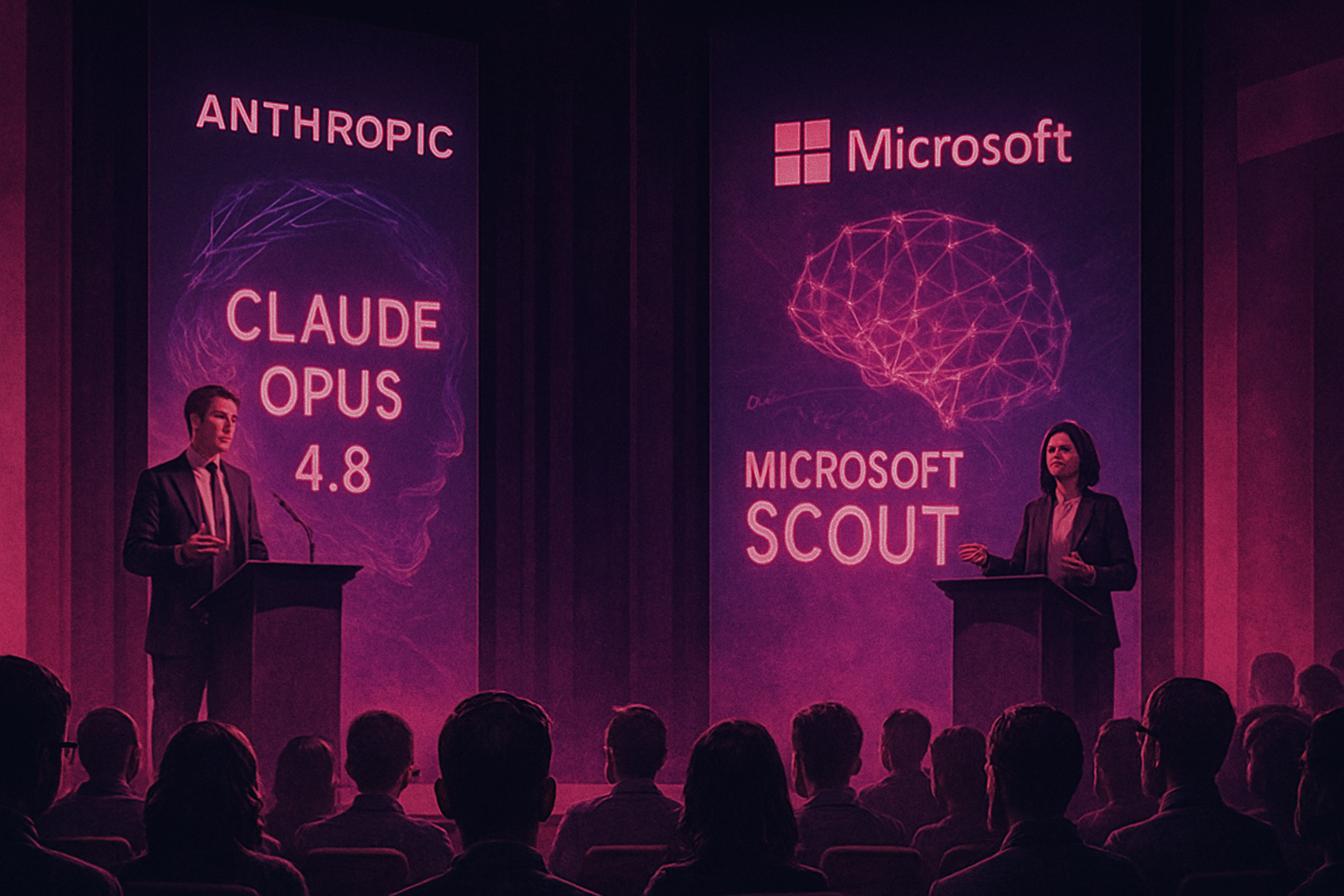
Anthropic Innovates with Claude Opus 4.8
Anthropic recently unveiled the latest version of its artificial intelligence model, Claude Opus 4.8. This update stands out with improved benchmark scores, highlighting a significant advancement in the assessment of artificial consciousness. In addition to these technical enhancements, Anthropic emphasized themes of well-being and corrigibility, derived from its system map, aimed at making AI more aligned with human needs. One of the major innovations in this version is the introduction of Dynamic Workflows, designed to efficiently manage multi-agent tasks over extended periods.
Anthropic also addressed the results of its research on consciousness assessment, a complex and evolving field. The themes of well-being and corrigibility are crucial to ensure that AI systems can be adjusted and corrected according to human needs, which is essential for their integration into real-world environments. The Dynamic Workflows, on the other hand, allow for smoother and more adaptable management of tasks involving multiple agents, which is particularly relevant in contexts where coordination and flexibility are essential.
Microsoft Introduces Scout and Its New MAI Models
In another major development, Microsoft launched a new personal assistant, Microsoft Scout, which remains active at all times. This tool is based on the OpenClaw platform and comes with new internal models called MAI, including MAI Thinking 1. The company places a particular emphasis on "frontier tuning," an approach that strengthens enterprise security architecture while enabling the creation of AI models from scratch.
Microsoft Scout is designed to be a constantly available digital companion, capable of responding to user needs in real-time. The OpenClaw platform on which it is built provides a robust foundation for the development of advanced AI applications. The new MAI models, including MAI Thinking 1, are developed to offer enhanced reasoning and decision-making capabilities, which are essential for complex enterprise applications. "Frontier tuning" is an innovative method that allows for the customization and optimization of AI models for specific tasks while ensuring enhanced security.
Anthropic Prepares for IPO
On the financial front, Anthropic has raised an impressive $65 billion in its Series H funding round, reaching a valuation of $965 billion. This financial performance is accompanied by a filing for an initial public offering, marking a crucial step in the company's expansion. Meanwhile, an analysis by JPMorgan highlights that OpenAI needs significant revenue growth to justify its infrastructure spending. Additionally, the startup Cognition has raised $1 billion, achieving a valuation of $25 billion.
Anthropic's fundraising is one of the largest in the tech sector, underscoring investor confidence in the company's potential. The $965 billion valuation places Anthropic among market leaders, surpassing even some of the largest tech companies. The anticipated IPO could transform the AI landscape, providing Anthropic with the resources needed to accelerate its development and expansion. JPMorgan's analysis regarding OpenAI sheds light on the challenges faced by AI companies in terms of profitability and cost management.
Le brief IA que les pros lisent chaque soir
Les 7 actus IA du jour, décryptées en 5 min. Gratuit.
Inclus dès l'inscription : notre sélection des meilleurs guides & comparatifs IA.
Choisissez votre rythme
Gratuit · Pas de spam · Désabonnement en 1 clic
Political and Security Issues
On the political and security front, several initiatives have been undertaken. A preliminary voluntary government testing framework has been introduced by the Trump administration to oversee powerful AIs. Additionally, Meta AI has been involved in an Instagram account hijacking case, while the United States has tightened export controls on Nvidia chips. In China, AI experts must now obtain approval before traveling internationally, a measure aimed at securing top talent. Finally, cybersecurity and biological defense initiatives, such as Glasswing/Mythos, continue to expand.
The testing framework introduced by the Trump administration aims to establish standards for the evaluation and management of powerful AIs to ensure their responsible use. The Meta AI case highlights potential vulnerabilities of AI systems to cyberattacks, while restrictions on Nvidia chip exports reflect growing national security concerns. In China, the new approval policy for AI experts aims to protect strategic knowledge and skills by limiting the risks of talent leakage. Cybersecurity and biological defense initiatives, such as Glasswing/Mythos, are essential for enhancing resilience against emerging threats.
Timestamps and Tools
The podcast addresses these topics through various segments, including an introduction and initial discussions, followed by insights into news and applications. Anthropic and Microsoft are extensively covered, with details on their latest innovations and strategies.
The provided timestamps allow listeners to easily navigate the podcast content, accessing segments that interest them the most. The initial discussions set the context for subsequent developments, while the news insights offer a summary of key announcements and innovations. The segments dedicated to tools and applications highlight the latest technological advancements and their potential impact across various sectors.
Projects and Open Source
Another highlight of the episode is the launch of MiniMax-M3, a model that outperforms GPT-5.5 and Gemini 3.1 Pro in terms of performance on key benchmarks, while being significantly more cost-effective. This development underscores the growing importance of open-source solutions in the AI landscape.
MiniMax-M3 represents a significant advancement in the field of language models, offering performance comparable to that of the most advanced models but at a fraction of the cost. This economic efficiency is crucial for democratizing access to AI and enabling a larger number of organizations to benefit from these cutting-edge technologies. The success of MiniMax-M3 also illustrates the potential of open-source projects to drive innovation and collaboration in the tech sector.
Synthetic Media and Research
Finally, the podcast discusses advancements in synthetic media, with YouTube beginning to automatically label AI-generated videos. Recent research also explores why larger models have better learning capabilities, examining factors such as capacity, interference, and retention of rare tasks.
YouTube's initiative to label AI-generated videos aims to increase transparency and help users identify content created by algorithms. This measure is important for maintaining user trust and ensuring informed content consumption. Research on language models highlights the advantages of larger models, which can better handle complex and rare tasks due to their increased capacity to retain and integrate diverse information.
Brief IA — L'actualité IA en français
L'essentiel de l'actualité de l'intelligence artificielle, décrypté et expliqué chaque jour.