Anthropic and Samsung: Custom AI Chip for Claude
Le brief IA que les pros lisent chaque soir
Les 7 actus IA du jour, décryptées en 5 min. Gratuit.
Inclus dès l'inscription : notre sélection des meilleurs guides & comparatifs IA.
Choisis ton rythme
Gratuit · Pas de spam · Désabonnement en 1 clic
Anthropic and Samsung Partner for a Dedicated AI Chip for Claude
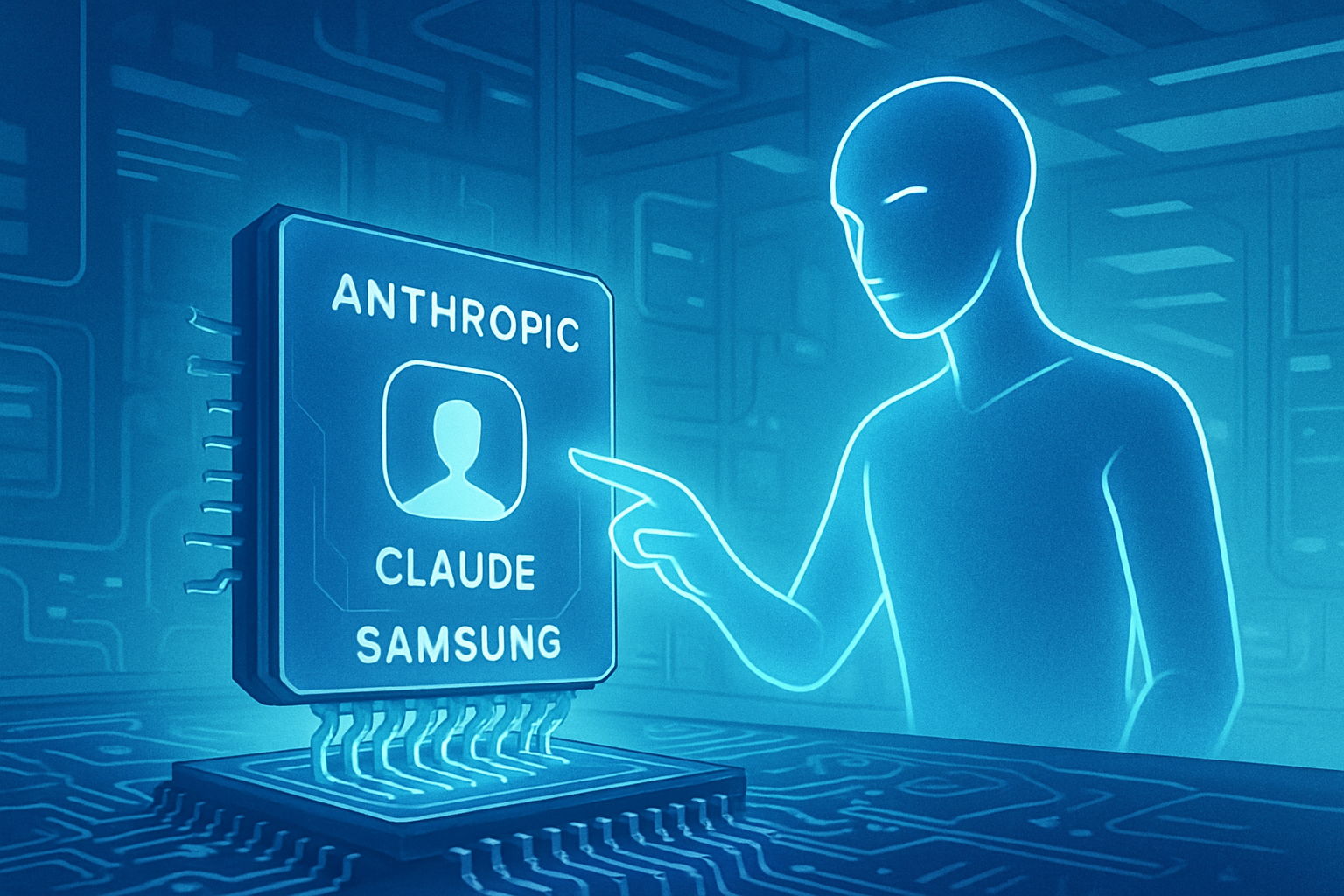
Anthropic, a pioneering company in the field of artificial intelligence, is currently exploring the development of a custom AI chip in collaboration with Samsung. According to information reported by The Information, this project, while still in the exploratory phase, could have significant implications for the cost, latency, and energy efficiency of Claude, their AI model, for businesses. The main objective is to regain control over the infrastructure that supports Claude, reducing usage costs and optimizing hardware.
Towards Technical Optimization of AI Models
At this stage, many technical decisions remain to be made. Anthropic has not yet precisely defined the use of this chip, how it will integrate with existing servers, or even the level of power it needs to achieve. Therefore, it is too early to consider this chip as an established performance accelerator. Currently, AI model developers use general-purpose accelerators, but a chip specifically designed for Claude could allow for finer optimization of the model, servers, and computing hardware.
For businesses, the potential benefits are numerous. Improved efficiency in data processing could reduce inference costs, while latency and energy consumption could also be enhanced through a custom architecture. However, these improvements remain potential goals rather than guaranteed outcomes. Anthropic continues to rely on a diverse infrastructure, including chips from Google, Amazon, and Nvidia. A chip developed with Samsung would complement this ecosystem without immediately replacing it.
The Potential Impact on the Cost of AI in Business
With the growing adoption of AI at scale by businesses, the operational cost of models has become a major issue. While a few internal assistants have a limited impact, thousands of agents or applications using Claude continuously can significantly alter the financial equation. This is why the development of custom hardware is becoming crucial. OpenAI has also taken this direction with Broadcom and its Jalapeño inference processor, while Amazon and Google already have their own specialized accelerators.
For Anthropic, collaborating with Samsung could also reduce its dependence on Nvidia, the market leader in AI chips. Samsung, with its expertise in this area and its collaboration with Nvidia for component manufacturing, represents a strategic partner. If Anthropic succeeds in adapting its infrastructure to the specific needs of Claude, it could lead to better cost control, increased energy efficiency, and improved deployment capabilities. For B2B clients, these optimizations could make AI easier to industrialize. However, as long as the chip specifications are not publicly defined, its actual impact remains to be confirmed.
Brief IA — L'actualité IA en français
L'essentiel de l'actualité de l'intelligence artificielle, décrypté et expliqué chaque jour.